Science / Grade 5
Food to nutrients: three connected jobs
Learning goal: Separate digestion, absorption and transport, trace a simple nutrient route, and repair misleading body-system labels.
Before you start: Follow labeled arrows and distinguish a tube from nearby blood vessels. The lesson introduces digestive organ names; no food, body measurements or health details are needed.
Read or print this lesson What to practiceThe video could not load. The transcript is still available below.
Next: your worksheet
Food to Nutrients: Three Connected Jobs
Checking sign-in...
Read the transcript
Saved reading place
Video transcript and practice. Reading or printing does not count as playback time or an assessed grade.
1. Lunch is not a delivery parcel
Video: 0:00
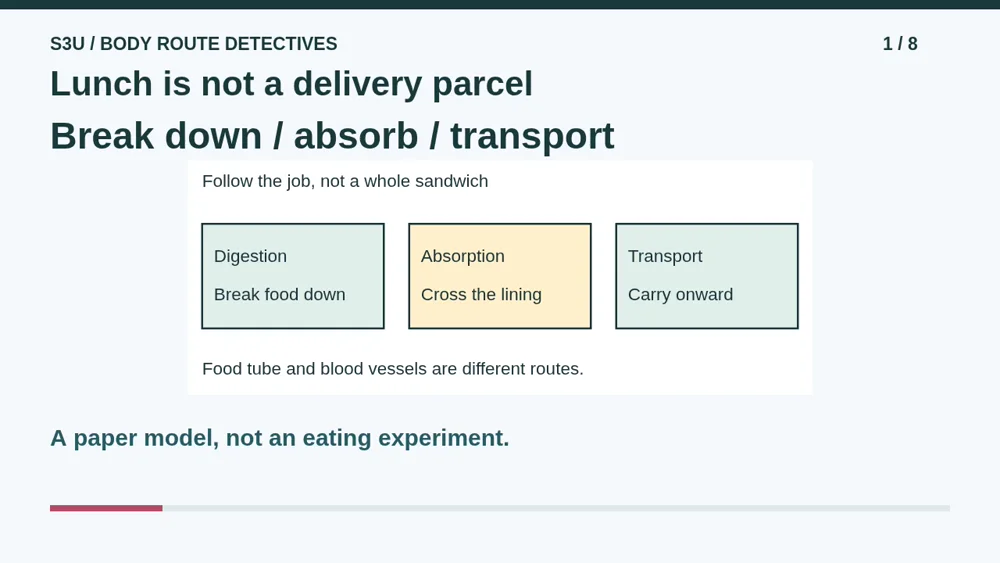
Imagine a sandwich trying to travel through a tiny blood vessel, still in its wrapper. That delivery plan needs a rethink. Food does not enter the blood as a whole sandwich. Digestion breaks food down. Absorption moves nutrients across an intestinal lining. Transport carries absorbed materials onward. These are connected jobs, not three names for the same thing. Today we will follow a simplified route and repair a museum model. You can explain the model aloud or on paper. No eating experiment, food diary, body measurement, or personal health information is needed.
2. The route starts before the stomach
Video: 0:45
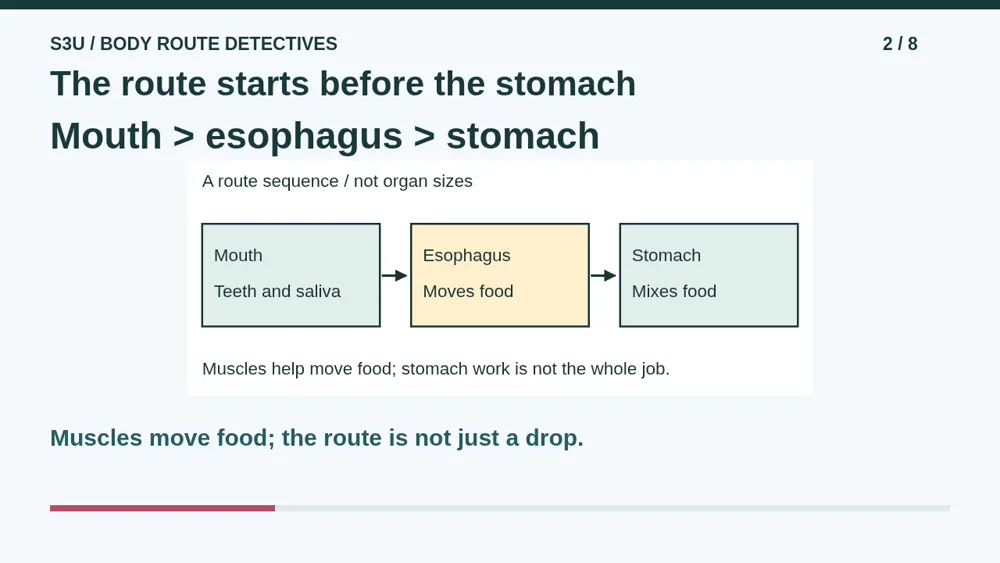
The mouth starts the work. Teeth break food into smaller pieces, and saliva moistens it and begins breaking down some starch. Swallowed food moves through the esophagus, the tube leading to the stomach. Muscles squeeze to move it along. In the stomach, movement mixes food with digestive juices. Breaking something into pieces and chemically breaking down its molecules are related but different changes. The stomach helps, but it is not the whole digestive system. Our three boxes show order, not the actual size or position of the organs.
3. Helpers send digestive juices
Video: 1:26
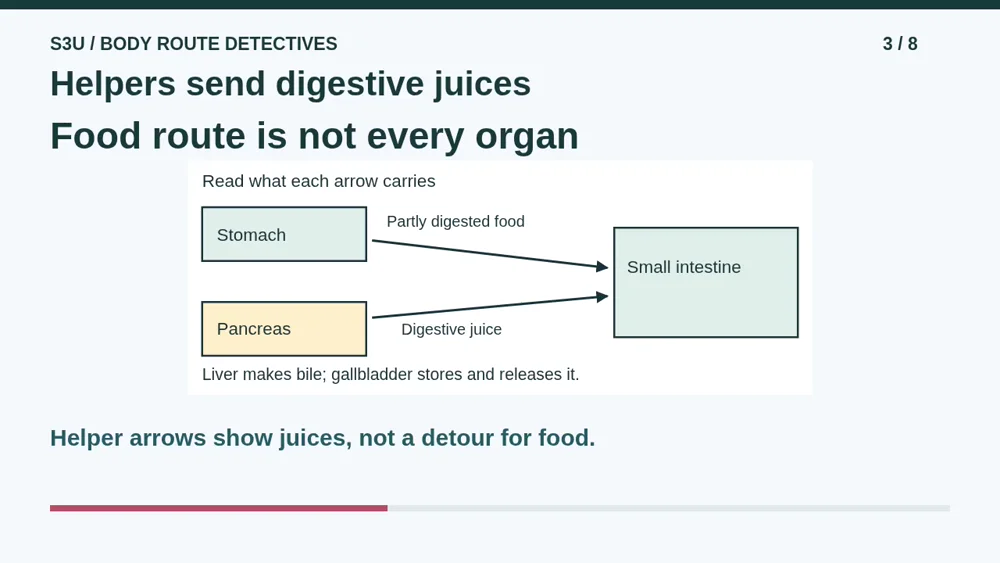
From the stomach, partly digested material enters the small intestine. The pancreas sends digestive juices there. The liver makes bile, which helps with fats; the gallbladder stores and releases bile. These helpers matter even though swallowed food does not travel through them in our route. Read an arrow label before following it. An arrow for digestive juice is different from an arrow for food moving along the tube. Do not send our imaginary lunch on a sightseeing tour through every organ name on the page. The labels tell us what moves.
4. Crossing the intestinal lining
Video: 2:07
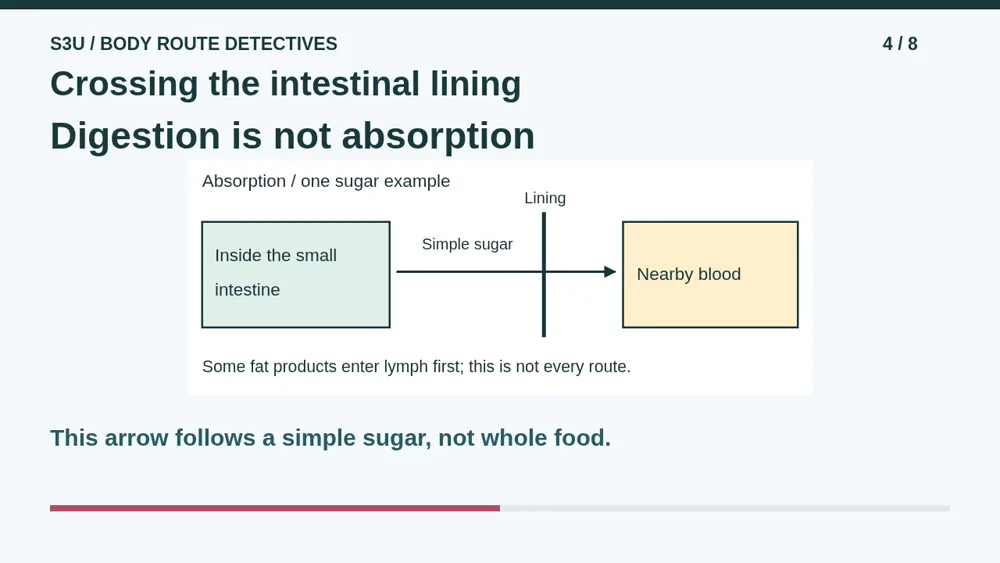
Digestion continues in the small intestine, where most nutrient absorption happens. Absorption means crossing its lining. Follow one simple sugar in our model: it moves from inside the small intestine, across the lining, into nearby blood. Blood can carry it onward. Many nutrients enter blood this way; some products of fat digestion first enter another transport network called lymph. Our single sugar arrow is not every nutrient route. A large food piece moving along the tube is not the same as a small nutrient crossing its wall. Name the substance, starting place, and destination.
5. What continues along the tube?
Video: 2:53
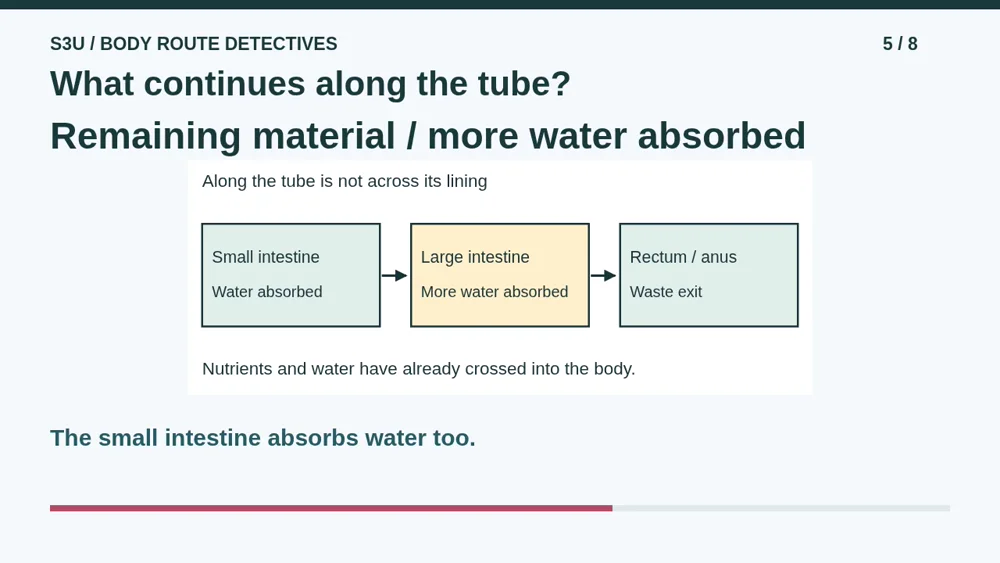
Material that remains in the tube continues into the large intestine. More water is absorbed there, and the remaining waste becomes stool. It is held in the rectum before leaving through the anus. The large intestine is not the only place water is absorbed: the small intestine absorbs water too. And not everything eaten becomes stool, because nutrients and water have already crossed into the body. Our route diagram separates material continuing along the tube from substances crossing its lining. It cannot tell how long a particular person takes to digest a meal.
6. Pause: fix the museum arrows
Video: 3:36
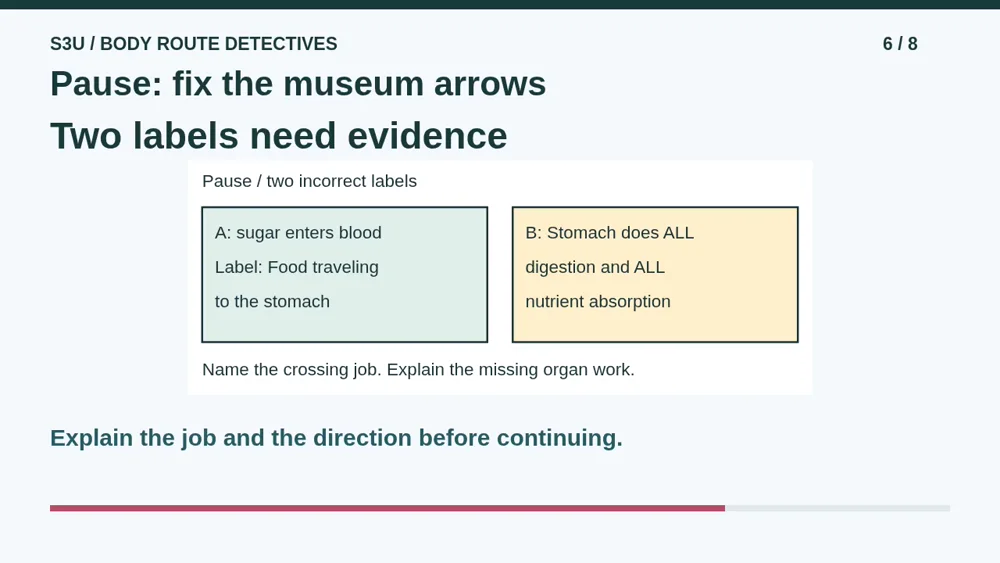
Pause for a fresh museum task. Card A shows a small sugar moving from inside the small intestine into nearby blood, but its label says, food traveling to the stomach. Card B says, the stomach does all digestion and all nutrient absorption. Repair both labels. For Card A, name the job and the direction shown. For Card B, explain which part of the route its claim leaves out. You may use the earlier diagrams or give a spoken explanation. Do not guess from a color. Continue when you can explain both repairs.
7. Check the three different jobs
Video: 4:17
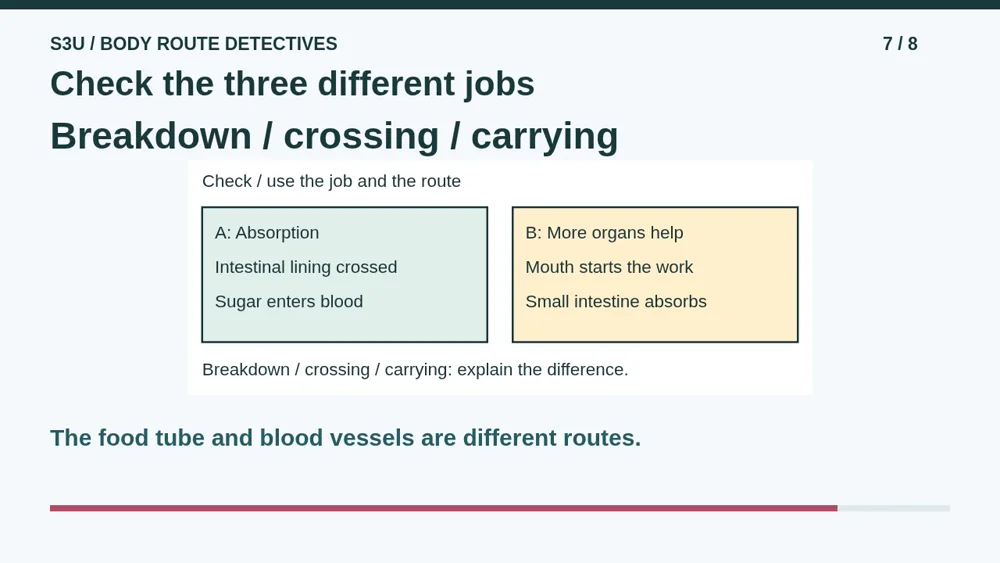
Card A shows absorption: a small sugar crosses from inside the small intestine into blood. It is not a whole food parcel moving back toward the stomach. Card B must include the other digestive organs. Work begins in the mouth, the stomach helps, and digestion continues in the small intestine, where most nutrients are absorbed. Now connect the three jobs. Breaking down food prepares small nutrients; crossing the intestinal lining is absorption; carrying absorbed nutrients onward is transport. The blood route connects to digestion, but blood vessels are not the same tube that food travels along.
8. The tube has moving muscles
Video: 5:03
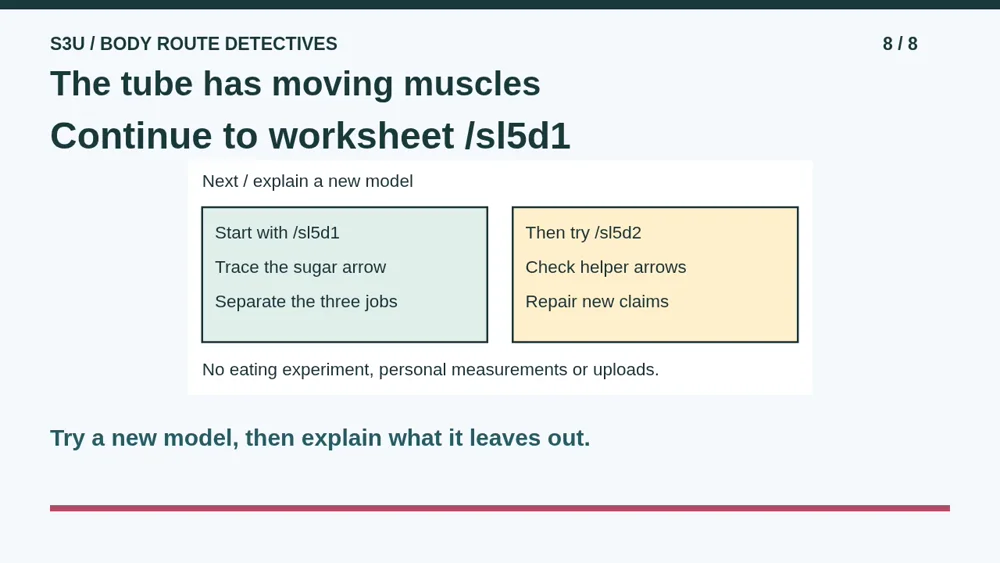
Fun fact: waves of muscle squeezing help move food through the digestive tract. The scientific name is peristalsis. Food does not move only because it falls downward. Our paper arrows show the direction, but not those moving muscle waves. Continue to the first worksheet, then try the second with its changed labels and new claims. Separate digestion, absorption, and transport, and explain why one small sugar arrow cannot stand for every nutrient. These diagrams are learning models, not a way to judge anyone's diet, body, or health. No upload is required.
Show your understanding
You can point, explain aloud, draw or write.
- Distinguish food breakdown, nutrient absorption and transport using a simple sugar crossing the small-intestine lining into blood.
- Repair route and organ-job claims, including helper juices, water absorption and limits of a simplified model.
Try it yourself
Pause at the museum labels. Explain what the sugar arrow shows and why the stomach cannot do every digestive job.
Continue to both worksheets. Read what each arrow carries and distinguish a simplified route from personal health information.
Next: your worksheet
Food to Nutrients: Three Connected Jobshttps://s3u.com/sl5d1
Lesson: https://s3u.com/lessons/food-to-nutrients