Math / Grade 3
Division: what about the leftovers?
Learning goal: Make equal groups, check the remainder and decide when a leftover needs one more group.
Before you start: Make equal groups and use multiplication to check their total.
Read or print this lesson What to practiceThe video could not load. The transcript is still available below.
Next: your worksheet
Make Sense of Division Leftovers
Checking sign-in...
Read the transcript
Saved reading place
Video transcript and practice. Reading or printing does not count as playback time or an assessed grade.
1. The button shop has a puzzle
Video: 0:00
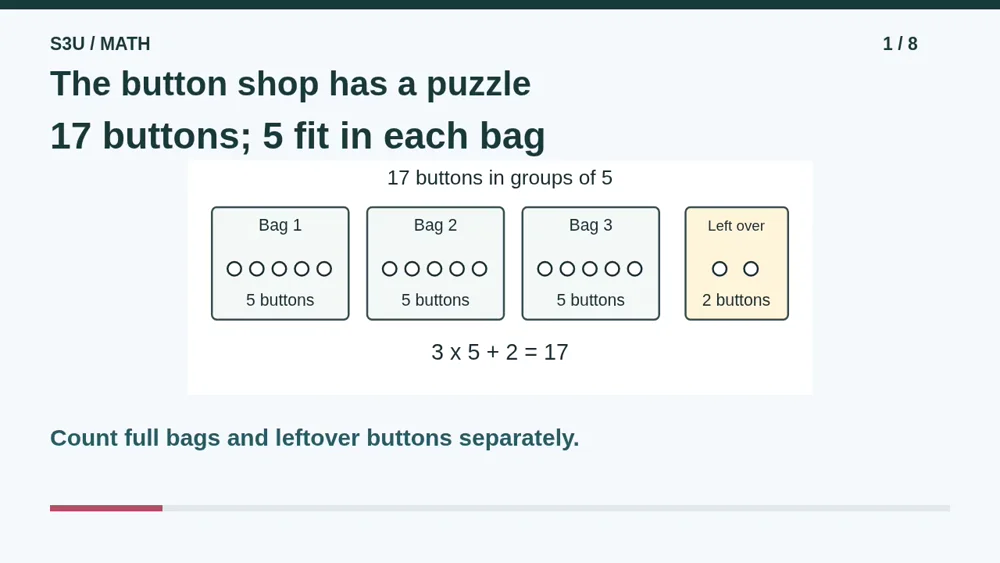
The button shop has seventeen buttons. Each full bag holds five. We want to know how many full bags we can fill, and whether any buttons stay outside. Draw dots if you like. The buttons are not allowed to sneak in as bag number four.
2. Build equal groups
Video: 0:19
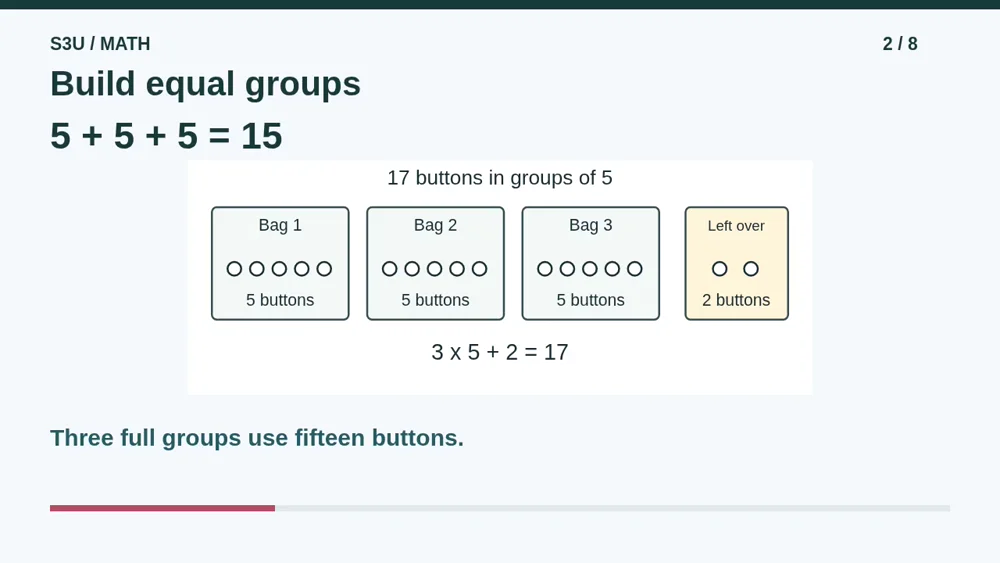
Put five buttons in the first bag, five in the second, and five in the third. That uses fifteen. Two buttons remain. We have three full bags and two loose buttons. A bag with two buttons is not another full bag of five.
3. Name the remainder
Video: 0:38
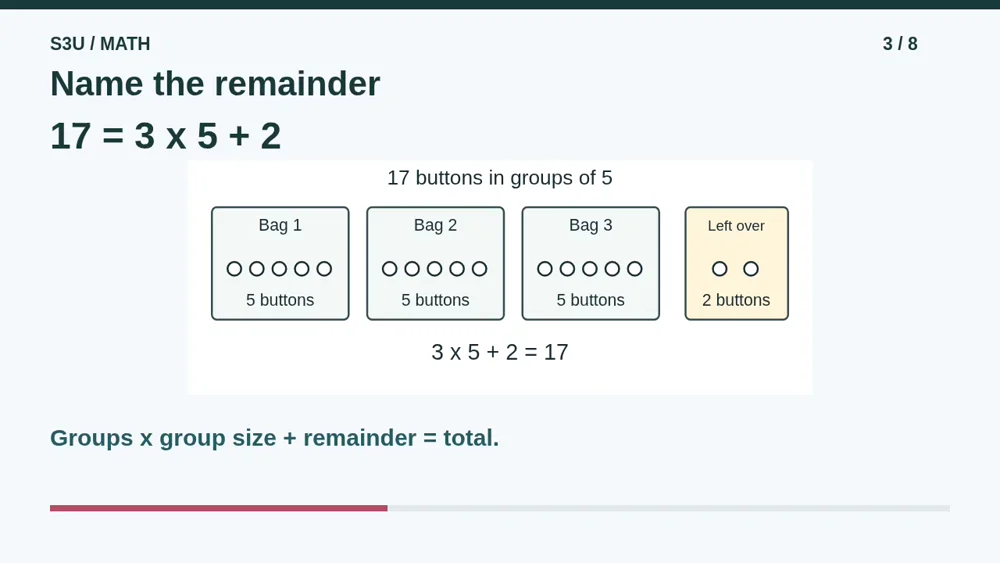
The number left over is called the remainder. Here it is two. Check by multiplying three groups by five buttons, then adding the two leftovers. Fifteen plus two is seventeen, so every button is accounted for. None escaped under the table.
4. Can we make one more full bag?
Video: 0:58
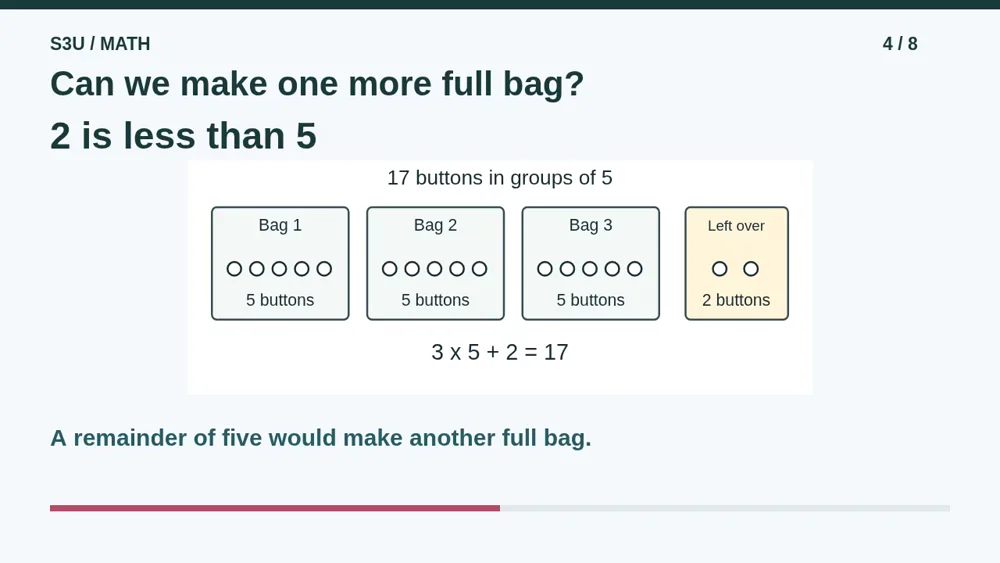
The remainder must be smaller than the size of a full group. If five buttons were still loose, we could fill another bag. Two is smaller than five, so grouping is finished. This check can help you catch a division mistake before moving on.
5. Pause: everyone needs a seat
Video: 1:16
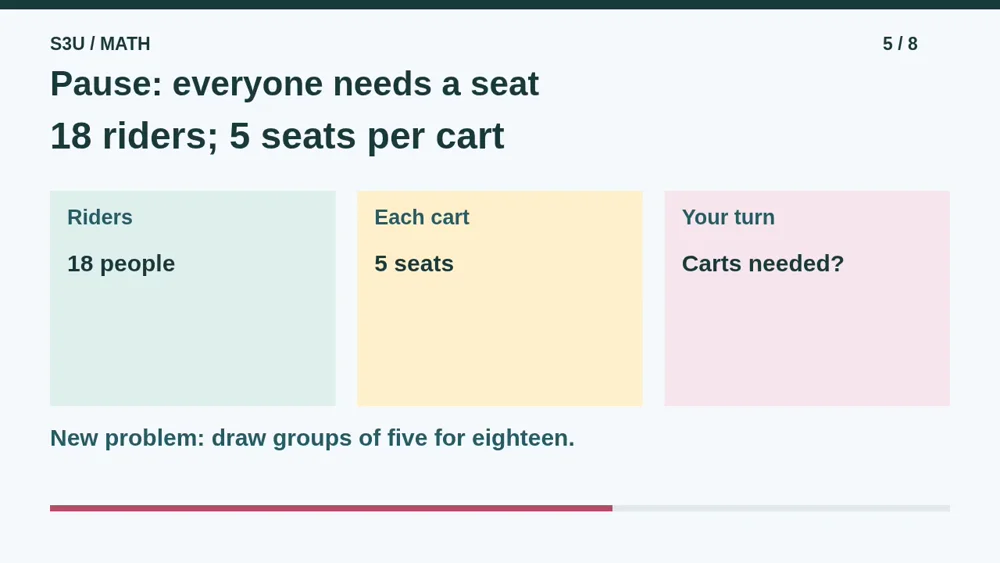
Here is a new pretend problem. Eighteen riders need seats. Each cart holds five people. Pause and work out how many carts are needed so everyone can ride. You may leave seats empty, but nobody may be left without a seat.
6. A partial group can still matter
Video: 1:35
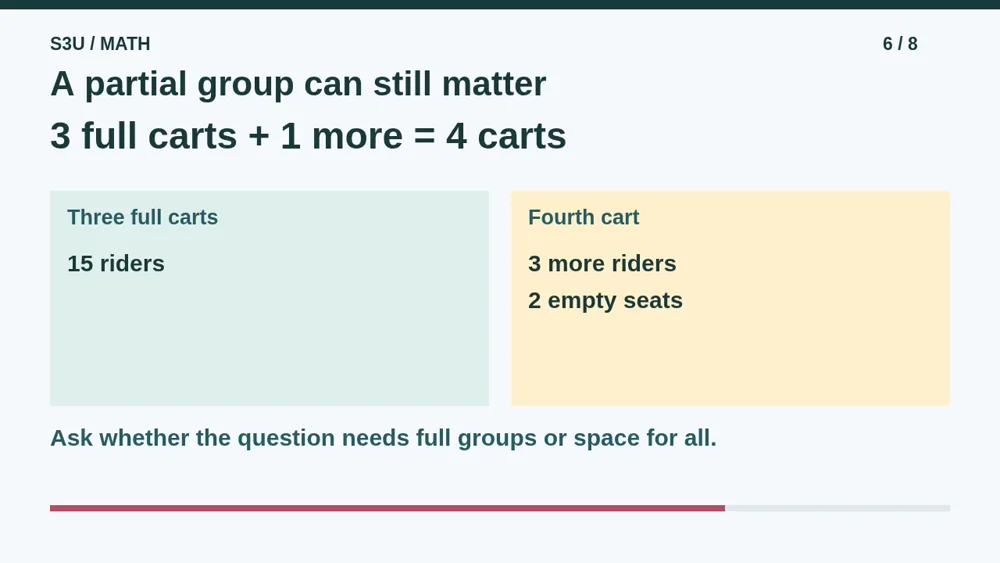
Three carts hold fifteen riders. Three riders still need seats, so we need a fourth cart. It does not have to be full. The answer depends on the question: three full groups, but four carts to carry everyone. Leftovers have jobs too.
7. The same remainder returns
Video: 1:54
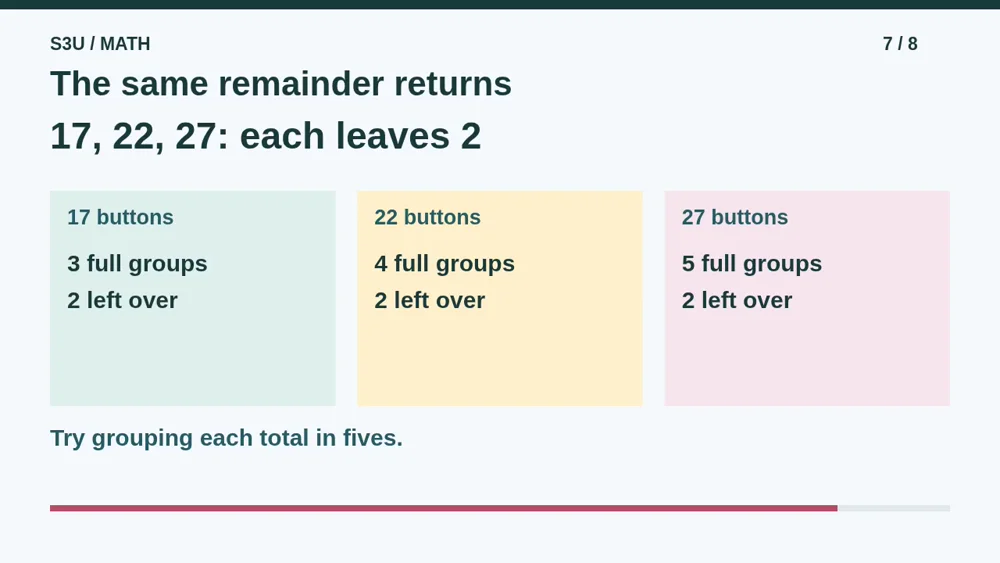
Fun fact: adding one full group keeps the remainder the same. Seventeen buttons leave two when grouped in fives. Twenty-two and twenty-seven do too. Each time we add five, we gain a full bag while those two loose buttons stay outside.
8. Your turn at the button shop
Video: 2:13
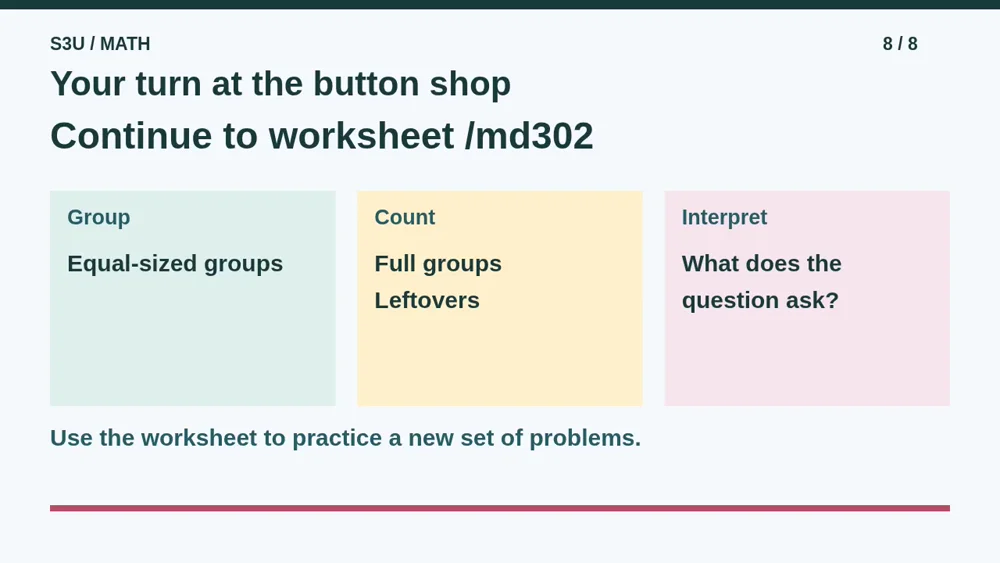
Continue to the worksheet below the video. Draw equal groups, count what remains, then read what the problem asks. Does it want full groups, leftovers, or enough space for everyone? Explain that choice before checking your answers. Your drawing is a useful tool, not a decoration.
Show your understanding
You can point, explain aloud, draw or write.
- Find equal groups and a remainder smaller than one full group.
- Use the story context to decide whether a leftover needs another group or remains ungrouped.
Try it yourself
Here is a new pretend problem. Eighteen riders need seats. Each cart holds five people. Pause and work out how many carts are needed so everyone can ride. You may leave seats empty, but nobody may be left without a seat.
Continue to the matching worksheet. Explain your reasoning before checking your answers.
Next: your worksheet
Make Sense of Division Leftovershttps://s3u.com/md302
Lesson: https://s3u.com/lessons/division-leftovers