Math / Grade 5
Divide with unit fractions
Learning goal: Count fraction-sized groups or share a fraction equally, keep the original whole fixed, and check each answer with multiplication.
Before you start: Name equal parts of a fixed whole, count groups and multiply fractions by whole numbers.
Read or print this lesson What to practiceThe video could not load. The transcript is still available below.
Next: your worksheet
Divide with Unit Fractions - Practice 1
Checking sign-in...
Read the transcript
Saved reading place
Video transcript and practice. Reading or printing does not count as playback time or an assessed grade.
1. How many quarter-size pieces?
Video: 0:00
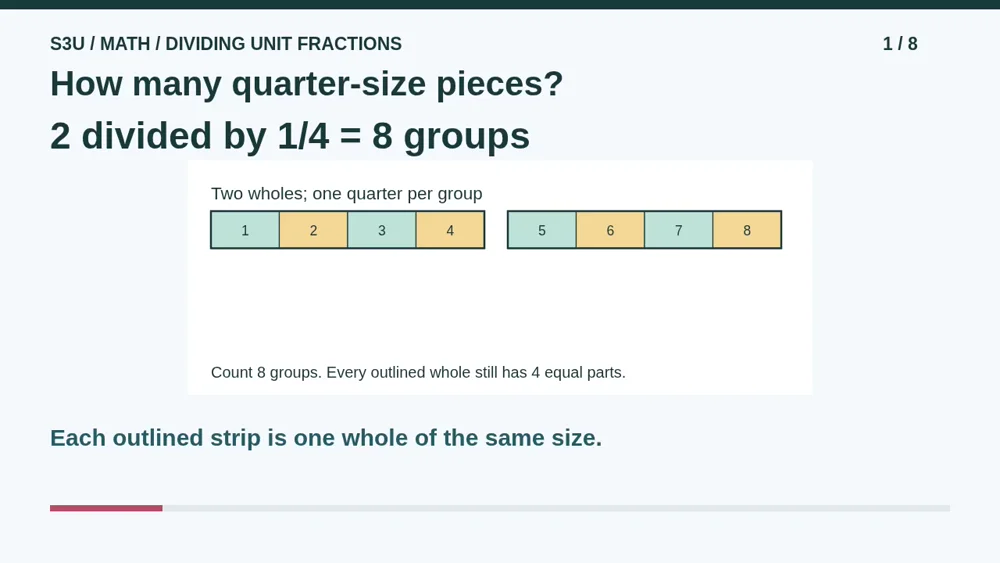
Our pretend ribbon shop has two whole strips. Each order needs one quarter of a strip. How many orders can we fill? Divide each whole into four equal pieces. Count the eight selected pieces across both wholes. Two divided by one quarter equals eight groups. The answer counts quarter-size orders, not eight whole strips. That would be a very generous ribbon shop.
2. Multiply to check the count
Video: 0:29
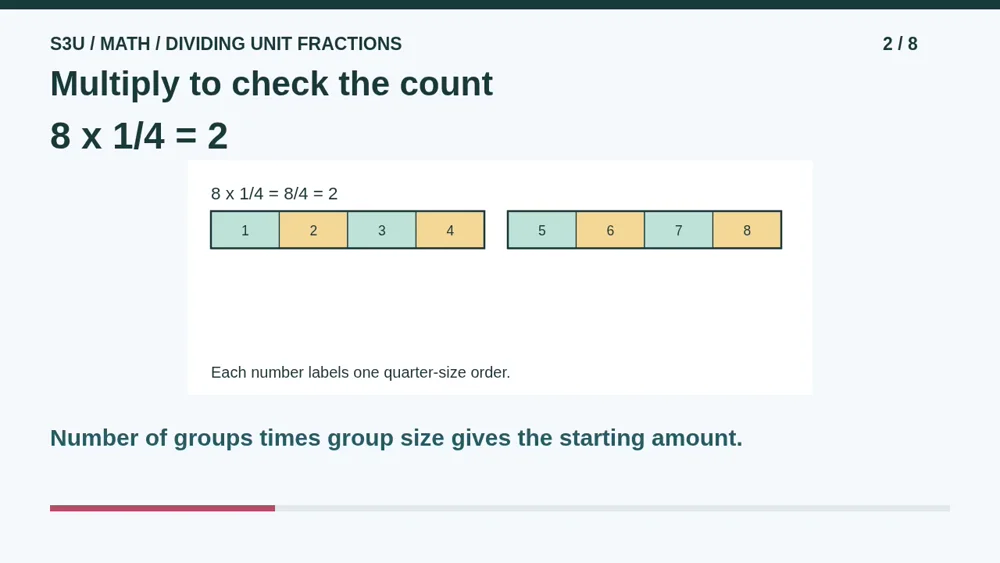
Check the order by multiplying. Eight orders, each using one quarter of a strip, use eight quarters altogether. Four quarters make one whole, so eight quarters make two wholes. That matches the amount we started with. Dividing a whole number by a unit fraction counts how many of those small pieces fit. A unit fraction has one as its numerator.
3. Share one quarter among three
Video: 0:56
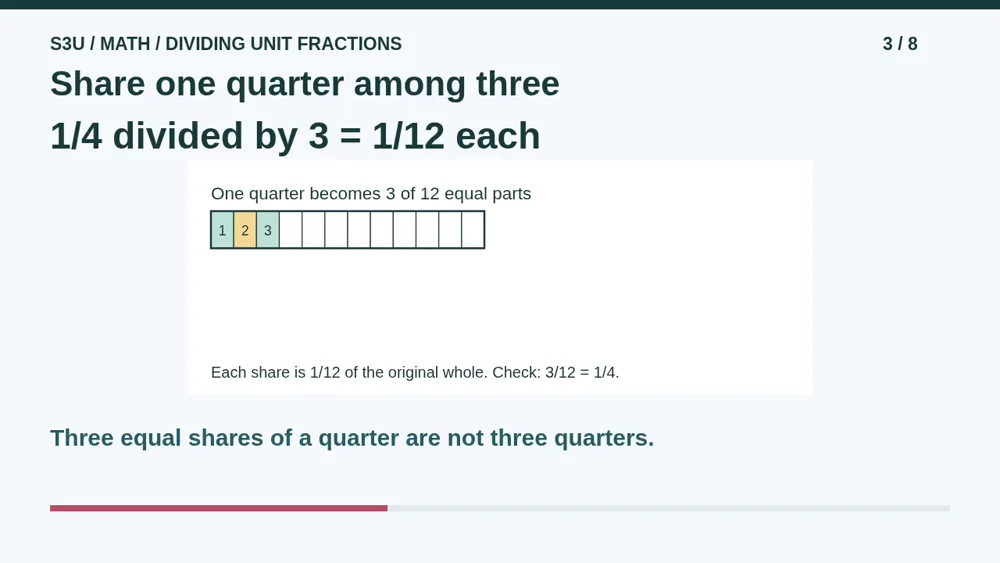
Now the question changes. We have only one quarter of a strip, and three people share it equally. Split every quarter into three equal pieces. The original whole now contains twelve equal pieces. Our available quarter contains three of those pieces. Each person gets one twelfth of the original whole. Check: three times one twelfth is three twelfths, which is one quarter.
4. Zero ribbon, but not zero size
Video: 1:26
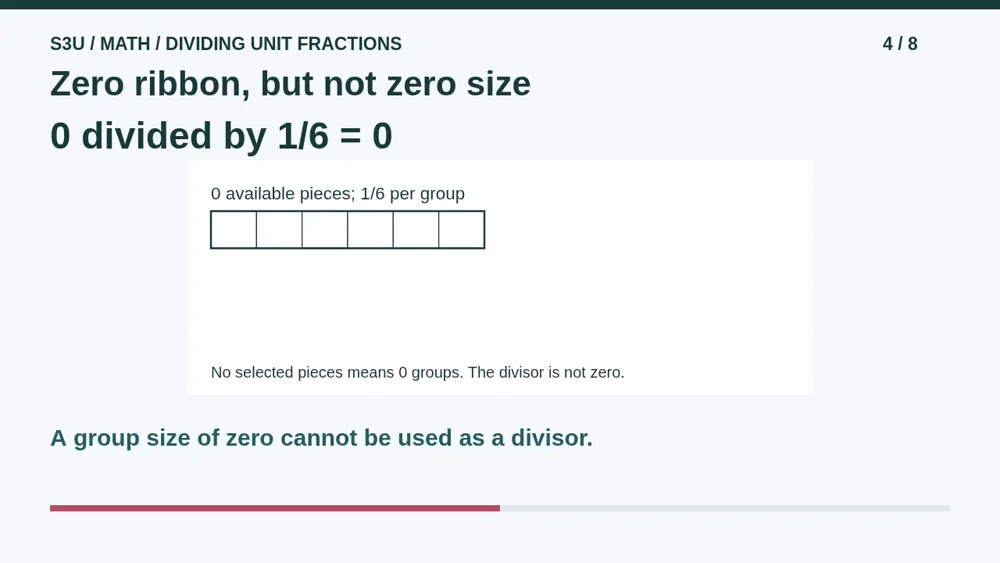
With no ribbon available, how many sixth-size orders can we fill? Zero. Zero times one sixth is still zero, so the multiplication check works. But dividing a positive amount by zero is different. No number of zero-size groups will make a positive amount. We do not use zero as a divisor. An empty order form cannot manufacture ribbon.
5. Pause: share half a strip
Video: 1:55
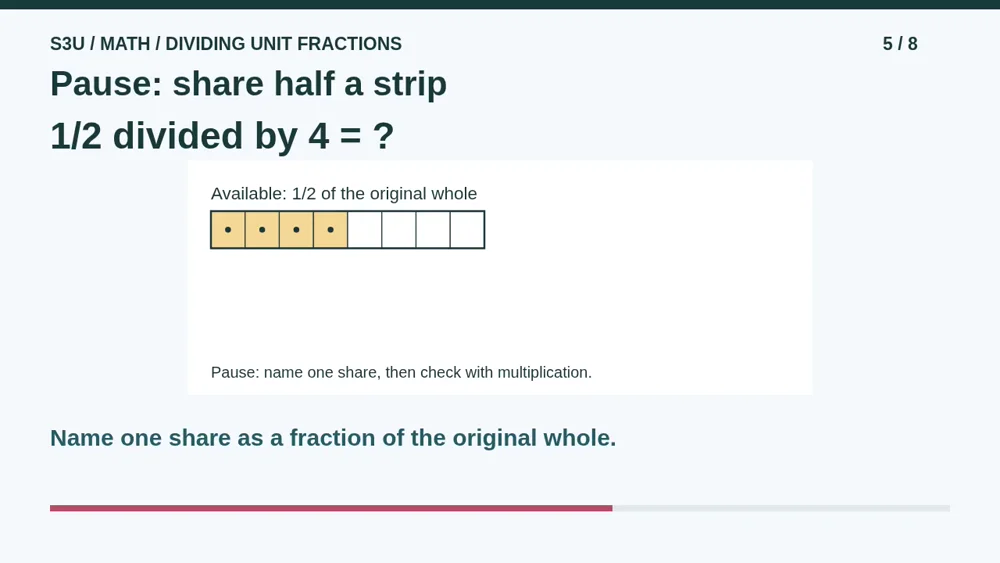
Four people share one half of a strip equally. Pause the video before the next chapter. What fraction of the original whole does each person receive? The picture splits the whole into eight equal pieces. Explain which pieces are available and how you would share them. Then use multiplication to check that four equal shares rebuild the starting half.
6. Four eighths rebuild the half
Video: 2:21
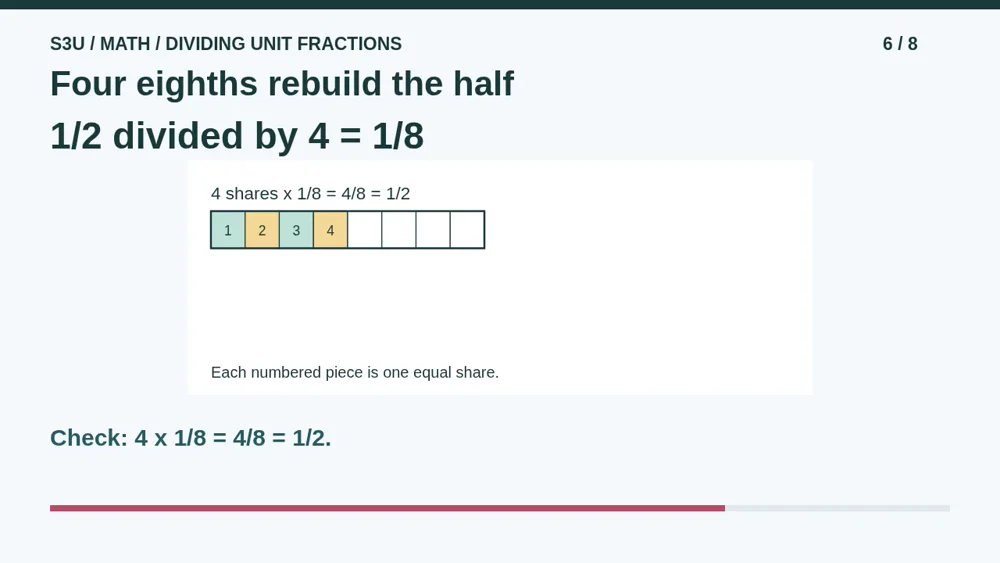
The available half contains four eighth-size pieces. Give one piece to each of four people. Each share is one eighth of the original whole. Four times one eighth equals four eighths, which is one half. If you answered one quarter, check your unit: one share is a quarter of the available half, but an eighth of the original whole.
7. Same ribbon, different count
Video: 2:46
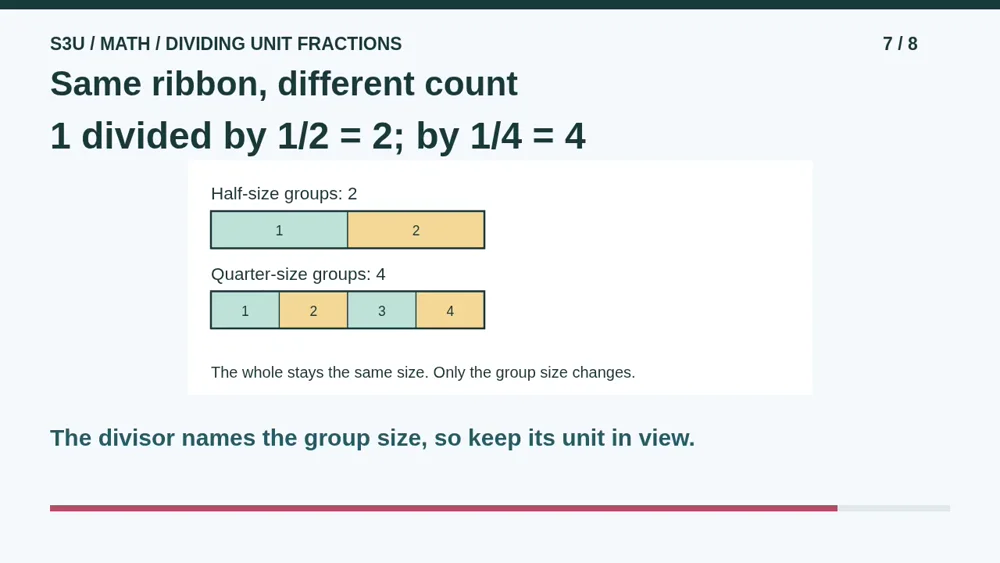
Fun fact: one whole strip can contain two halves or four quarters without changing its length. The ribbon has not grown. We changed the size of the groups we are counting. This is why division does not always make a number smaller. Say both the count and the unit: two half-size groups, or four quarter-size groups, in the same whole.
8. Continue to the worksheet
Video: 3:12
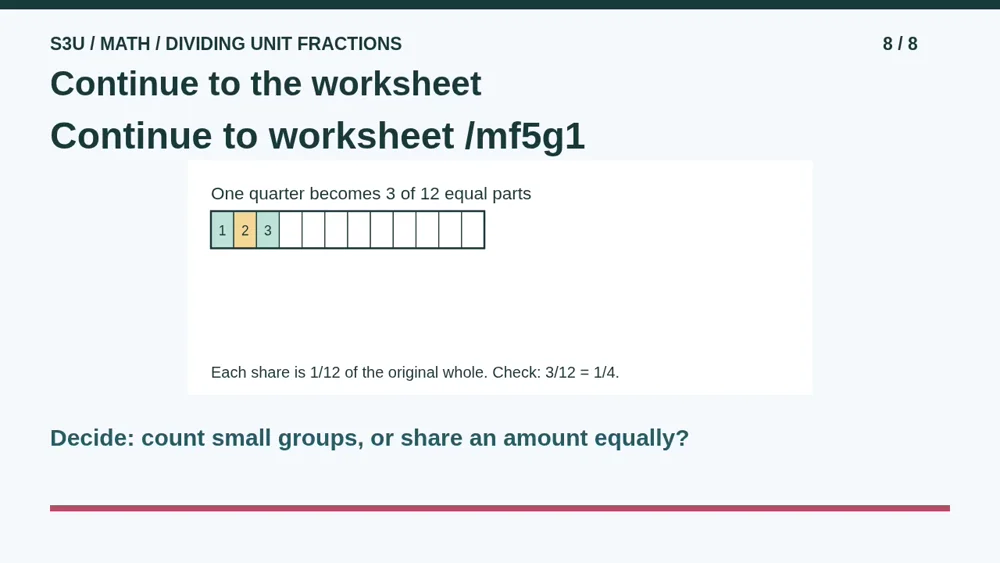
Continue to the worksheet below for fresh problems. First decide whether you are counting fraction-size groups or sharing a fraction among a number of people. Keep the original whole fixed. Write a multiplication check in the working space. Then try Practice Two. For another way to explore group sizes, visit Fraction Dock and choose the Grouping route.
Show your understanding
You can point, explain aloud, draw or write.
- Distinguish counting unit-fraction groups in a whole number from sharing a unit fraction among people.
- Name each answer with its reference unit, check by multiplication and distinguish zero available from a zero divisor.
Try it yourself
Pause to share one half equally among four people. Name each share using the original whole.
Continue to the worksheet, multiply to check, then try Practice 2 or choose Grouping at Fraction Dock.
Next: your worksheet
Divide with Unit Fractions - Practice 1https://s3u.com/mf5g1
Try Fraction Dock: choose Grouping
Lesson: https://s3u.com/lessons/divide-unit-fractions