Math / Grade 7
Count tiles, compare chances
Learning goal: Count equally likely individual tiles, compare matching groups, and distinguish probability from a promised short-run result.
Before you start: Count a small set, identify matching shapes, and read or simplify a fraction. Each individual tile is equally likely in these stated models.
Read or print this lesson What to practiceThe video could not load. The transcript is still available below.
Next: your worksheet
Count Equally Likely Tiles
Checking sign-in...
Read the transcript
Saved reading place
Video transcript and practice. Reading or printing does not count as playback time or an assessed grade.
1. Count tiles, not shape names
Video: 0:00
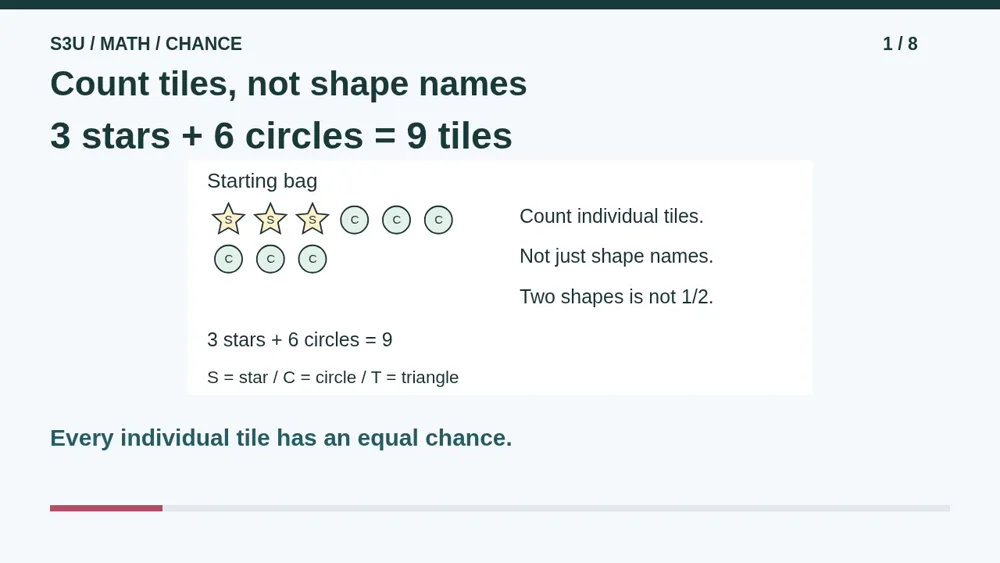
This pretend bag has three star tiles and six circle tiles. Each individual tile has the same chance of being picked. Count all nine tiles, not just the two shape names. Two names do not make this a fifty-fifty choice. The stars may look impressive, but they do not get extra turns for dressing up.
2. Choose the matching tiles
Video: 0:24
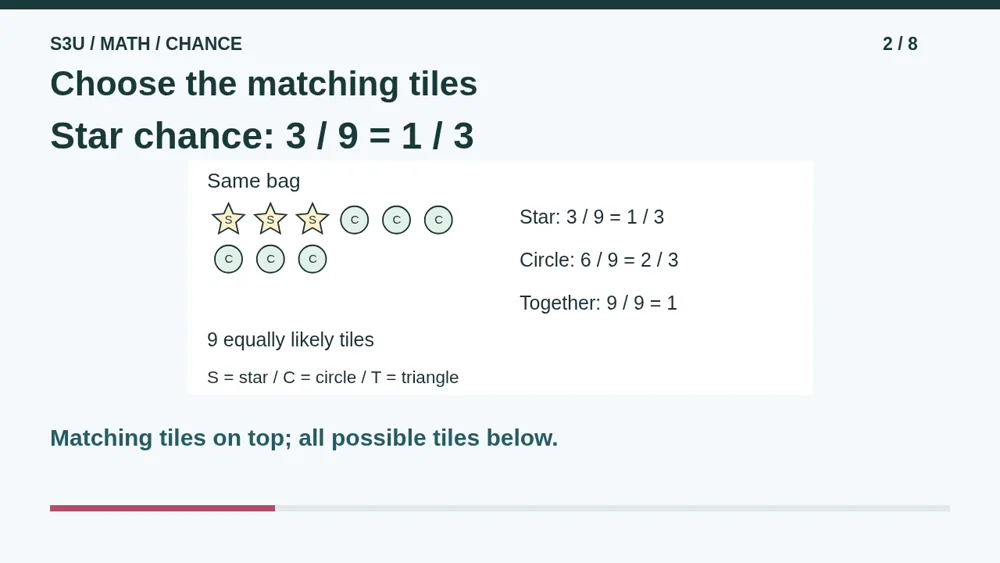
Ask for a star. Three tiles match, out of nine possible tiles, so the chance is three ninths. Divide the top and bottom by three to write one third. For a circle, six of the nine tiles match. Six ninths simplifies to two thirds. Circles are more likely in this bag, but a star is still possible.
3. Impossible and certain
Video: 0:49
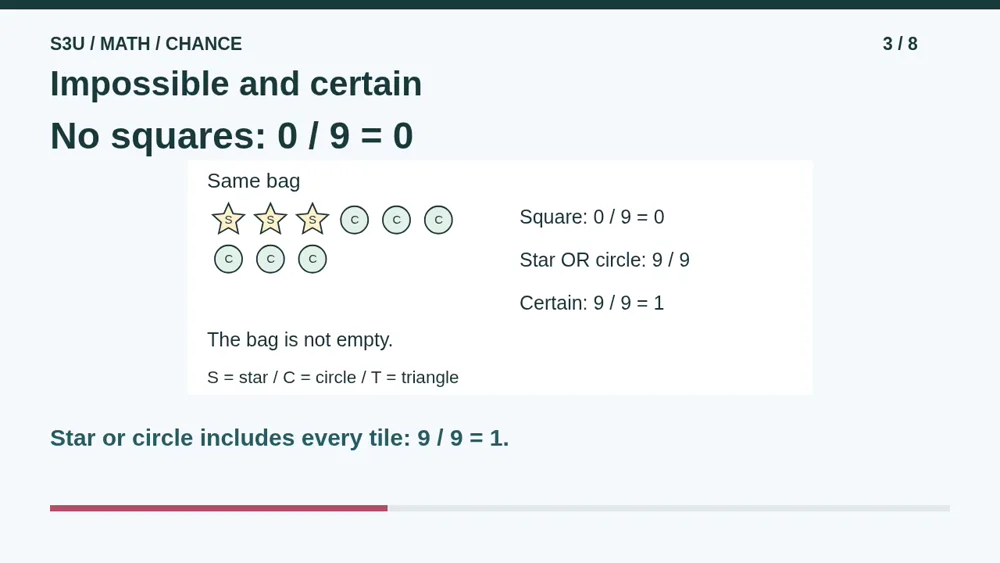
There are no square tiles in this bag. Picking a square has probability zero out of nine, or zero. Now ask for a star or a circle. Every tile matches one of those descriptions, so the chance is nine out of nine, or one. In this model, zero means impossible and one means certain. Neither statement predicts which particular tile comes out.
4. Pause: a new bag
Video: 1:16
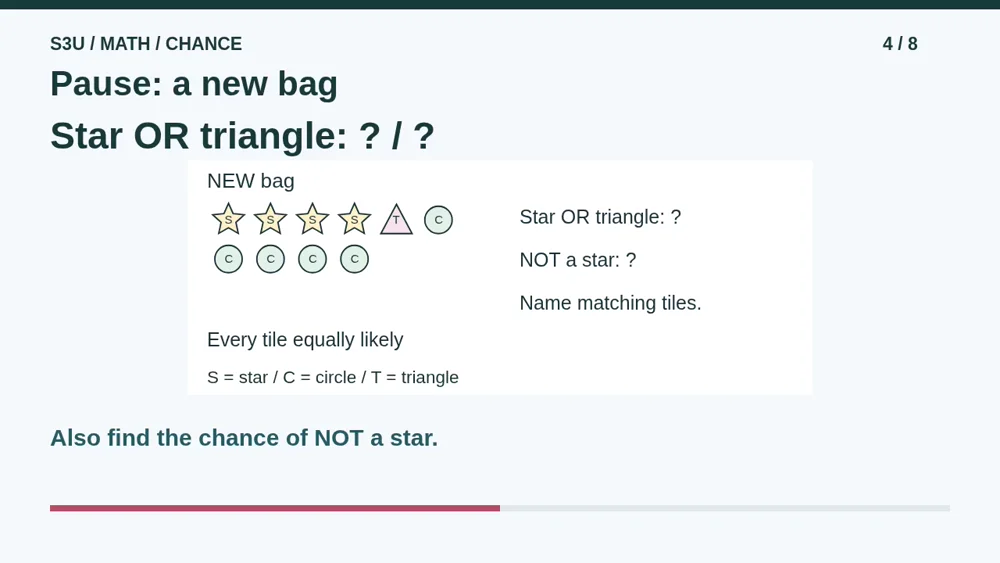
Pause for a different bag. It has four stars, one triangle and five circles. All ten individual tiles are equally likely. What is the chance of a star or a triangle? Then find the chance of not a star. Draw or point to every matching tile before writing the fractions. A tile should be counted only once for each question.
5. Check both matching groups
Video: 1:43
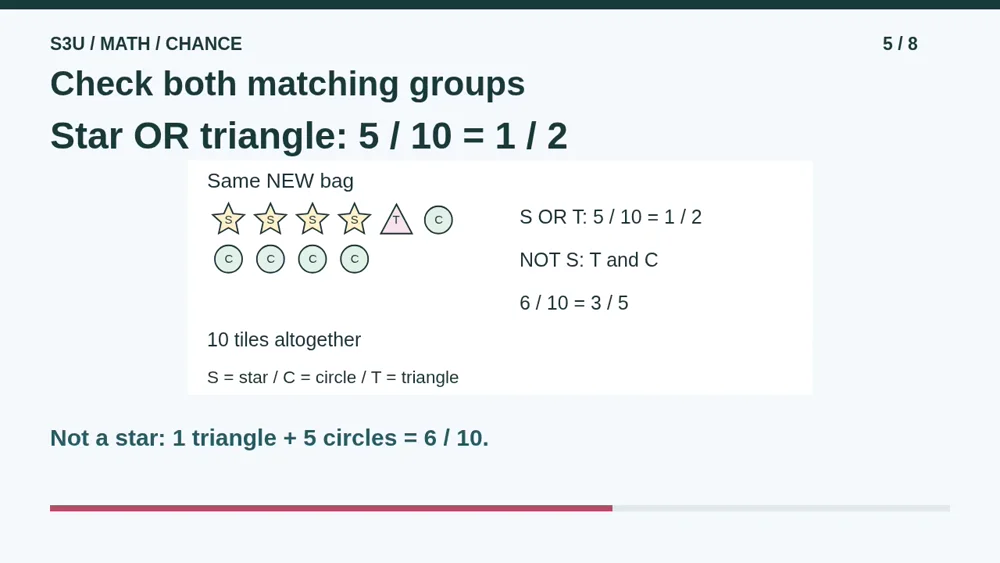
Four stars and one triangle make five matching tiles out of ten. That is five tenths, or one half. Not a star includes the triangle and all five circles: six out of ten, or three fifths. Not a star does not mean only circles in this new bag. The extra shape matters. Check the whole list instead of borrowing the earlier answer.
6. Bigger bag, same chance
Video: 2:09
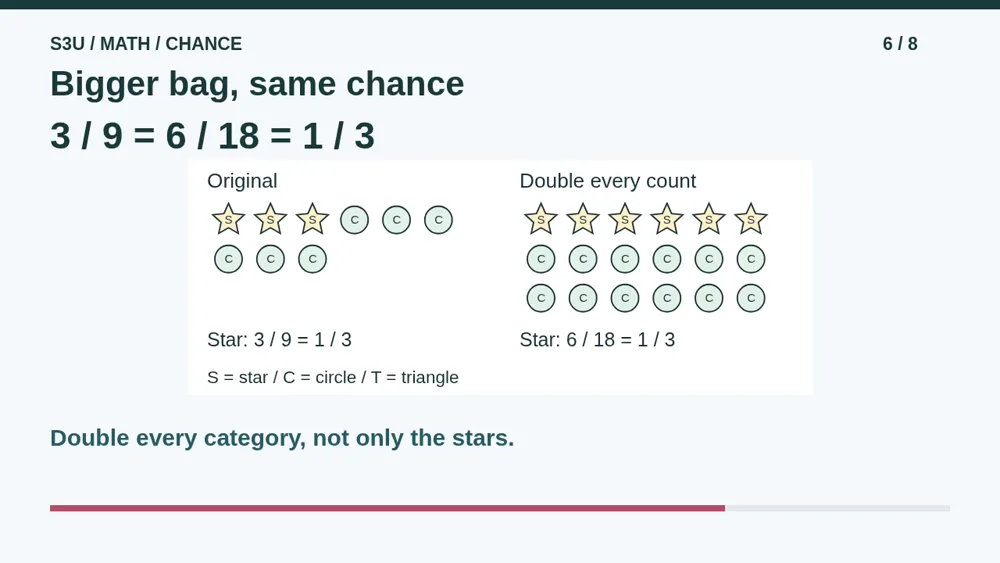
Fun fact: a bigger bag can keep exactly the same chance. Return to the first bag, with three stars and six circles. Double every count. Now there are six stars and twelve circles, making eighteen tiles. Six eighteenths is still one third. Doubling only the stars would be a different change. A bigger numerator alone does not tell the whole story.
7. A chance is not a promise
Video: 2:37
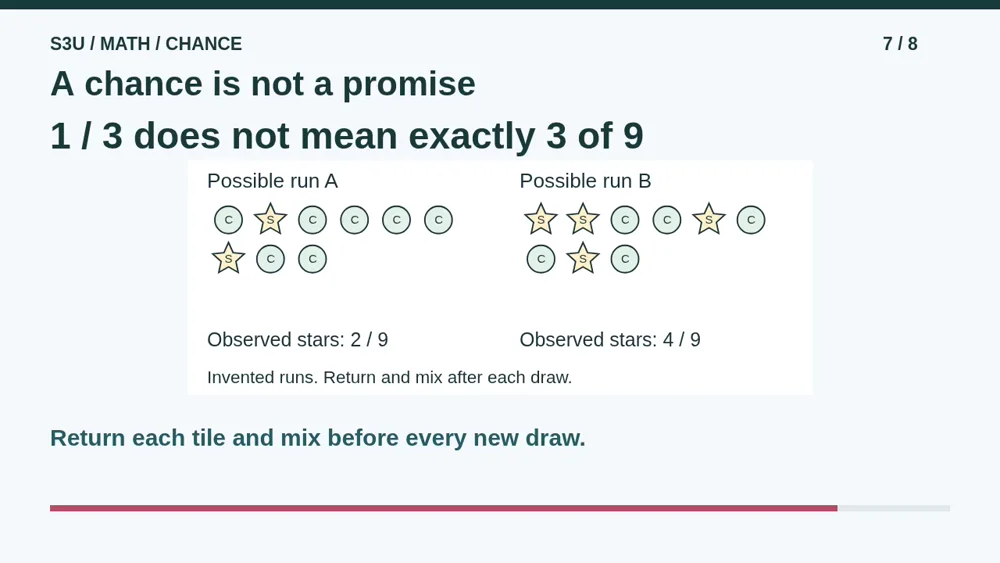
Use the first bag and return each tile before drawing again. Every new draw still has a star chance of one third. Nine draws do not have to contain exactly three stars. One possible run has two stars; another has four. The fraction describes the chance on a draw, not a rule forcing the bag to fill an order. Keep predictions separate from observed counts.
8. Continue to the worksheet
Video: 3:06
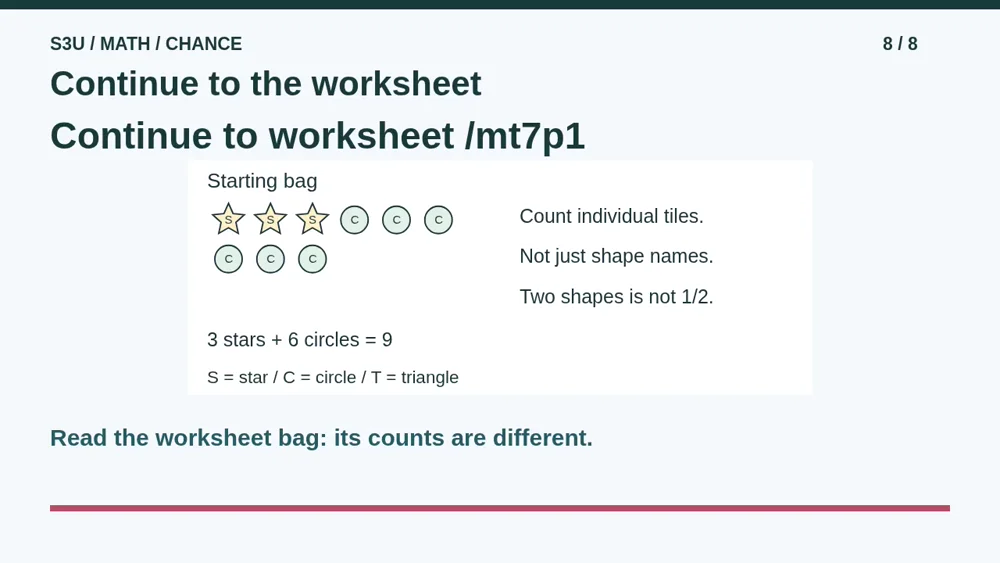
Continue to the worksheet below. Read its own counts first, identify the event, and count matching tiles out of all equally likely tiles. Explain impossible, certain and more likely without promising a particular next result. The second form compares chances and combined shapes. You can also try Chance Lab and compare your prediction with what actually happens. Watching a video alone is not proof of understanding.
Show your understanding
You can point, explain aloud, draw or write.
- Count matching tiles out of all equally likely choices, including combined disjoint shapes, complements, impossible and certain events.
- Explain why doubling every count preserves chance and why a probability does not guarantee an exact short-run result.
Try it yourself
Pause at the new ten-tile bag. Count star or triangle, then not a star. Explain each numerator and denominator.
Continue to both worksheets, then explore Chance Lab. A probability describes a model, not a guaranteed quota of observed results.
Next: your worksheet
Count Equally Likely Tileshttps://s3u.com/mt7p1
Lesson: https://s3u.com/lessons/count-tile-chances