Math / Grade 6
Count fraction-sized loads
Learning goal: Use common-sized pieces to count full and partial fraction loads, distinguish rolls from loads, and explain the multiplication check.
Before you start: Rename equivalent fractions with common denominators, simplify fractions and multiply positive fractions.
Read or print this lesson What to practiceThe video could not load. The transcript is still available below.
Next: your worksheet
Count Fraction-Sized Loads - Practice 1
Checking sign-in...
Read the transcript
Saved reading place
Video transcript and practice. Reading or printing does not count as playback time or an assessed grade.
1. How many loads fit?
Video: 0:00
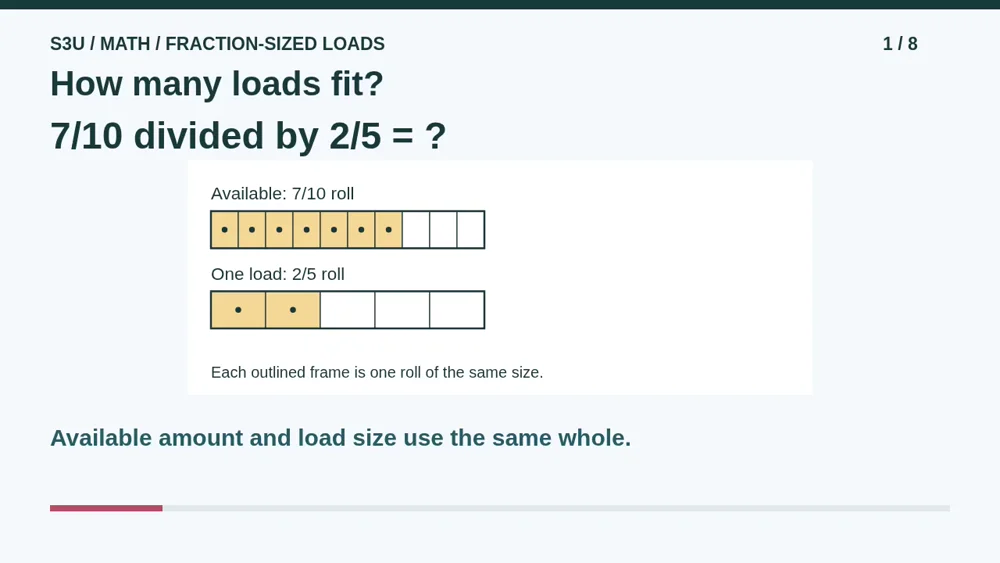
Our pretend ribbon dock has seven tenths of a roll. One delivery load needs two fifths of a roll. How many loads is that? Both fractions use the same-sized whole roll. The answer will count loads, including a possible part of another load. Keep the unit in mind. The delivery label says loads, not a mysterious number of extra rolls.
2. Count common-size pieces
Video: 0:28
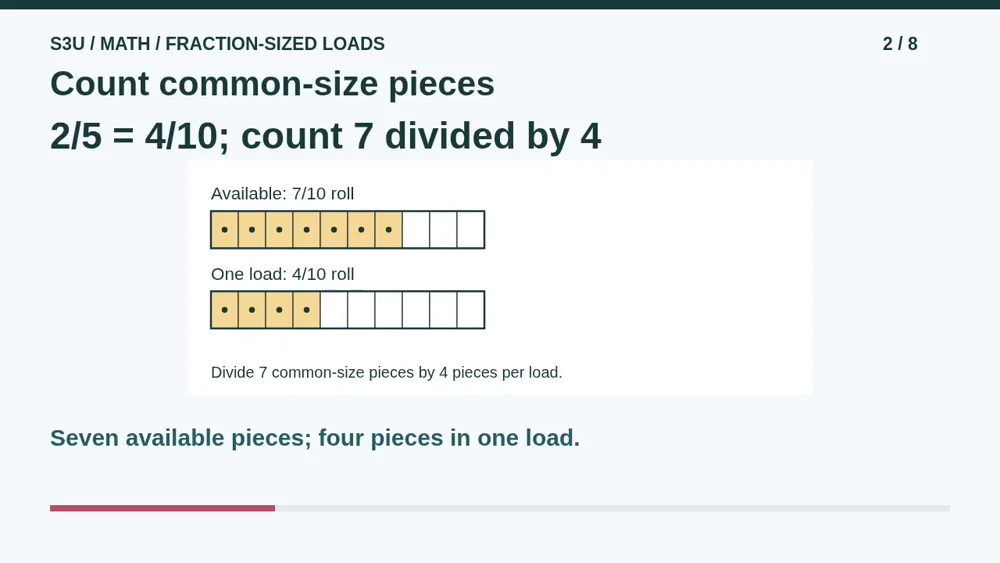
Rename two fifths as four tenths. Now every small piece has the same size: one tenth of a roll. We have seven pieces available, and each load needs four pieces. So we divide seven by four. When both amounts are measured in the same unit, division compares their piece counts. The whole roll still has ten equal pieces, not seven or four.
3. One load and part of another
Video: 0:55
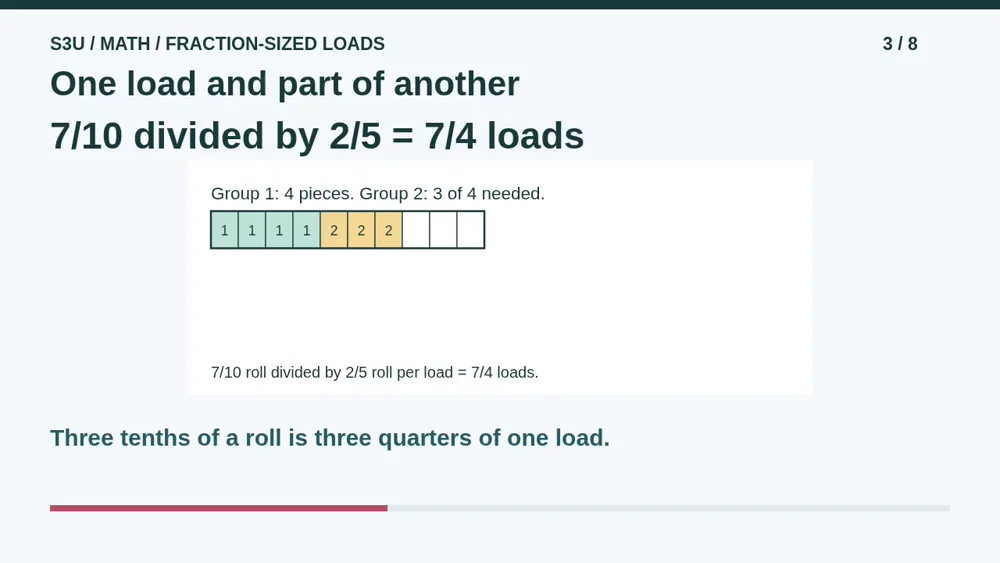
Four pieces fill the first load. Three pieces remain, while a whole load would need four. Those three pieces make three quarters of another load. Altogether we have one and three quarters loads, or seven fourths loads. The leftover ribbon is three tenths of a roll, but three quarters of a load. These names describe the same ribbon using different reference amounts.
4. Check with multiplication
Video: 1:23
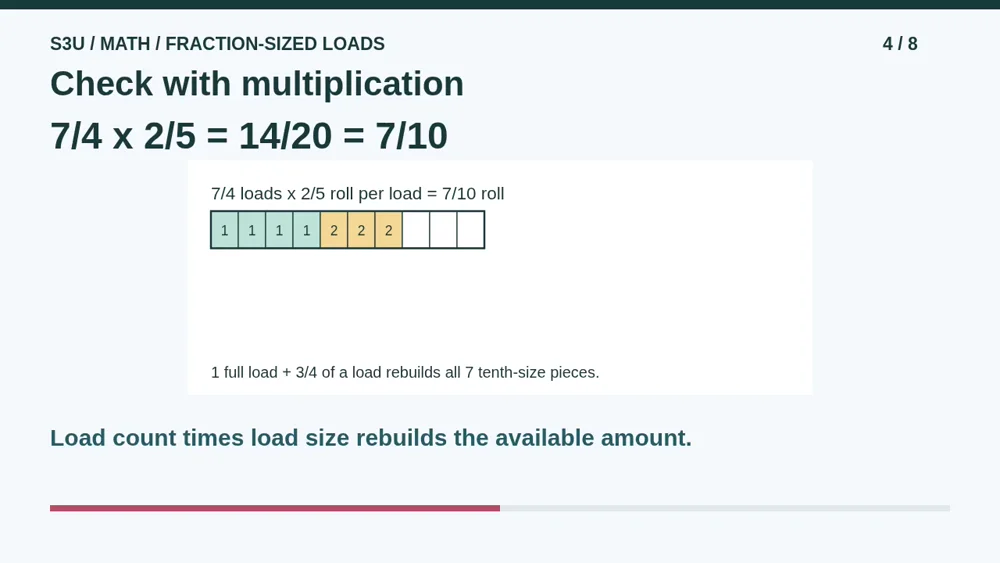
Multiply seven fourths loads by two fifths of a roll per load. Fourteen twentieths is seven tenths, our starting amount. The common-piece model also explains the reciprocal rule: seven tenths divided by two fifths equals seven tenths times five halves. It is the divisor, two fifths, whose reciprocal we use. Check the meaning, not just a remembered flipping trick.
5. Pause: a different delivery
Video: 1:52
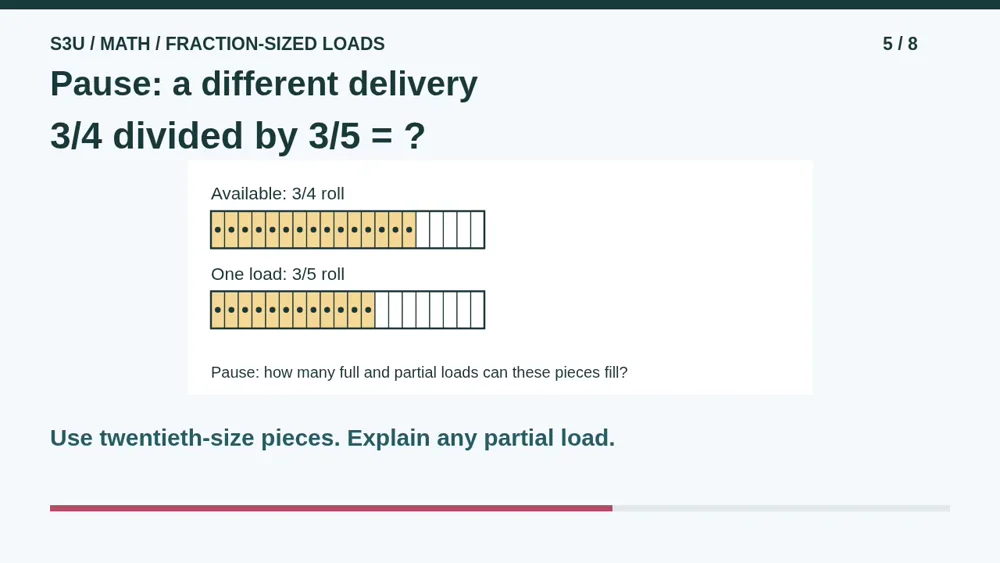
Try a fresh delivery. We have three quarters of a roll, and each load needs three fifths. Pause the video. Rename both amounts using twentieth-size pieces. How many pieces are available? How many belong in one load? Find the full load and the fraction of the next load. Explain that leftover fraction using a load, not a whole roll, as your reference.
6. Fifteen pieces, twelve per load
Video: 2:22
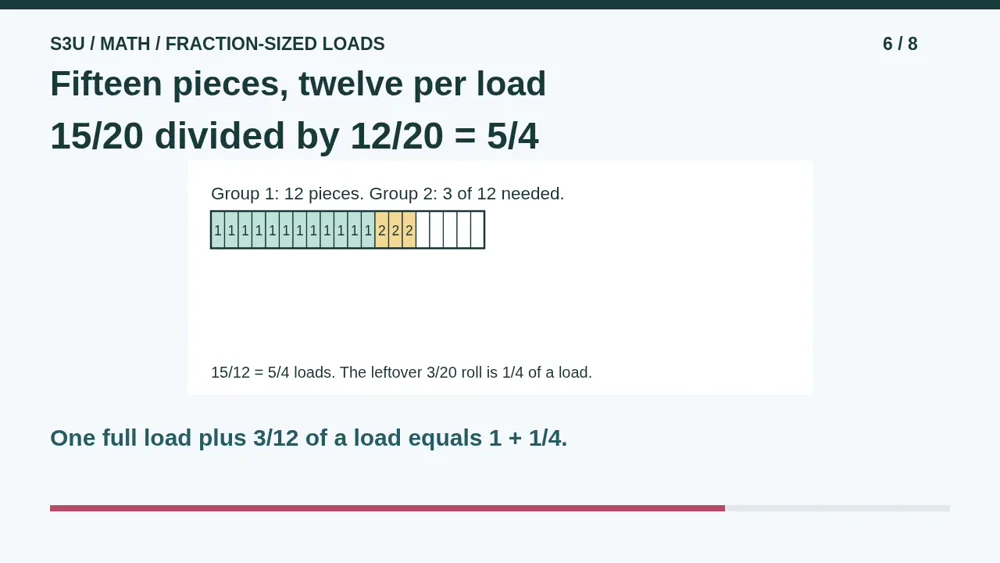
Three quarters is fifteen twentieths, and three fifths is twelve twentieths. Twelve pieces fill one load, leaving three pieces. Three out of twelve is one quarter of another load. That gives five fourths loads altogether. Check: five fourths times three fifths is fifteen twentieths, or three quarters. Saying one and three twentieths loads would mix the roll unit with the load unit.
7. A larger load gives fewer loads
Video: 2:51
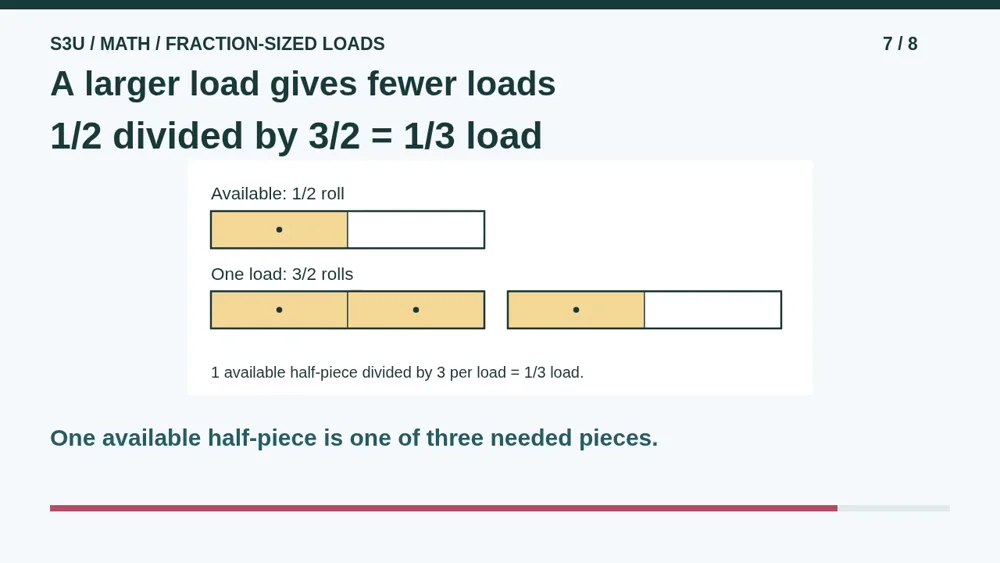
Fun fact: the same half roll is half of a one-roll load, but only one third of a one-and-a-half-roll load. Our picture shows one available half-piece and three half-pieces needed for the larger load. Changing the load size changes the count. Zero ribbon gives zero loads for a positive load size. A zero load size is not a valid divisor.
8. Continue to the worksheet
Video: 3:18
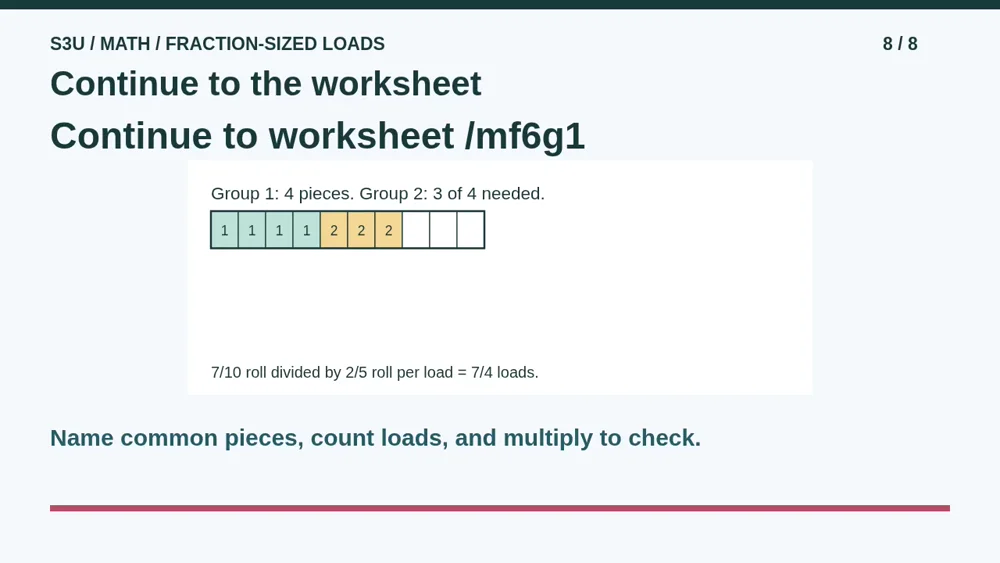
Continue to the worksheet below for fresh load problems. Name the available amount and the size of one load using the same whole. Count common-size pieces, include partial loads, and check with multiplication. Write your reasoning in the working space. Then try Practice Two, or choose Grouping at Fraction Dock to build your own model before giving an answer.
Show your understanding
You can point, explain aloud, draw or write.
- Count full and partial loads using common-size pieces, with a clear distinction between part of a roll and part of a load.
- Explain division using the reciprocal of a positive divisor and verify the load count by multiplication.
Try it yourself
Pause at three quarters divided by three fifths. Count common-sized pieces and explain the partial load.
Continue to the worksheet with fresh amounts, then try Practice 2 or choose Grouping at Fraction Dock.
Next: your worksheet
Count Fraction-Sized Loads - Practice 1https://s3u.com/mf6g1
Try Fraction Dock: choose Grouping
Lesson: https://s3u.com/lessons/count-fraction-loads