Math / Grade 9
Correct cash record errors
Learning goal: Use receipts to repair expense payments entered too small or too large, and keep confirmed bank errors separate from book corrections.
Before you start: Review cash, expense, income and debit/credit entries, plus bank-side and book-side reconciliation. Use only the fictional records and one closing date per case.
Read or print this lesson What to practiceThe video could not load. The transcript is still available below.
Next: your worksheet
Correct Cash Record Errors - Practice 1
Checking sign-in...
Read the transcript
Saved reading place
Video transcript and practice. Reading or printing does not count as playback time or an assessed grade.
1. Find the wrong record first
Video: 0:00
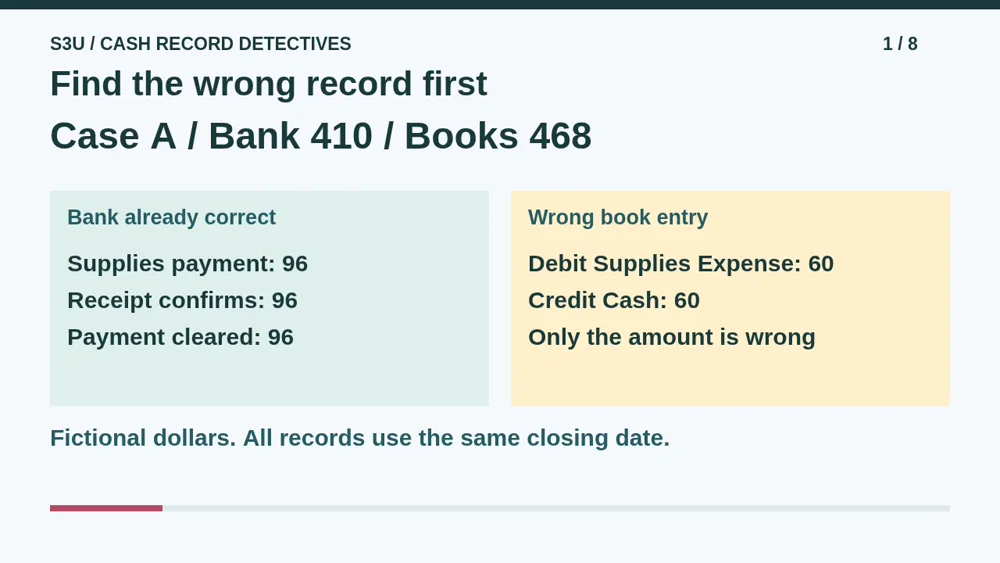
Our fictional workshop paid ninety-six dollars for supplies used immediately. The receipt and cleared payment both confirm ninety-six. But its books debited Supplies Expense sixty and credited Cash sixty. The account names were correct; the amount was not. Before any adjustments, the bank balance is four hundred ten and book Cash is four hundred sixty-eight, for the same closing date. We will explain the other differences shortly. Start with this payment: did the books subtract too much cash or too little? A calculator can subtract, but it cannot read the receipt for us.
2. Too small: subtract the difference
Video: 0:42
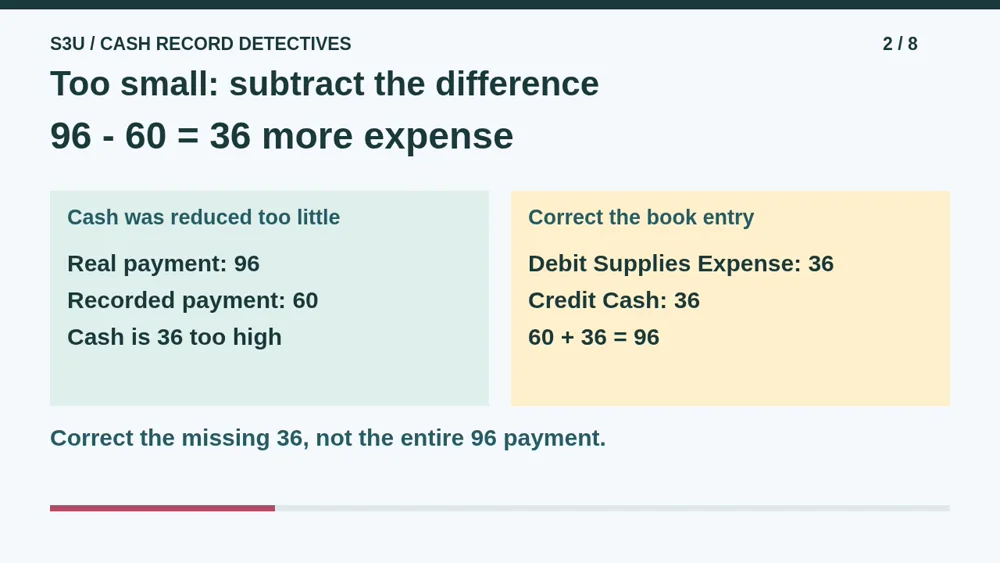
The books subtracted only sixty instead of ninety-six. Recorded Cash is thirty-six too high, and Supplies Expense is thirty-six too low. Correct that difference: debit Supplies Expense thirty-six and credit Cash thirty-six. The original sixty plus the correction thirty-six gives the true payment of ninety-six. Recording a second complete payment of ninety-six would give a total recorded payment of one hundred fifty-six. That would create another error. Correcting a record is not paying the shop again. The bank already deducted the right ninety-six, so this payment needs no bank-side correction.
3. Finish Case A on both sides
Video: 1:27
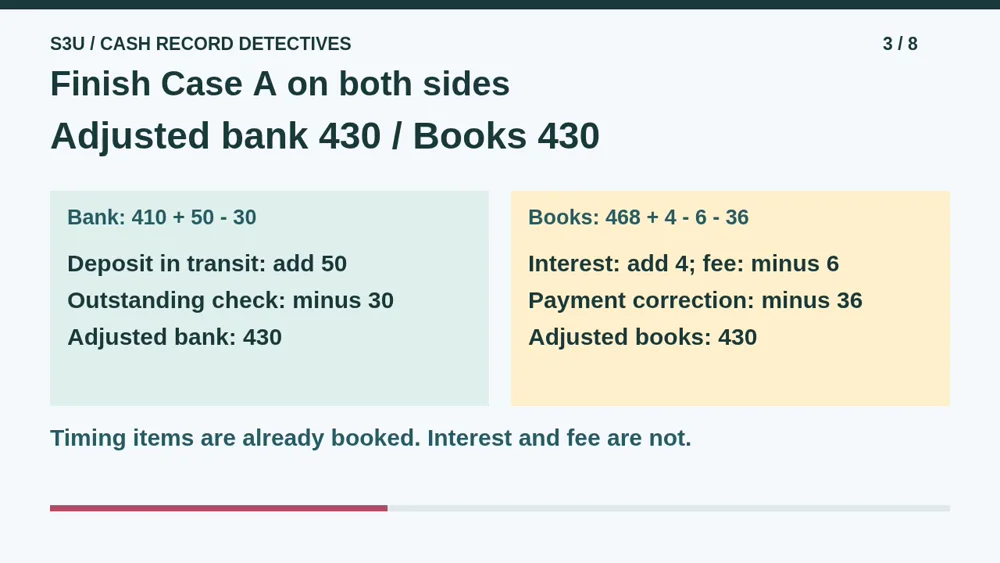
Here are the remaining Case A records. A fifty-dollar deposit and a thirty-dollar outstanding check are already booked but missing from the statement. Add fifty and subtract thirty on the bank side: four hundred thirty. The statement includes four of interest and a fee of six, neither yet booked. Book Cash becomes four hundred sixty-eight plus four, minus six, minus our thirty-six correction: four hundred thirty. For interest, debit Cash four and credit Interest Income four. For the fee, debit Bank Fee Expense six and credit Cash six. Do not book the deposit or outstanding check twice. These are all the differences in Case A.
4. Too large: put the extra back
Video: 2:14
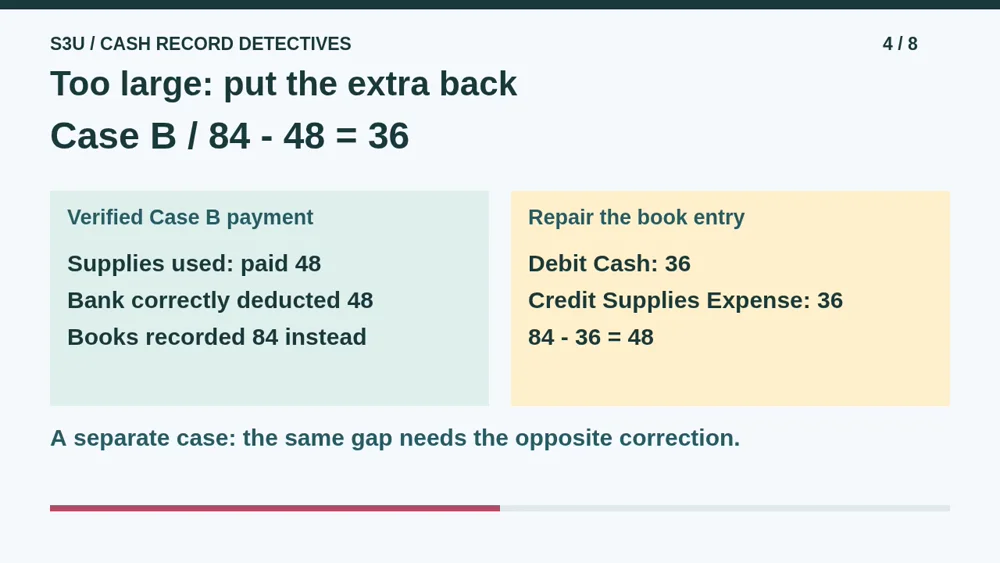
Start a separate workshop, Case B. Its book Cash is three hundred thirty-eight. A supplies payment was really forty-eight, confirmed by its receipt and the bank. The books instead debited Supplies Expense eighty-four and credited Cash eighty-four. This time the books subtracted thirty-six too much. Increase Cash by thirty-six and reduce Supplies Expense by thirty-six: debit Cash, credit Supplies Expense. Eighty-four minus thirty-six leaves the correct expense of forty-eight. The same thirty-six-dollar gap as Case A needs the opposite correction. The source amounts decide the direction; the size of the gap alone does not.
5. Keep a bank error on its side
Video: 3:01
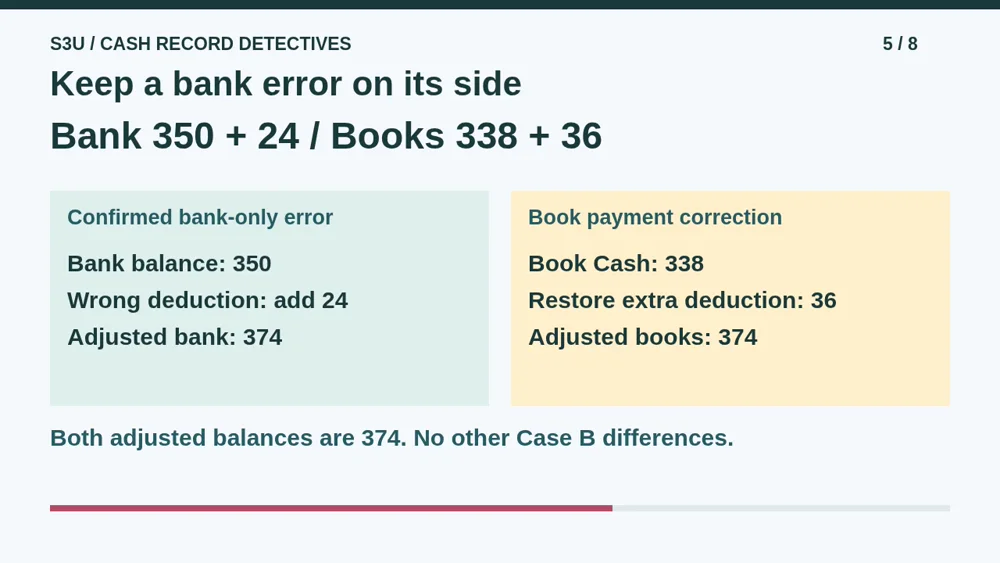
Case B has one other difference. Its bank statement balance is three hundred fifty. Our fictional evidence confirms that the bank wrongly deducted twenty-four for another workshop. The books never recorded that unrelated payment. Add twenty-four on the bank side of the reconciliation to get three hundred seventy-four. Book Cash is three hundred thirty-eight plus the thirty-six correction, also three hundred seventy-four. Do not enter the bank error as workshop income or expense. This comparison does not repair the bank system itself. In our paper exercise, flag the confirmed bank error for correction and keep its evidence with the reconciliation.
6. Pause: repair a fresh case
Video: 3:50
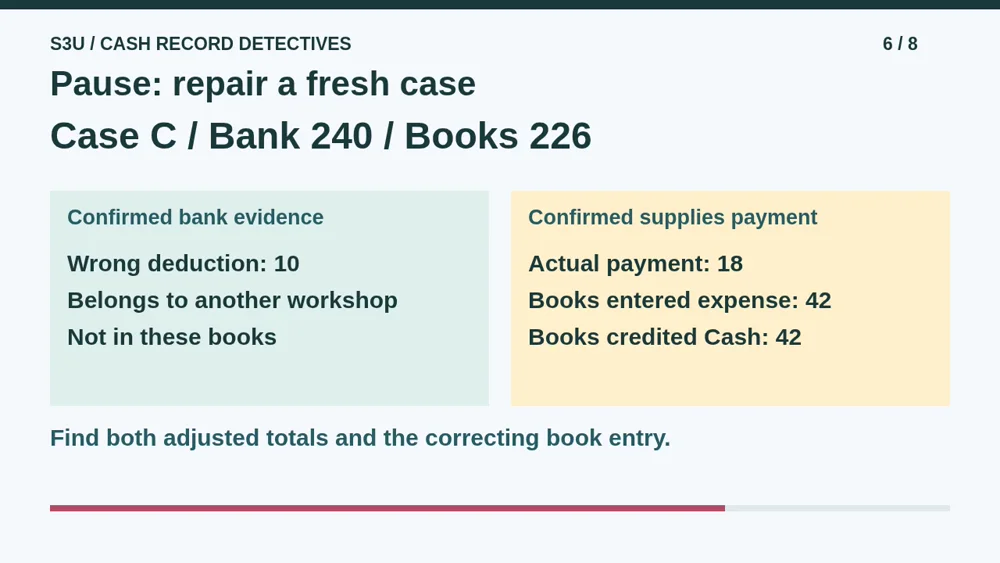
Pause for Case C, a new fictional workshop and one closing date. Bank Cash is two hundred forty; book Cash is two hundred twenty-six. The bank confirms a wrong ten-dollar deduction belonging to another workshop; its books never included it. Separately, a receipt proves that supplies used cost eighteen, and the bank correctly deducted eighteen. The books instead debited Supplies Expense forty-two and credited Cash forty-two. There are no other differences. Find each adjusted balance. Write the correcting book entry, and explain why you are not recording the whole payment again. Solve before continuing; neither earlier answer belongs to this case.
7. Check Case C with the receipt
Video: 4:39
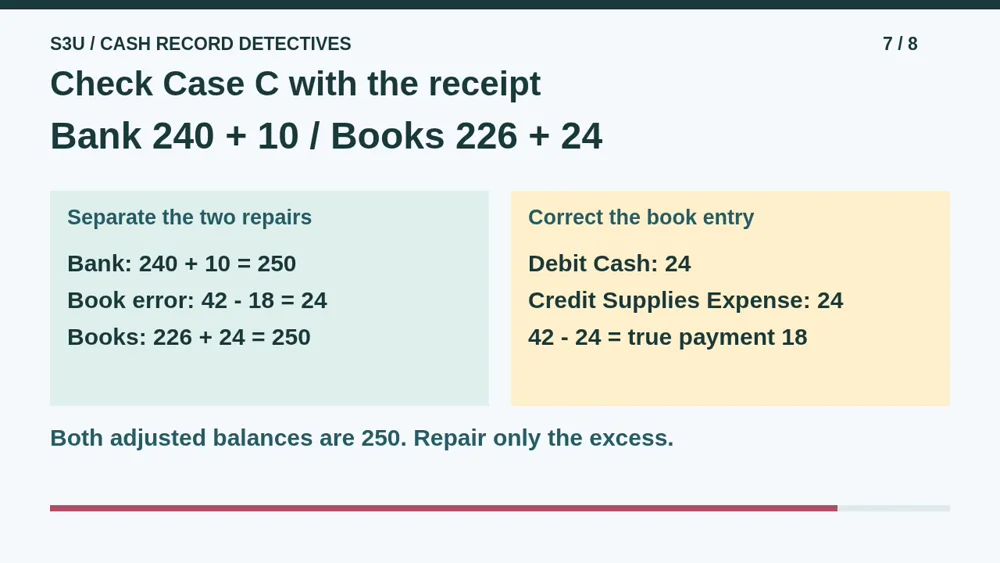
For Case C, add the confirmed wrong deduction of ten on the bank side: two hundred fifty. The books subtracted forty-two for an eighteen-dollar payment, twenty-four too much. Add twenty-four to book Cash: two hundred twenty-six plus twenty-four equals two hundred fifty. Debit Cash twenty-four and credit Supplies Expense twenty-four. Check the combined entry: forty-two of original expense minus twenty-four of correction leaves eighteen, matching the receipt. The bank-only ten never becomes workshop income. If your direction was different, return to the actual eighteen and recorded forty-two. Ask which number is bigger before deciding what to undo.
8. Evidence first, then your worksheet
Video: 5:27
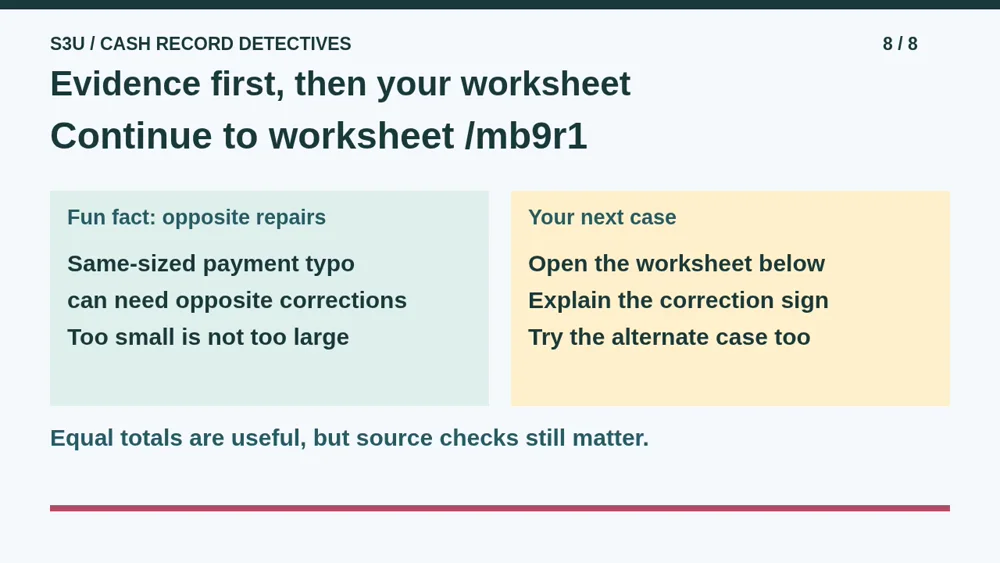
Fun fact: the same-sized payment typo can need opposite corrections. Our first two cases each had a thirty-six-dollar book error, but one lowered Cash and the other raised it. Equal final balances are not proof that every item is right. Imagine two separate payments, one overstated by five and the other understated by five. Their cash errors cancel, yet both records need correction. Continue to the worksheet below, using its own evidence and amounts, then try its alternate case. Explain the direction, correct only the difference, and investigate any unexplained gap. Watching is preparation; solving a fresh case shows what you can do.
Show your understanding
You can point, explain aloud, draw or write.
- Use the verified payment and recorded amount to explain the correction direction, and journal only the difference in the books.
- Reconcile a fresh case with a confirmed bank error kept separate, and explain why matching adjusted balances still need source checks.
Try it yourself
Pause at Case C: bank 240, books 226, a confirmed bank-only wrong deduction of 10 and a payment of 18 entered as 42. Explain both adjusted totals and the book entry.
Continue to the worksheet with its new evidence, then try the alternate case. Explain the correction direction rather than copying a sign.
Next: your worksheet
Correct Cash Record Errors - Practice 1https://s3u.com/mb9r1
Lesson: https://s3u.com/lessons/correct-cash-record-errors