Math / Grade 12
Accumulate a constant rate
Learning goal: Use signed rate rectangles and interval lengths to find net change, then add a starting amount separately.
Before you start: Multiply signed numbers, find interval length and interpret units such as liters per minute.
Read or print this lesson What to practiceThe video could not load. The transcript is still available below.
Next: your worksheet
Accumulate a Constant Rate - Practice 1
Checking sign-in...
Read the transcript
Saved reading place
Video transcript and practice. Reading or printing does not count as playback time or an assessed grade.
1. A rate is not an amount
Video: 0:00
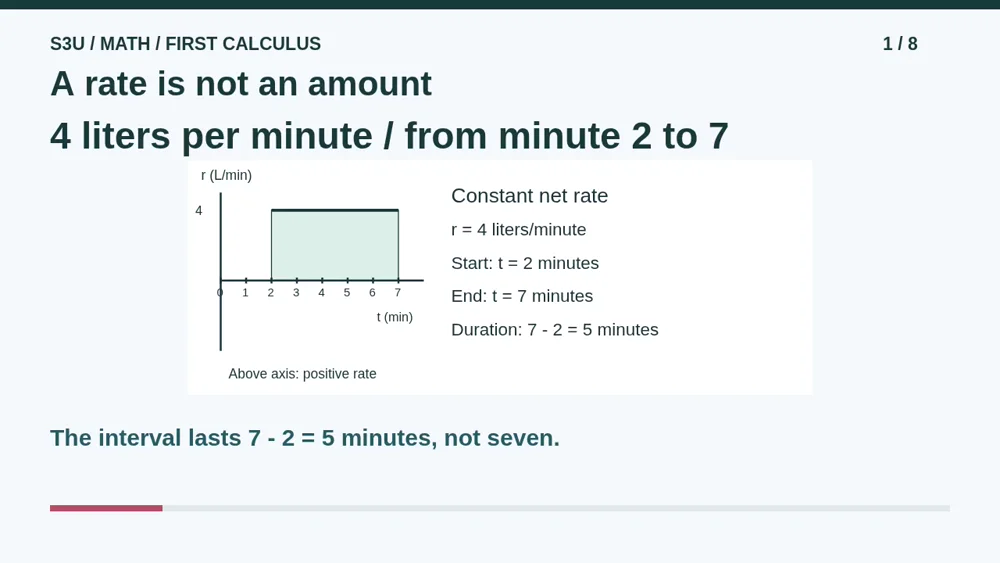
Imagine a model tank with water entering at a constant net rate of four liters per minute, from minute two to minute seven. Net rate includes all inflow and outflow together. The interval lasts five minutes. Rate tells us how fast the amount changes; it is not the amount already in the tank. The clock does not start over just because our calculation begins at minute two.
2. Multiply rate by interval length
Video: 0:28
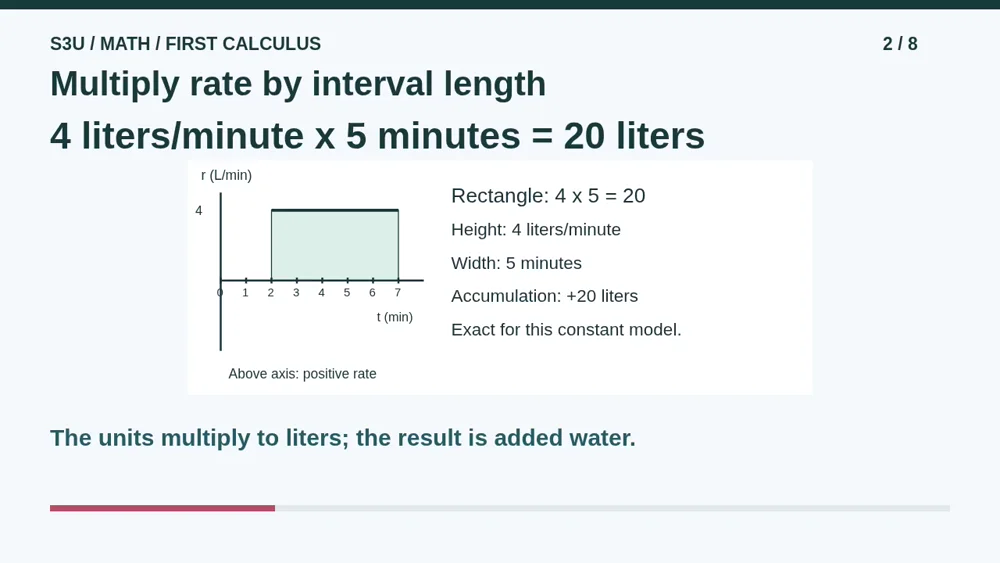
A constant rate of four liters per minute for five minutes adds twenty liters. On a graph of rate against time, this is a rectangle of height four and width five. The product has units of liters because minutes cancel. This rectangle is exact for the stated constant model. If the rate changes during the interval, one rectangle at the starting rate does not generally give the exact accumulation.
3. Read the definite integral
Video: 0:58
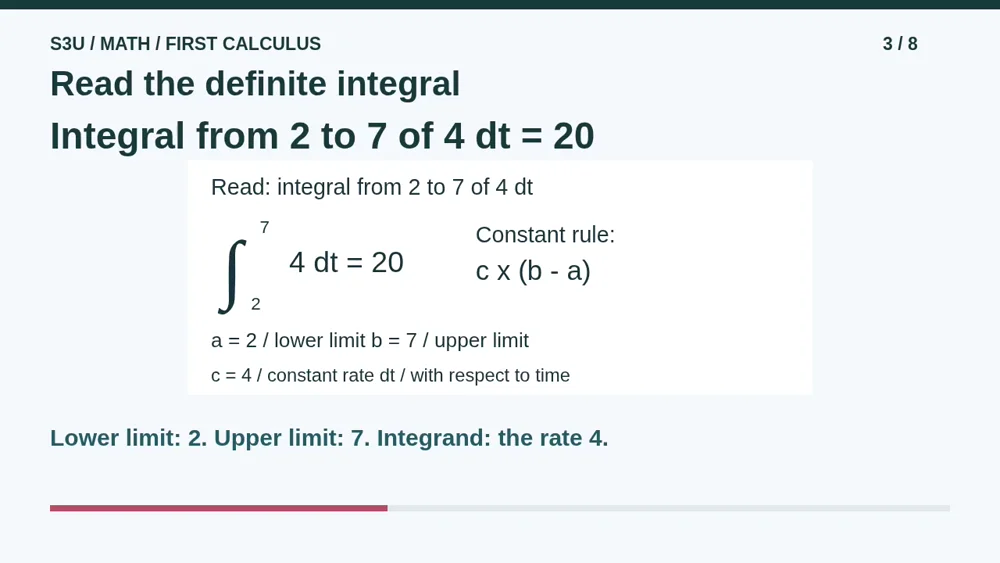
The definite integral records this signed accumulation. Read the integral from two to seven of four, d t. The limits say where the time interval starts and ends. The rate inside is four, and d t indicates accumulation with respect to time. For a constant rate c from a to b, the result is c times b minus a. Here that gives four times five, or twenty.
4. Add the starting amount separately
Video: 1:26
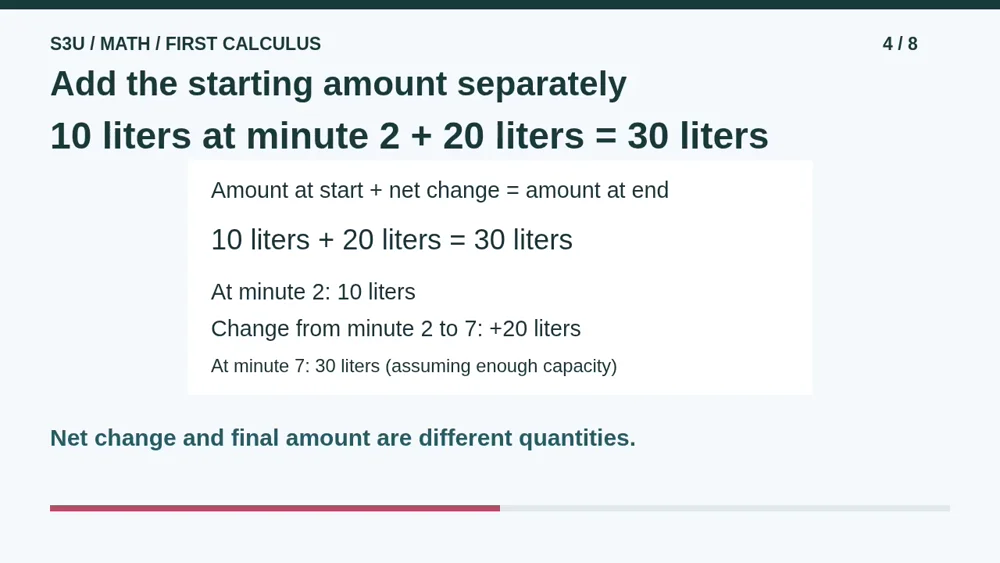
Suppose the tank contains ten liters at minute two. Adding the twenty liters accumulated during our interval gives thirty liters at minute seven. The integral alone gave the change, not the final amount. Without a starting amount, we cannot determine that final total. Our imaginary tank has enough capacity for this example. A real tank that overflows would need a different net-rate model.
5. Pause: the tank is losing water
Video: 1:56
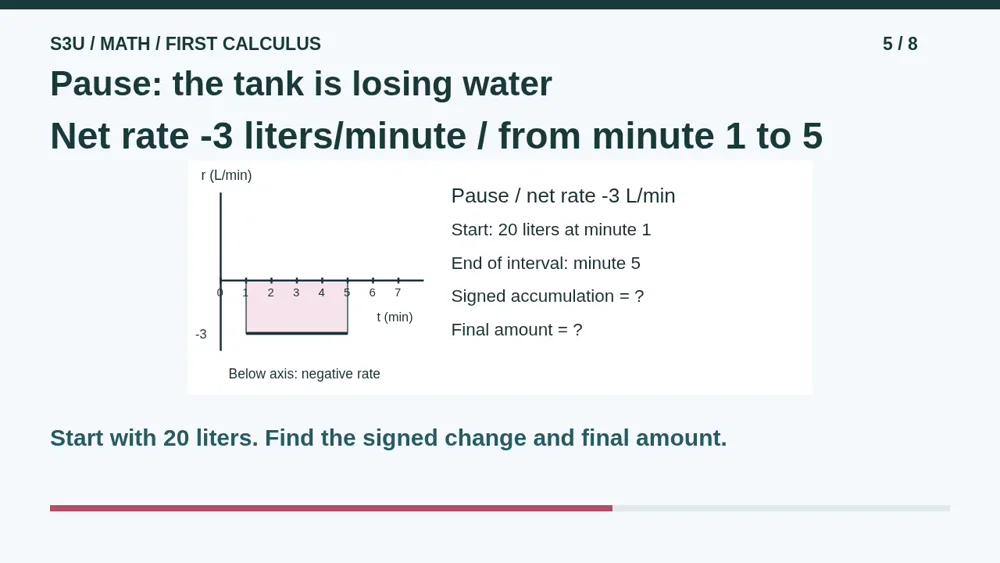
Pause for a new model. The net rate is negative three liters per minute from minute one to minute five, and there are twenty liters at minute one. What is the signed accumulation? What is the final amount? Keep the negative sign when multiplying the rate by the interval length. A negative rate describes water leaving overall; it does not mean that a tank contains a negative amount of water.
6. A negative integral means net loss
Video: 2:26
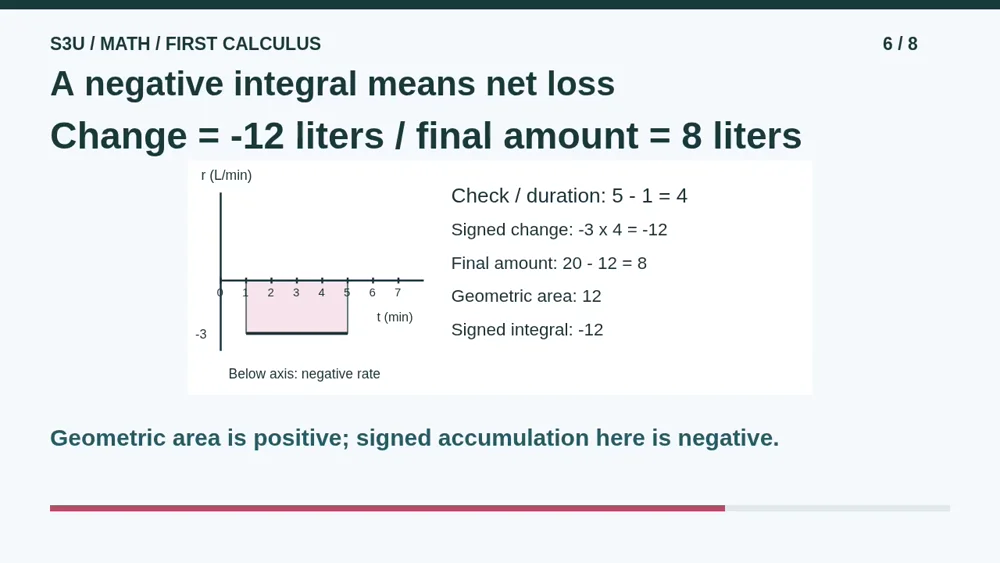
The interval lasts four minutes. Negative three times four gives a change of negative twelve liters. Add that signed change to the starting twenty liters: eight liters remain. The rectangle below the time axis has geometric area twelve, but its signed integral is negative twelve. Keep these distinct. If this model ever predicted water below zero, we would stop and reconsider its physical assumptions.
7. Split the interval without changing the total
Video: 2:58
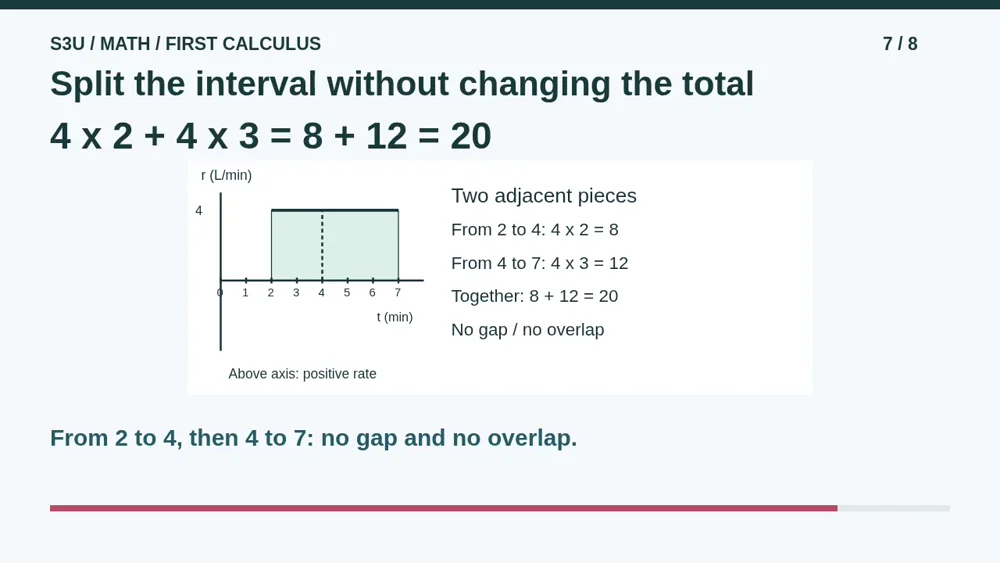
Fun fact: splitting this constant-rate interval does not change the accumulation. From minute two to four, four liters per minute adds eight liters. From four to seven, it adds twelve more. Eight plus twelve is still twenty. There is no gap or overlapping time. This is not two separate starting amounts to add; it is the same change counted in two adjacent pieces.
8. Continue to the accumulation worksheet
Video: 3:27
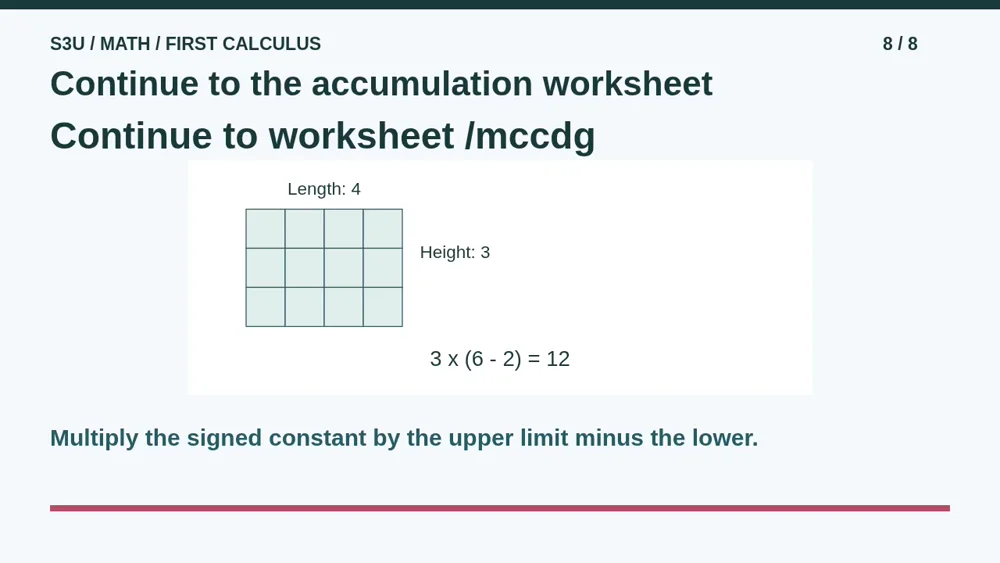
Continue to the worksheet below, then Practice Two. Each question gives a constant and an interval. Subtract the lower limit from the upper limit, then multiply by the signed constant. A negative constant can give a negative answer, and a zero constant gives zero change. These are exact constant-rate problems. Accumulating a changing rate requires further integral methods, which we have not yet developed here.
Show your understanding
You can point, explain aloud, draw or write.
- Calculate positive, negative or zero accumulation for a constant rate using the upper limit minus the lower.
- Distinguish signed change from geometric area and from a final amount that requires an initial value.
Try it yourself
Pause at a net rate of -3 liters per minute from minute 1 to 5, starting with 20 liters. Find both signed change and final amount.
Continue to the accumulation worksheet and Practice Two. Multiply the signed constant by upper limit minus lower limit; distinguish signed integral from geometric area.
Next: your worksheet
Accumulate a Constant Rate - Practice 1https://s3u.com/mccdg
Lesson: https://s3u.com/lessons/constant-rate-accumulation