Science / Grade 4
Compare cooling fairly
Learning goal: Read matched cup records, calculate temperature drops and explain what insulation does without treating it as a heater.
Before you start: Read positive Celsius temperatures, subtract whole numbers and identify matching test conditions. All readings are supplied; no equipment is needed.
Read or print this lesson What to practiceThe video could not load. The transcript is still available below.
Next: your worksheet
Compare Thermal Insulation under a Fixed Test - Practice 1
Checking sign-in...
Read the transcript
Saved reading place
Video transcript and practice. Reading or printing does not count as playback time or an assessed grade.
1. Two cups, one fair question
Video: 0:00
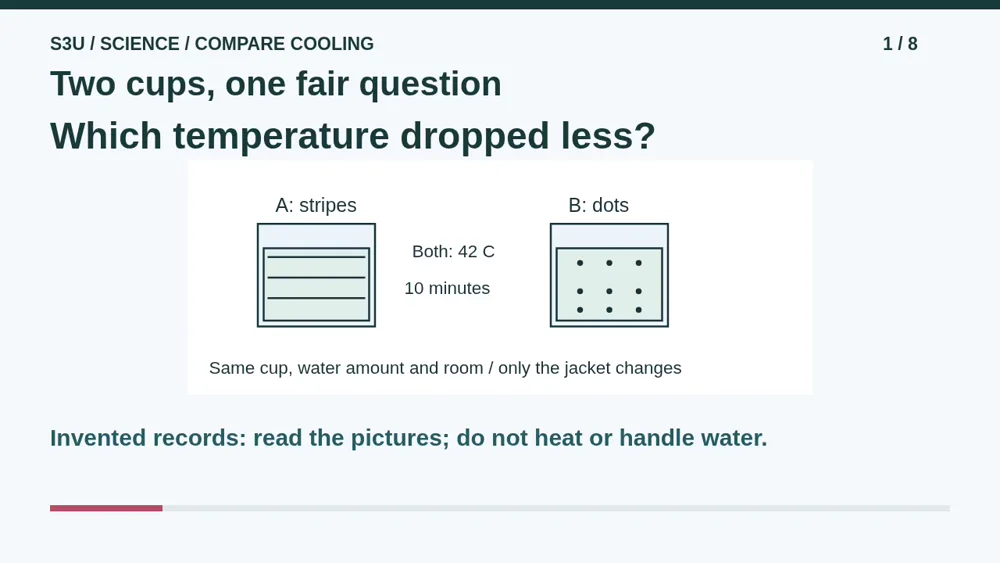
Our pretend science club has made two cup jackets. One has stripes, and one has dots. The dots are not extra science points. We need evidence: which jacket helped the water cool more slowly in this test? We will read invented thermometer records, subtract, and explain our choice. This is a picture investigation. You do not need hot water, a heater, or an actual cup.
2. Make the comparison fair
Video: 0:30
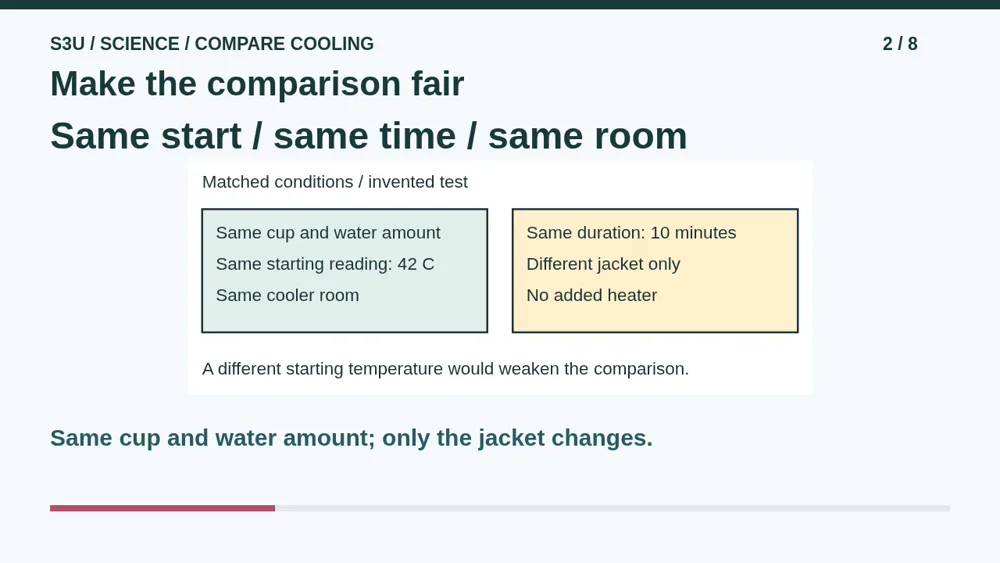
Both cups start at forty-two degrees Celsius. They hold equal amounts of water in matching cups. They sit in the same cooler room for ten minutes. Only the jacket is different. Those matching conditions matter. Starting one cup warmer, waiting longer for one, or moving one into sunlight would give us extra differences. Then the jacket would not be the only possible reason for the result.
3. Find each temperature drop
Video: 1:00
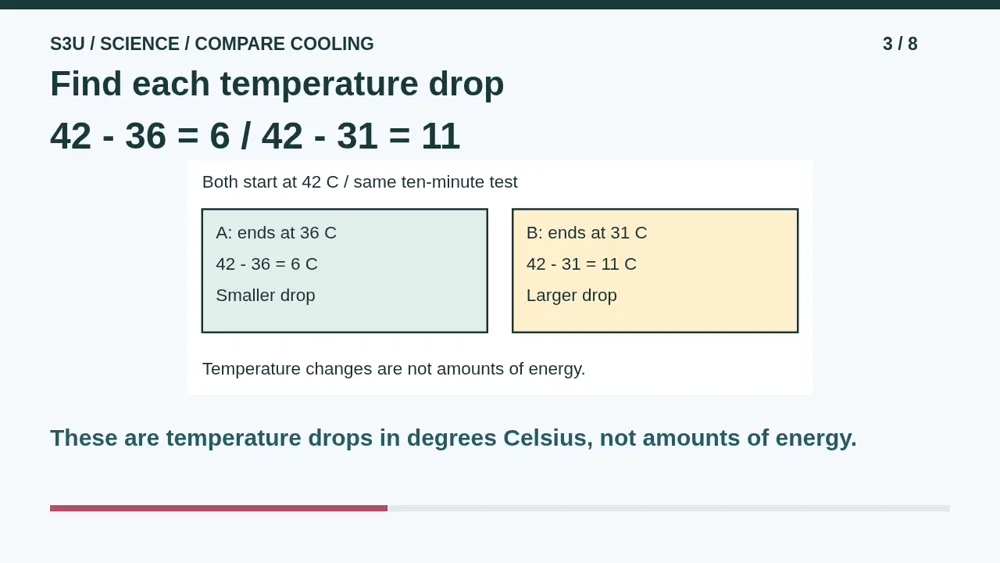
After ten minutes, cup A reads thirty-six degrees Celsius and cup B reads thirty-one. For A, forty-two minus thirty-six gives a drop of six degrees. For B, forty-two minus thirty-one gives a drop of eleven. Six is smaller than eleven. Cup A cooled less during this matched test. We are comparing temperature changes, not claiming that six degrees means six units of energy.
4. Slower cooling is not new warmth
Video: 1:30
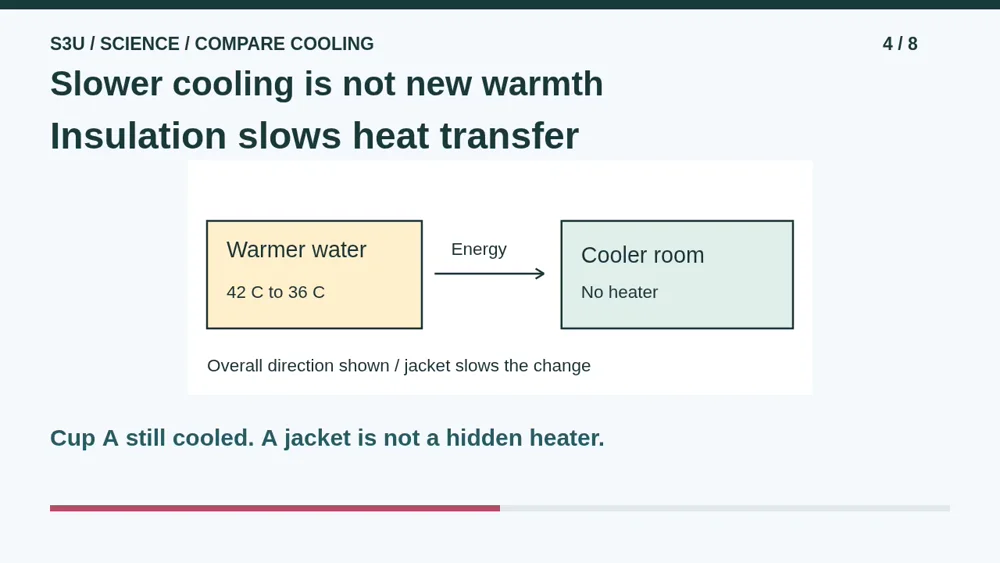
The water starts warmer than the room. Overall, energy moves from the warmer water toward its cooler surroundings. Insulation can slow that transfer. It does not make fresh energy appear inside the cup. Cup A still cooled from forty-two to thirty-six. Our striped jacket is doing useful work, but it has not secretly become a tiny stove. These records describe this test, not every possible jacket or room.
5. Pause: try a fresh comparison
Video: 2:02
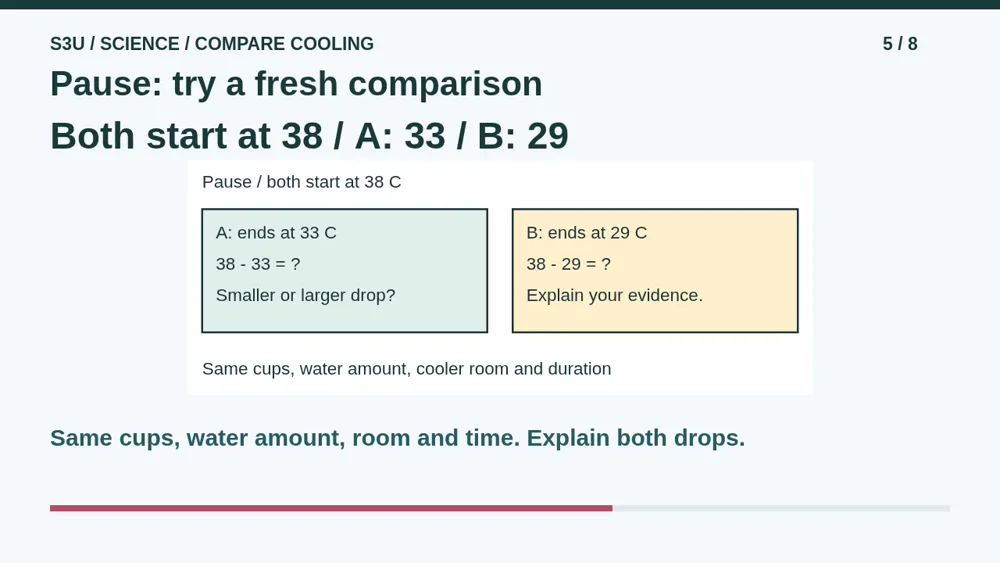
Here is a new matched test. Both cups start at thirty-eight degrees Celsius. After the same time in the same cooler room, A reads thirty-three and B reads twenty-nine. Pause the video. Find the temperature drop for each cup. Which drop is smaller? Then explain why the higher final reading helps us compare these cups only because the starting readings and other conditions were matched.
6. Check the change, then the claim
Video: 2:32
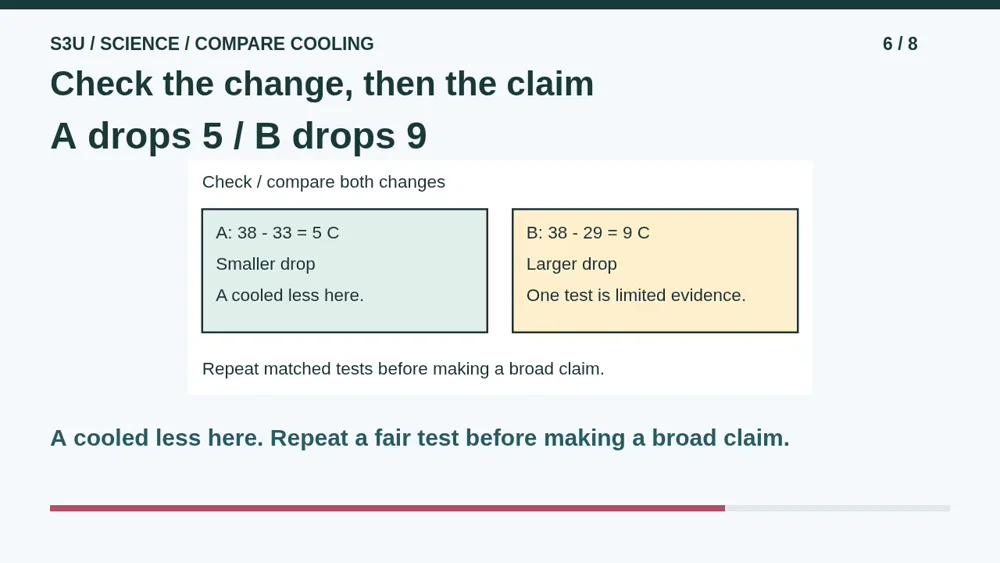
For A, thirty-eight minus thirty-three is five. For B, thirty-eight minus twenty-nine is nine. A cooled less in this test. If the starting temperatures were different, the final readings alone would not make a fair jacket comparison. One trial is also limited evidence. A scientist would repeat a matched test and check the measuring method. A confident headline cannot replace those missing checks, even if it wears a very impressive hat.
7. Insulation can protect something cool
Video: 3:05
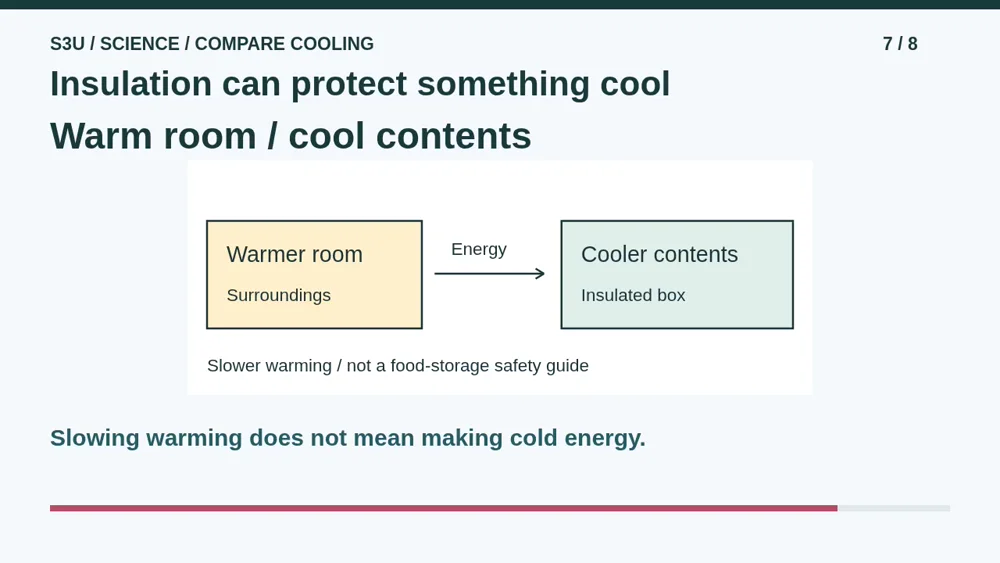
Fun fact: insulation can help keep something cool as well as warm. If a cooler box holds colder contents in a warmer room, insulation slows energy entering. The direction depends on which side is warmer. It does not create coldness or stop all transfer forever. Think of slowing a change, not ordering a temperature to stay put. Our example does not tell you whether real food has been stored safely.
8. Continue to the cooling worksheet
Video: 3:36
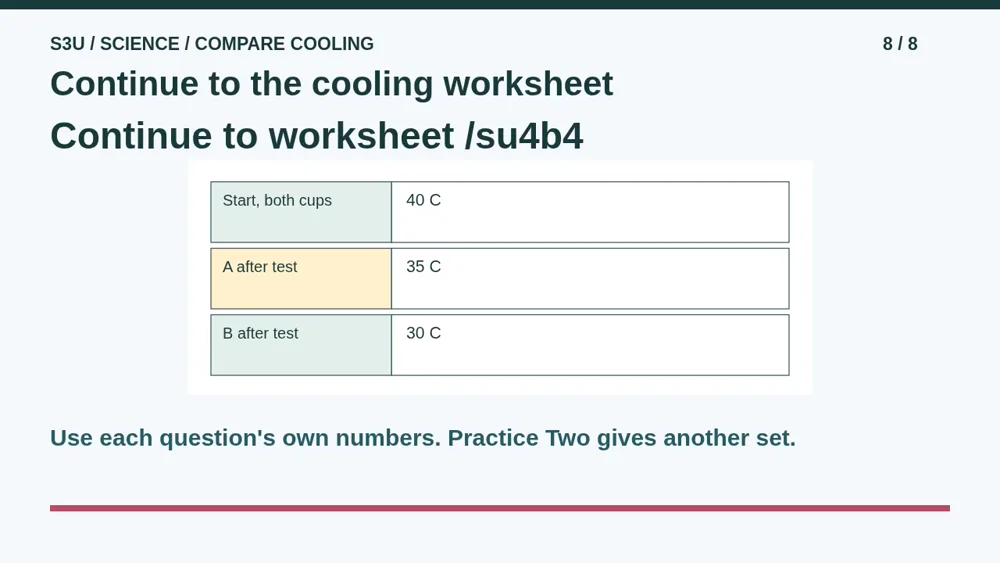
Continue to the worksheet below. Check that the cups have the same start and test duration, then compare their temperature drops. Say your explanation, or write it beside the printed question. Practice Two gives you another set of invented readings. Use those numbers instead of copying the video answer. You do not need equipment or an upload. The important part is showing how the evidence supports a careful claim.
Show your understanding
You can point, explain aloud, draw or write.
- Calculate and compare temperature drops when starting temperatures, durations and other test conditions are matched.
- Explain that insulation slows heat transfer rather than creating energy, and limit a conclusion to the supplied test.
Try it yourself
Pause at the new 38 C comparison. Calculate both temperature drops and explain which conditions make the comparison fair.
Continue to the worksheet and Practice Two using their own invented readings. Speak or write a careful conclusion; no heating equipment or upload is needed.
Next: your worksheet
Compare Thermal Insulation under a Fixed Test - Practice 1https://s3u.com/su4b4
Lesson: https://s3u.com/lessons/compare-cooling