Math / Grade 9
Choose the condition
Learning goal: Use a condition to choose the denominator, distinguish reversed questions and joint events, and recognize an empty condition.
Before you start: Read category counts and simplify fractions. Each pictured tile is equally likely within the stated nonempty group.
Read or print this lesson What to practiceThe video could not load. The transcript is still available below.
Next: your worksheet
Use Conditional Probabilities
Checking sign-in...
Read the transcript
Saved reading place
Video transcript and practice. Reading or printing does not count as playback time or an assessed grade.
1. One box, two descriptions
Video: 0:00
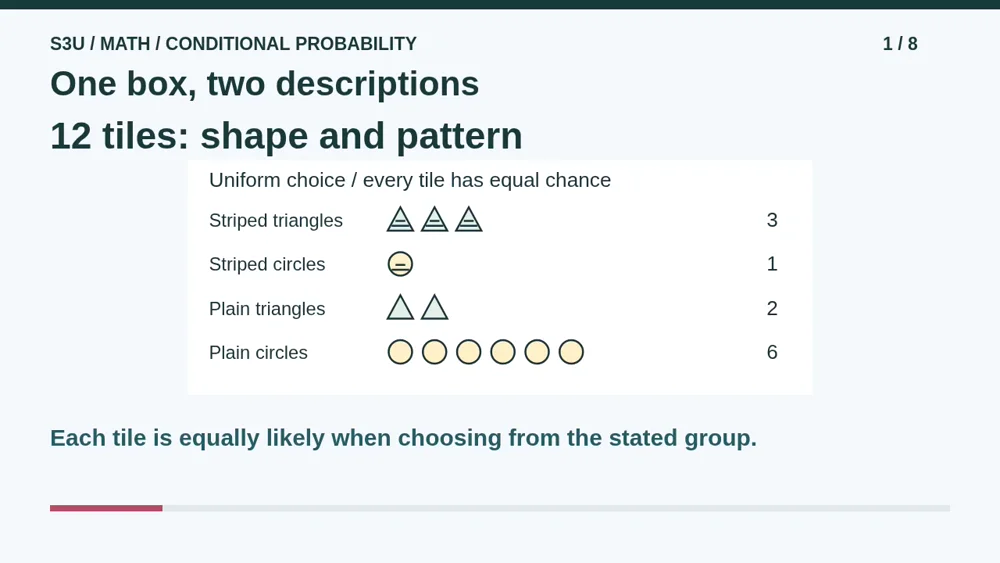
An invented box contains twelve tiles. Three are striped triangles, one is a striped circle, two are plain triangles, and six are plain circles. Each tile has both a shape and a pattern. We choose one tile uniformly at random, meaning every tile in the stated group has the same chance. The table keeps the four categories separate. Nobody gets an extra vote for having stylish stripes.
2. Given triangle: keep five tiles
Video: 0:30
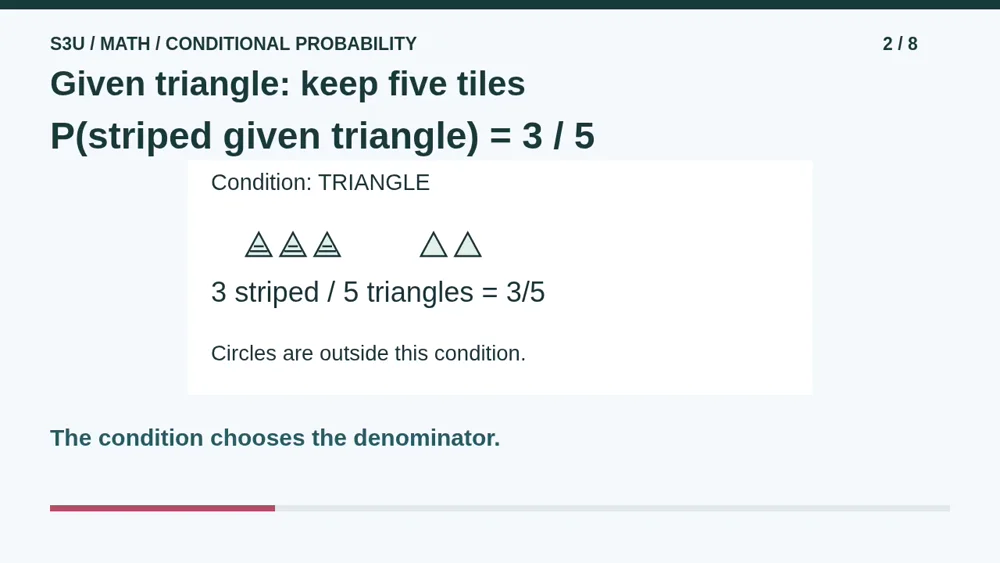
Suppose we know the chosen tile is a triangle. What is the probability that it is striped? Given triangle tells us which group to keep. There are five triangles: three striped and two plain. Three of those five match the requested pattern, so the probability is three fifths. The seven circles are outside this condition. Dividing by all twelve would answer a different question.
3. Reverse the question carefully
Video: 0:59
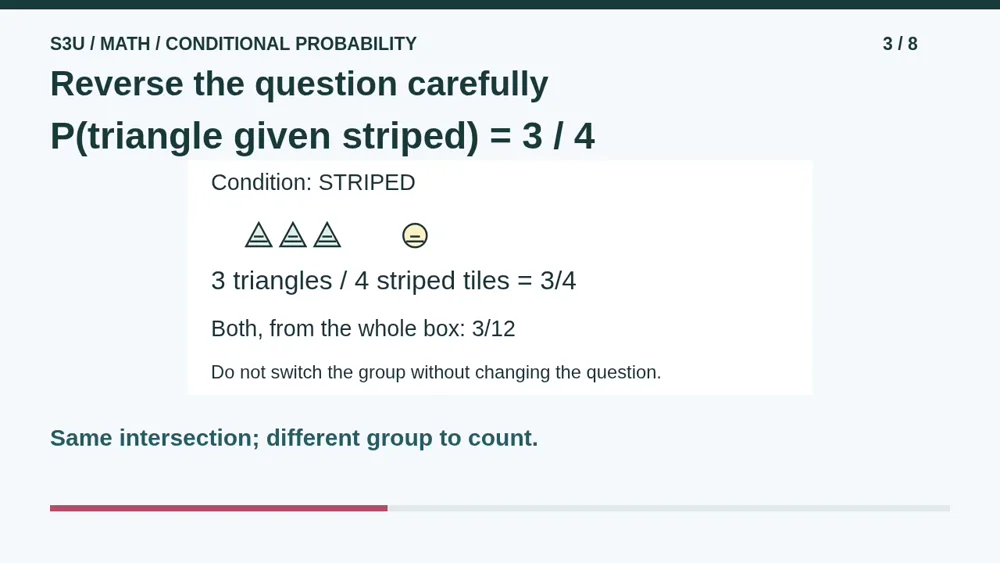
Now reverse the question. What is the probability of a triangle given that the tile is striped? Keep the four striped tiles: three triangles and one circle. The answer is three fourths, not three fifths. Both questions use the same three striped triangles, but different denominators. Choosing a striped triangle from the whole box would instead give three out of twelve. Say the condition before reaching for a fraction.
4. An empty condition is different
Video: 1:31
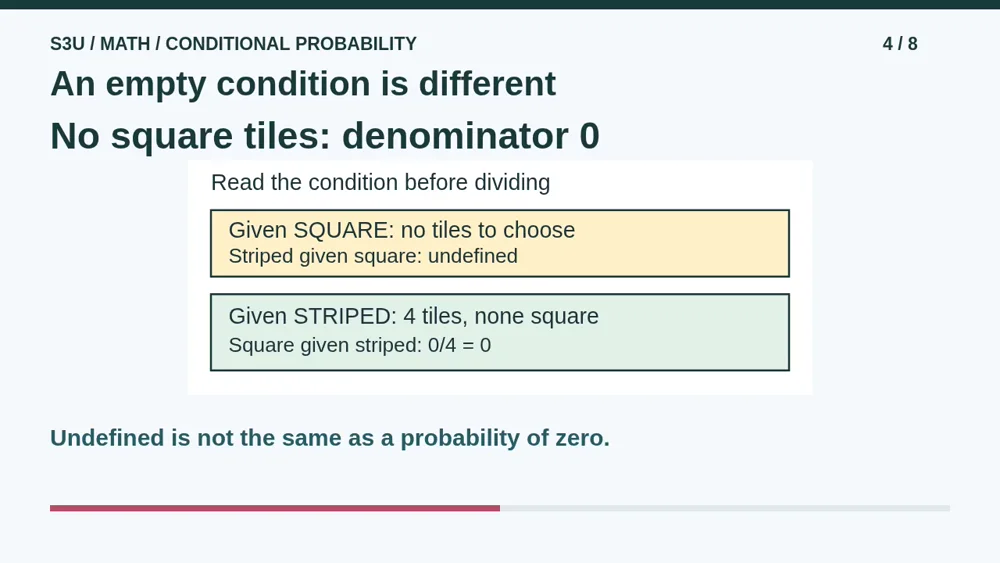
What if someone asks for the probability of striped given square? Our box has no square tiles. There is no tile to choose from that condition, and division by zero does not give a probability. This conditional probability is undefined in the stated model. That differs from asking for a square given striped: the four striped tiles exist, none is square, so that probability is zero out of four.
5. Pause: use a different box
Video: 2:01
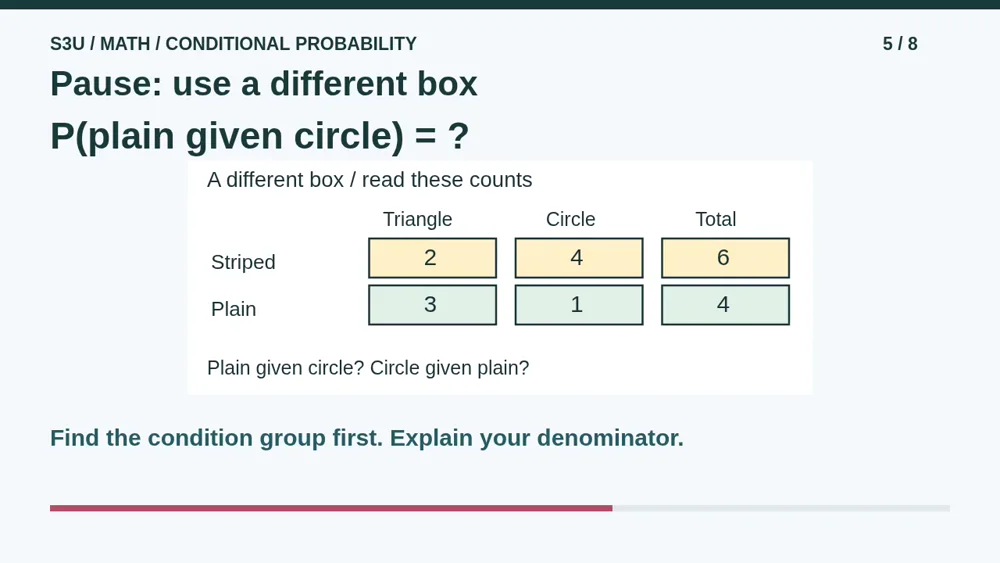
Try a new box with different counts. It contains two striped triangles, four striped circles, three plain triangles, and one plain circle. Each tile is equally likely. Pause the video and find the probability of plain given circle. Then reverse the question: circle given plain. You can point to the table, draw the groups, or explain aloud. Keep this new box separate from the earlier twelve-tile box.
6. Check both denominators
Video: 2:32
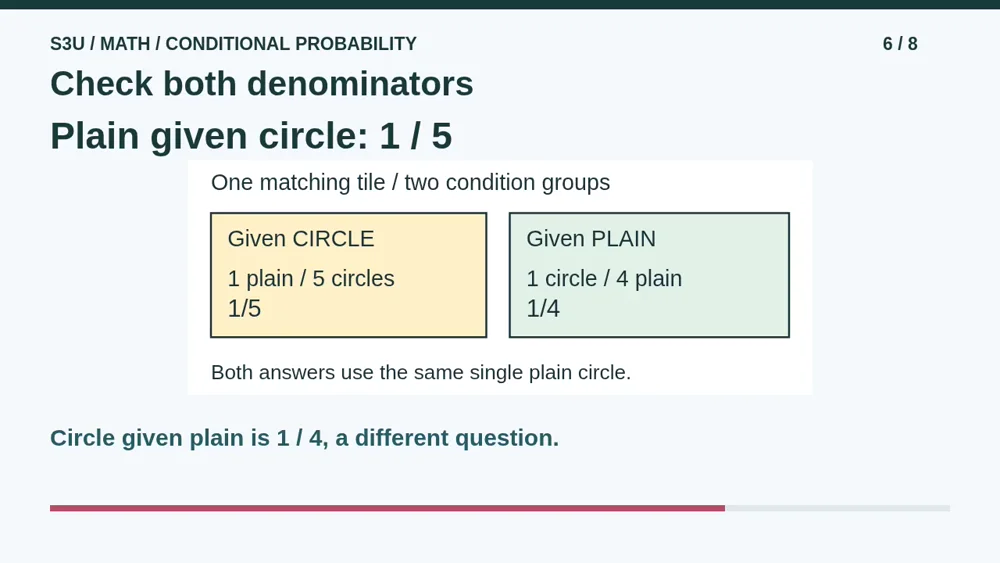
The new box has five circles: four striped and one plain. Plain given circle is therefore one fifth. Reverse the condition and keep the four plain tiles: three triangles and one circle. Circle given plain is one fourth. The favorable tile is the same single plain circle in both answers. What changed was the group we knew it belonged to. Neither question uses all ten tiles as its denominator.
7. More tiles can keep the same chance
Video: 3:04
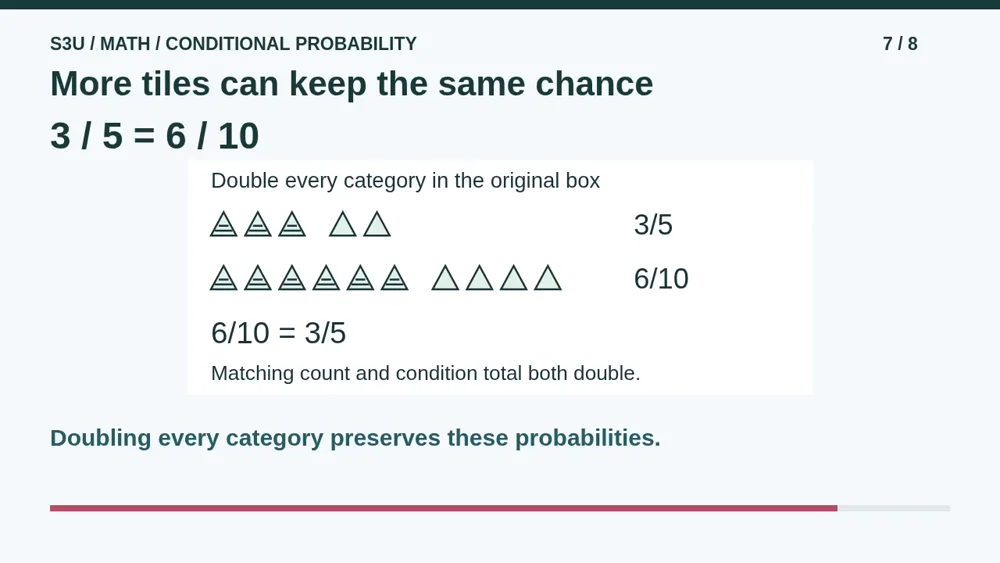
Fun fact: doubling every count in the original box doubles its size without changing these probabilities. Six striped triangles and four plain triangles make ten triangles, so striped given triangle becomes six tenths. That equals the original three fifths. More tiles do not automatically mean a bigger probability. We must compare the matching count with the size of the condition group, not just admire the bigger numerator.
8. Continue to the worksheet
Video: 3:36
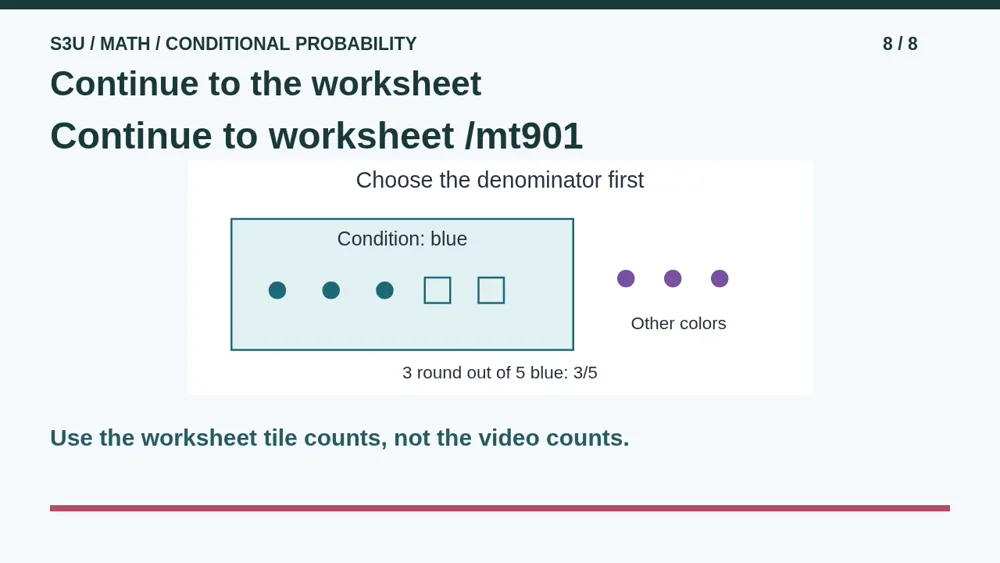
Continue to the worksheet below. It has its own red and blue tile counts, with round and square shapes. Read that table before calculating. For each question, name the group after given, count every tile in that group, and then count the ones matching the requested event. Explain why reversing the words may change the answer. The page can be completed on screen or printed.
Show your understanding
You can point, explain aloud, draw or write.
- Identify the condition group and calculate its matching fraction, distinguishing a reversed question from a joint event.
- Explain why an empty condition makes this ratio undefined and why scaling all category counts preserves the conditional probabilities.
Try it yourself
Pause at the new ten-tile box. Find plain given circle, then circle given plain, and explain each denominator.
Continue to the worksheet with its own red/blue and round/square counts. Uniform choice from a nonempty condition group is required for these count ratios.
Next: your worksheet
Use Conditional Probabilitieshttps://s3u.com/mt901
Lesson: https://s3u.com/lessons/choose-the-condition