Math / Grade 10
Choose a right-triangle ratio
Learning goal: Connect sine, cosine and tangent to side roles, explain scaling and a tangent above one, and use a given ratio to find a length.
Before you start: Identify the sides relative to an acute angle, simplify fractions and multiply by a fraction. Review Name the sides of a right triangle when needed.
Read or print this lesson What to practiceThe video could not load. The transcript is still available below.
Next: your worksheet
Choose Sine, Cosine or Tangent
Checking sign-in...
Read the transcript
Saved reading place
Video transcript and practice. Reading or printing does not count as playback time or an assessed grade.
1. Three comparisons, one angle
Video: 0:00
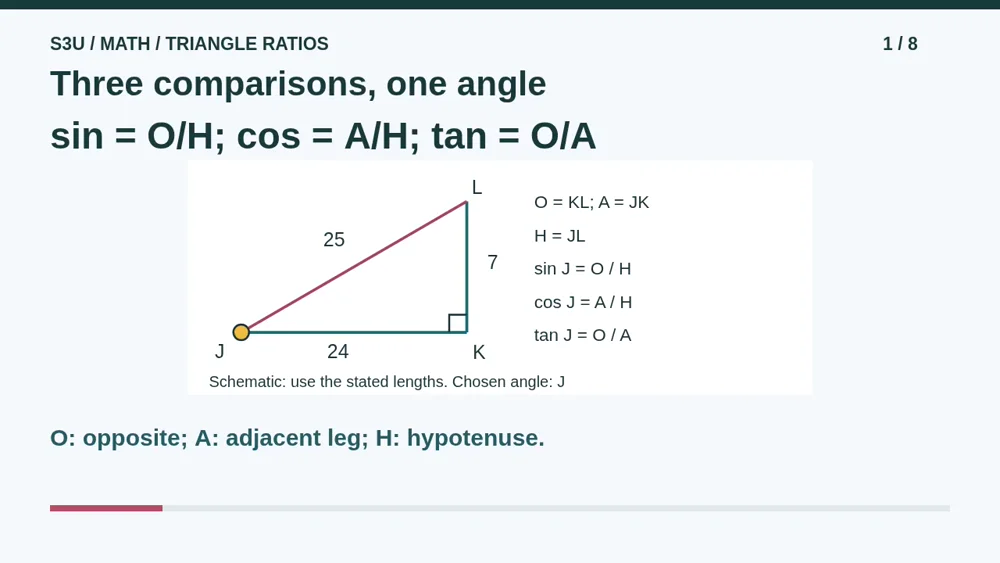
Choose an acute angle in a right triangle. Sine compares opposite to hypotenuse. Cosine compares the adjacent leg to hypotenuse. Tangent compares opposite to the adjacent leg. Here the capital letters O, A and H stand for side roles, not corner names. Name the chosen angle before using any formula. We are comparing lengths, not finding an angle from a calculator. Every denominator has a particular job.
2. Read the roles before dividing
Video: 0:34
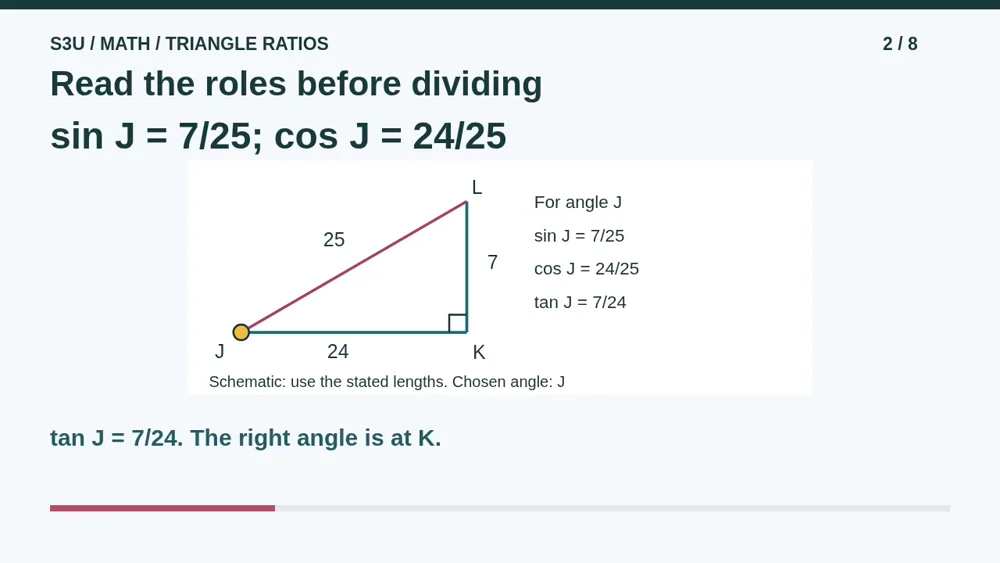
In triangle J K L, the right angle is K and our chosen angle is J. The opposite side K L is seven units. The adjacent leg J K is twenty four units. The hypotenuse J L is twenty five units. Sine J is seven over twenty five. Cosine J is twenty four over twenty five. Tangent J is seven over twenty four. Tangent does not borrow the hypotenuse just because it is nearby.
3. Scale lengths, preserve ratios
Video: 1:08
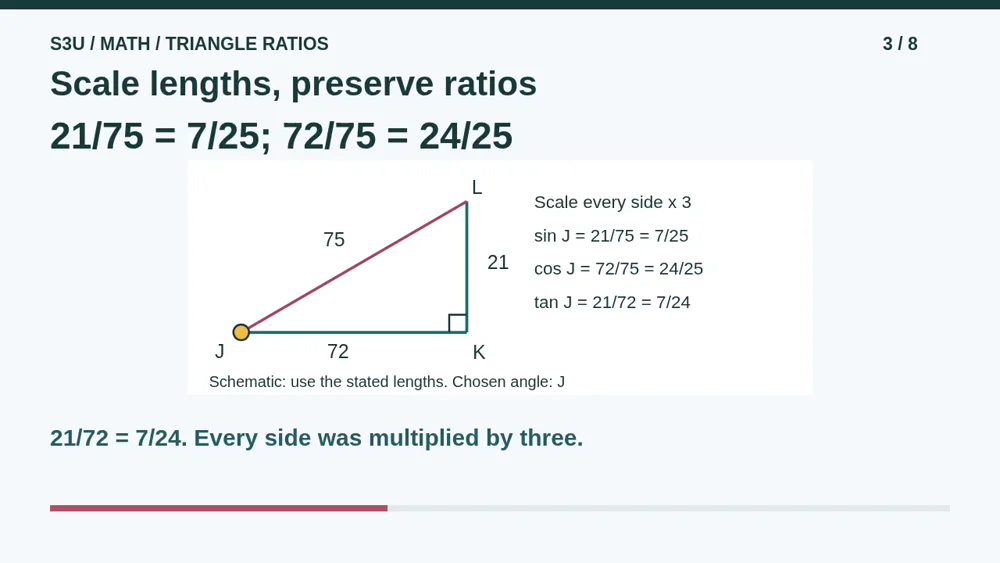
Make a similar triangle three times as large. Opposite becomes twenty one, adjacent becomes seventy two, and hypotenuse becomes seventy five. Each ratio has a factor of three in both numerator and denominator. Dividing both by three returns the original value. The triangle is larger, but the chosen corresponding angle and its ratios are unchanged. This only works when all corresponding lengths scale together, not when one leg gets an independent stretch.
4. Choose from the known sides
Video: 1:44
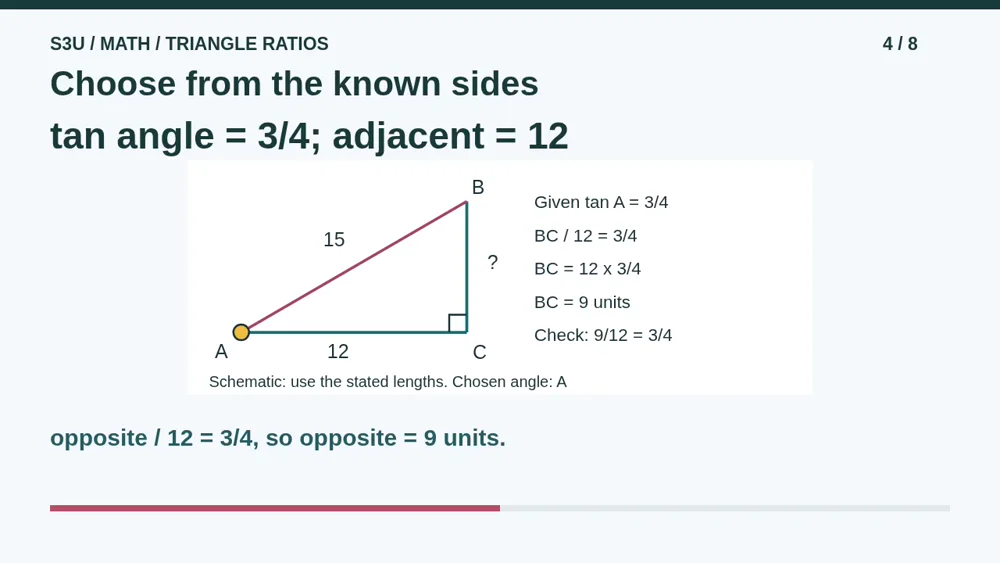
Suppose a different right triangle has an acute angle whose tangent is three fourths, and the adjacent leg is twelve units. We want the opposite leg. Tangent connects those two legs, so opposite divided by twelve equals three fourths. Multiply twelve by three fourths to get nine units. Check nine divided by twelve simplifies to three fourths. We were given the tangent value; we did not type an angle into a calculator or assume a special angle.
5. Pause: choose each fraction
Video: 2:18
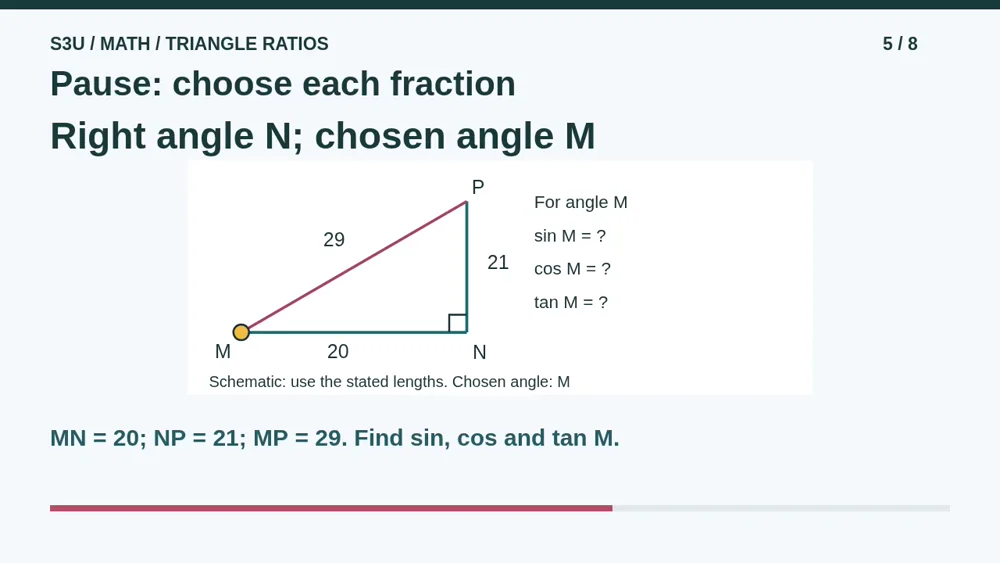
Pause and compare three ratios for a new triangle. M N P is right angled at N, and we choose angle M. M N is twenty units, N P is twenty one, and M P is twenty nine. Write sine M, cosine M and tangent M as fractions. Label each numerator and denominator by its side role before using the lengths. One of these ratios will be greater than one. Decide whether that alone makes it a mistake.
6. A tangent can be above one
Video: 2:51
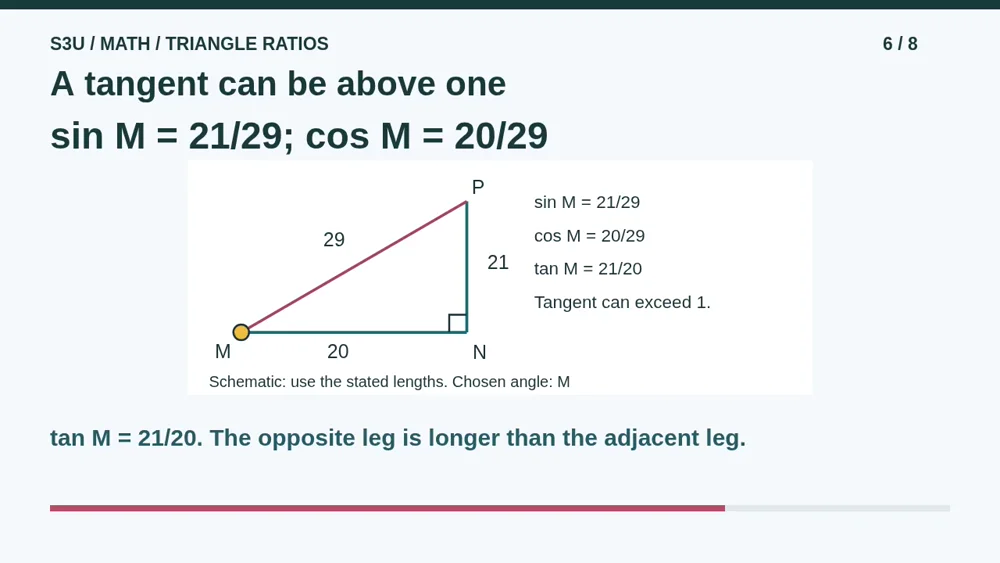
The hypotenuse M P is twenty nine. Relative to M, opposite N P is twenty one and adjacent M N is twenty. Sine M is twenty one over twenty nine. Cosine M is twenty over twenty nine. Tangent M is twenty one over twenty, which is greater than one. That is allowed: tangent compares the two legs. Sine and cosine for an acute angle are between zero and one because each leg is shorter than the hypotenuse.
7. The other acute angle connects
Video: 3:26
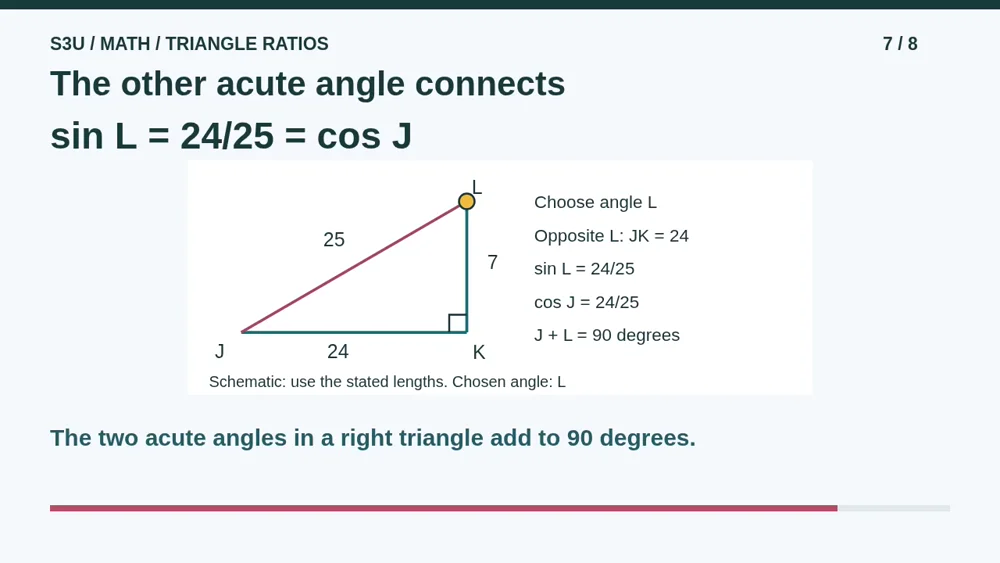
Fun fact: sine of one acute angle equals cosine of the other acute angle in the same right triangle. Return to J K L. Opposite L is J K, twenty four units, so sine L is twenty four over twenty five. That is also cosine J. The two acute angles add to ninety degrees; they are complementary. The equality comes from exchanging the roles of the same two legs, not from changing any side length.
8. Continue to ratio practice
Video: 3:59
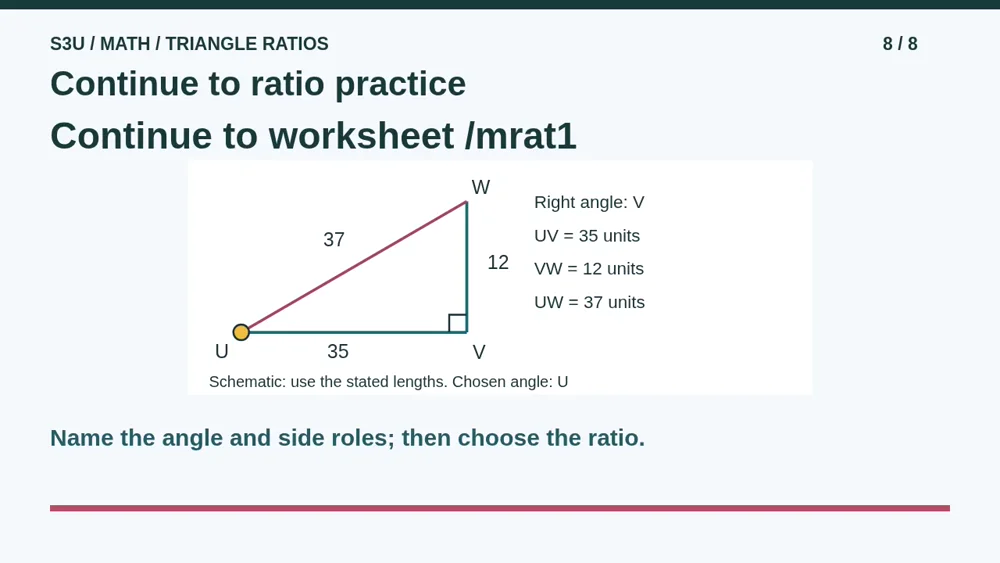
Continue to the worksheet below and its second practice sheet. Use the letters and lengths on those sheets, not the numbers from this video. Choose the ratio that includes the sides in the question, keep the fraction in the correct order, and explain one answer. Existing sine practice offers another focused review. These are right triangle models for acute angles. Other triangles and angles beyond a right angle need further ideas, not a stretched version of these diagrams.
Show your understanding
You can point, explain aloud, draw or write.
- Choose and evaluate sine, cosine and tangent from the correct side roles, including scaling and a tangent greater than one.
- Find a missing length from a given ratio and explain the complementary-angle sine/cosine connection without treating viewing as assessed mastery.
Try it yourself
Pause at MNP. Label the side roles for M, write all three ratios and explain why one exceeds one.
Continue to both ratio worksheets using their new letters and lengths. Name the side roles before calculating.
Next: your worksheet
Choose Sine, Cosine or Tangenthttps://s3u.com/mrat1
Lesson: https://s3u.com/lessons/choose-a-triangle-ratio