Math / Grade 4
Checkers: think one reply ahead
Learning goal: Compare legal moves, inspect the opponent's reply and plan around king promotion.
Before you start: Know ordinary steps, required jumps and how a man reaches the king row in English/American checkers.
Read or print this lesson What to practiceThe video could not load. The transcript is still available below.
Next: your worksheet
Checkers: Think One Turn Ahead
Checking sign-in...
Read the transcript
Saved reading place
Video transcript and practice. Reading or printing does not count as playback time or an assessed grade.
1. Legal is only the first question
Video: 0:00
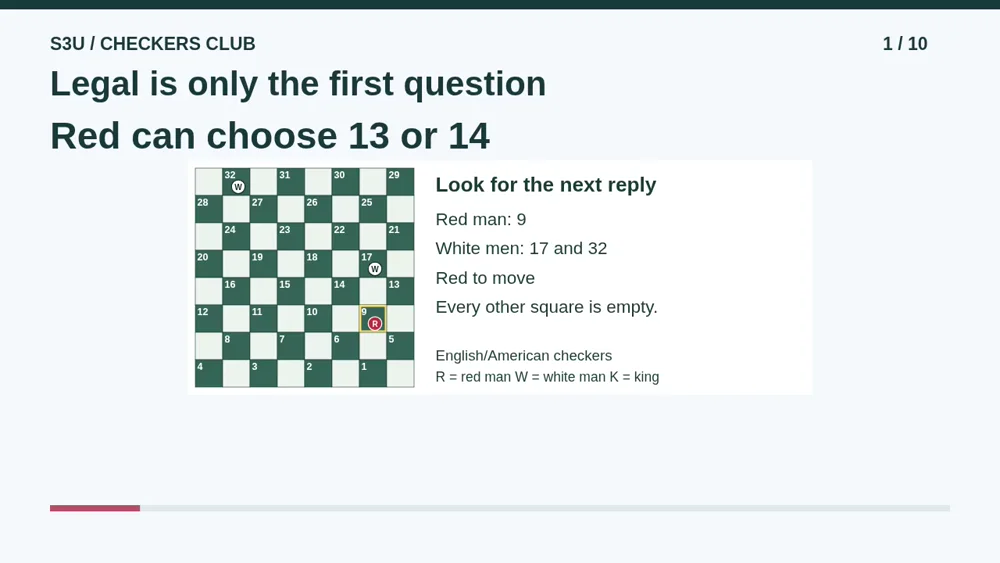
Red has a man on nine. White has men on seventeen and thirty two. All other squares are empty. Red can legally step to thirteen or fourteen. Before choosing, imagine the board after each move. Then ask what white can do. That extra question is the start of planning.
2. Try the risky choice in your mind
Video: 0:24
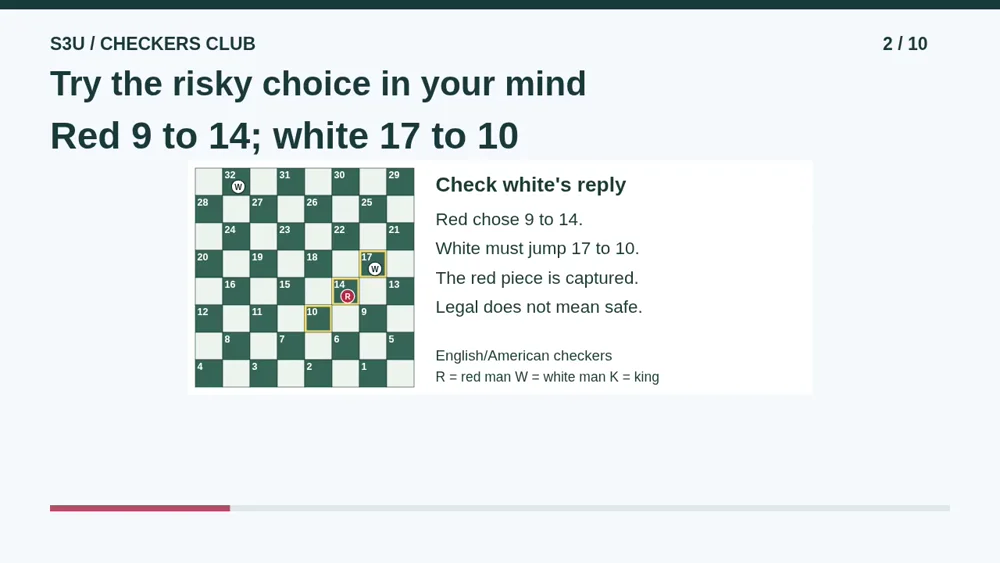
Imagine red moving to fourteen. White seventeen now has red next to it on a forward diagonal, with empty ten beyond. White must capture from seventeen to ten. Red made a legal move, but it put the piece where white could jump it. Legal did not mean safe.
3. Compare the other choice
Video: 0:45
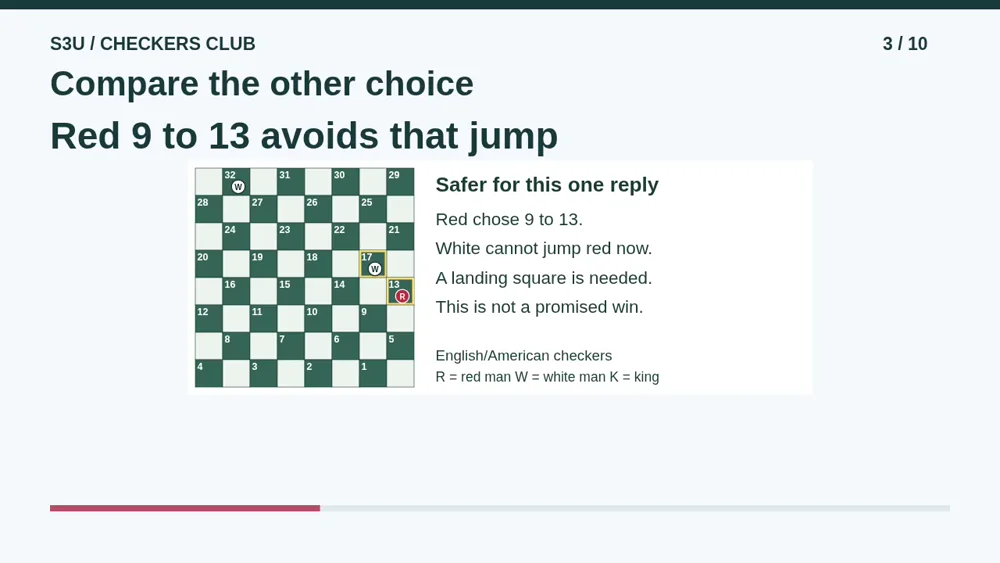
Now imagine red on thirteen instead. White seventeen is next to it, but the space beyond would be outside the board. No landing square means no jump. Thirteen avoids an immediate capture in this position. We have checked one reply, not proved that red will win the whole game.
4. Pause: a fresh comparison
Video: 1:07
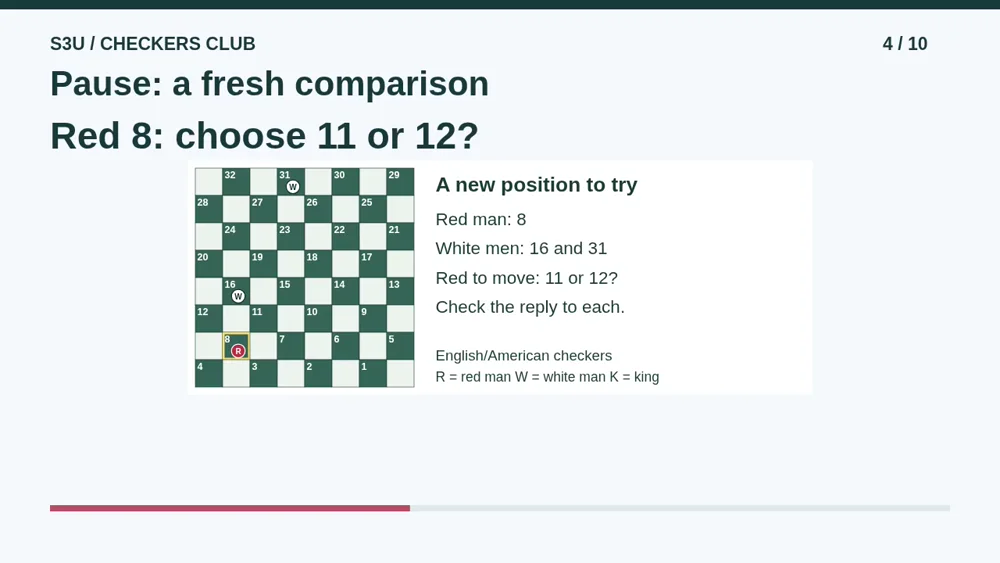
Try a new position. Red is on eight. White is on sixteen and thirty one. Every other square is empty. Red can step to eleven or twelve. Pause and imagine both moves. Which one lets white capture immediately? Which avoids a capture on that next reply? Check the landing beyond red.
5. Check your one-reply plan
Video: 1:33
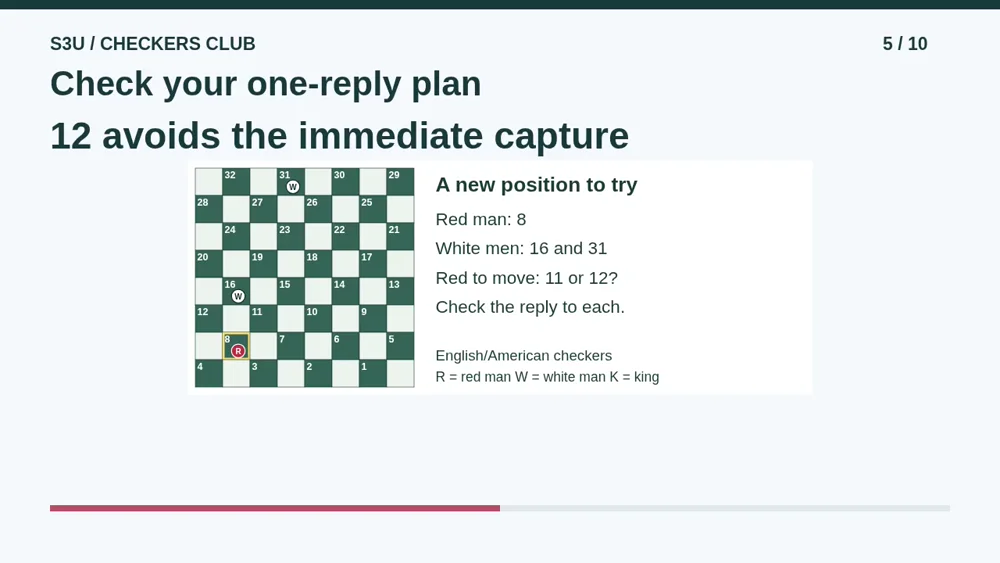
Moving red to eleven allows white sixteen to jump over it to seven. Moving red to twelve leaves no board square beyond red for that jump. Twelve is safer for this reply. Do not turn this example into a rule that edge squares are always safe. Different positions can give different answers.
6. A crown changes what comes next
Video: 1:57
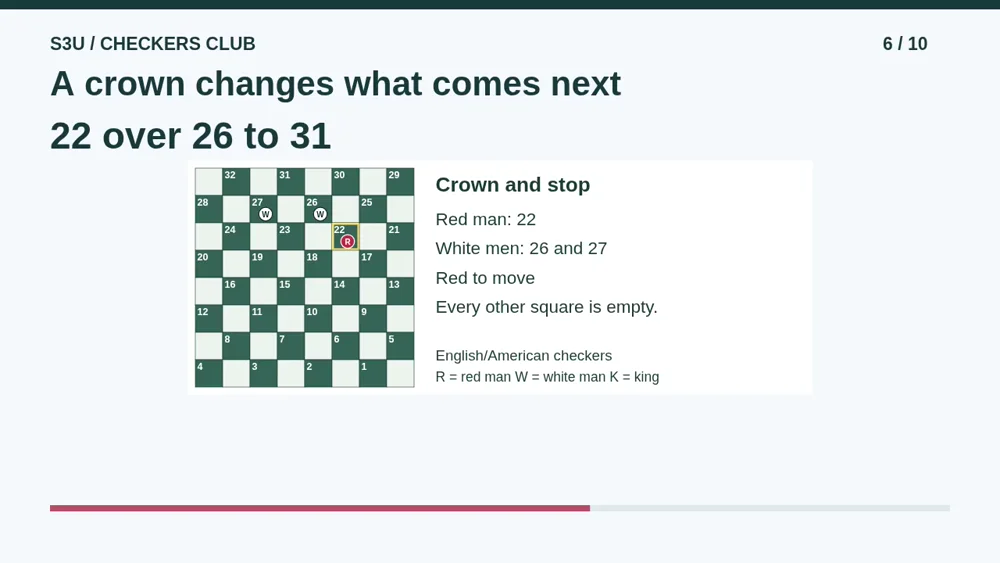
Here is a different planning problem. Red is a man on twenty two, with white on twenty six and twenty seven. Red must jump over twenty six to thirty one, the far king row. That landing promotes red to a king. The game marks kings with the letter K.
7. Crown and stop
Video: 2:18
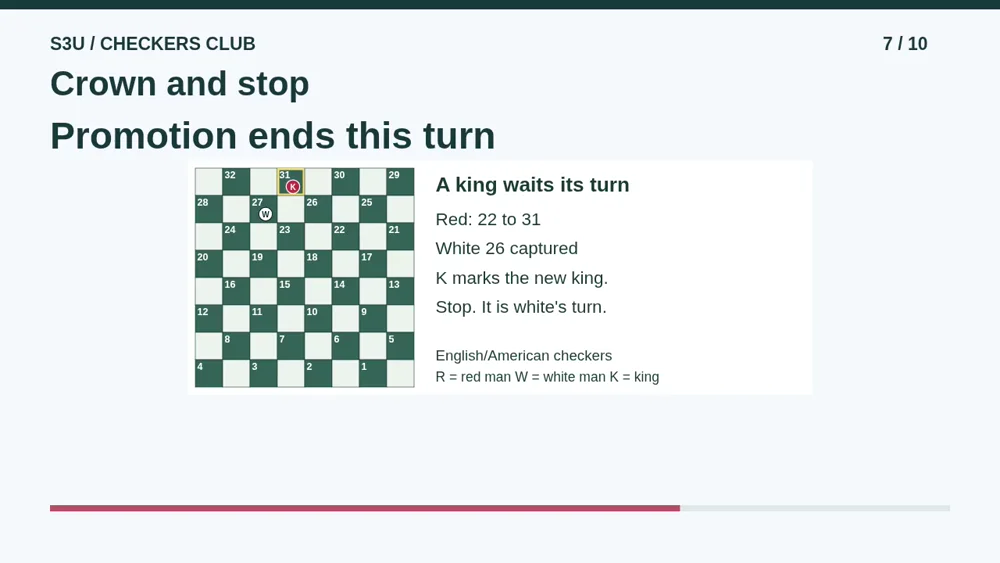
Stop at thirty one and give white a turn. A newly crowned king cannot immediately jump backward in the same turn. On a later turn, kings can step or jump diagonally backward as well as forward. A crown is useful, but it does not come with rocket boots or sideways moves.
8. Look at moves, not just totals
Video: 2:39
Counting pieces helps, but it is not the whole game. A player loses when they have no legal move on their turn, even if some pieces remain blocked on the board. In this practice game, repeated positions and a long sequence of quiet king moves can also produce a draw.
9. A useful limit to your proof
Video: 2:59
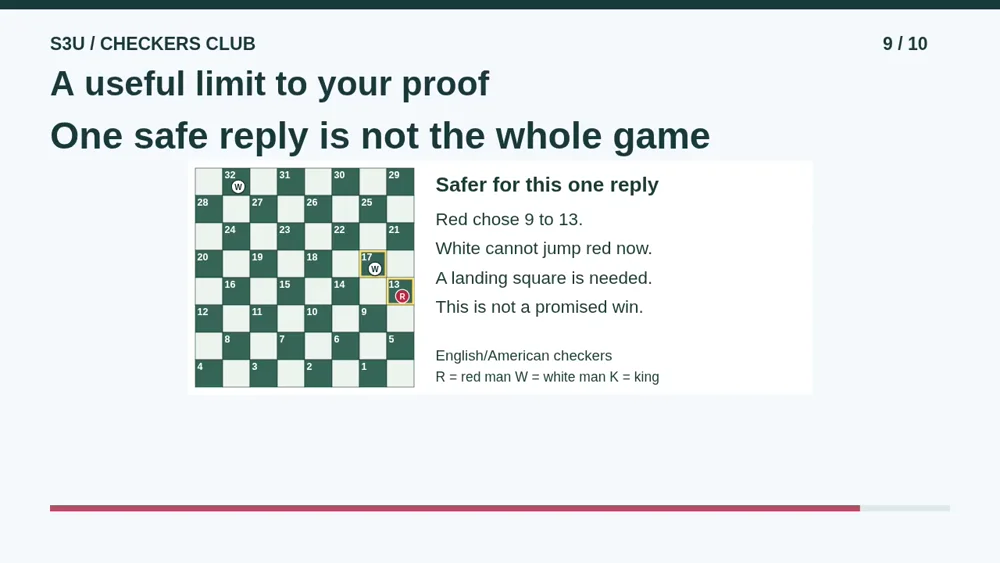
Fun fact: showing that a move avoids one immediate capture does not show what will happen after every later move. A good explanation can be useful without claiming too much. Say exactly what you checked: in this position, white has no capture on the next turn.
10. Make a plan you can explain
Video: 3:19
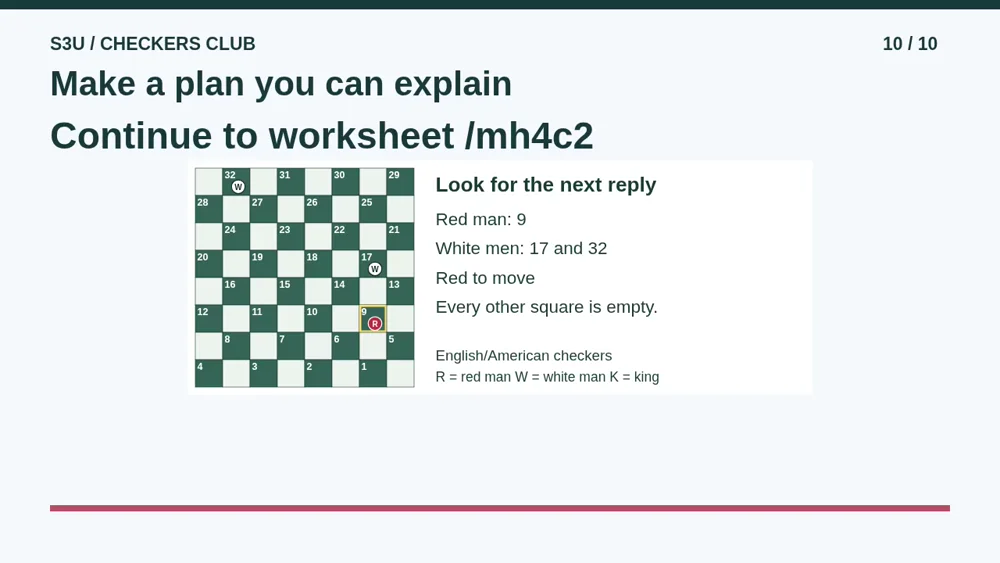
Continue to the worksheet below to compare two plans. Then try Kings: Crown and Stop. In Checkers Club, pause before your move and describe the opponent's possible reply. After the game, replay a turn and explain one choice you would keep or change. Thinking again is part of learning.
Show your understanding
You can point, explain aloud, draw or write.
- Compare legal moves by tracing an opposing capture that could follow.
- Explain how reaching the king row changes the piece and the available plan.
Try it yourself
Pause at the new position with red on 8 and white on 16 and 31. Compare white's reply after each legal red step.
Continue to the worksheet and the king-promotion exercise, then replay a turn in Checkers Club.
Next: your worksheet
Checkers: Think One Turn Aheadhttps://s3u.com/mh4c2
Lesson: https://s3u.com/lessons/checkers-plan-ahead