Science / Grade 6
Meet the cell team
Learning goal: Match five cell structures to their roles and correct a mixed-up model using function, not color.
Before you start: Recognize a cell as a living unit and read a labeled diagram. The model introduces the names; no microscope is needed.
Read or print this lesson What to practiceThe video could not load. The transcript is still available below.
Next: your worksheet
Match a Cell Structure to Its Main Stated Role - Practice 1
Checking sign-in...
Read the transcript
Saved reading place
Video transcript and practice. Reading or printing does not count as playback time or an assessed grade.
1. A tiny cell, several different jobs
Video: 0:00
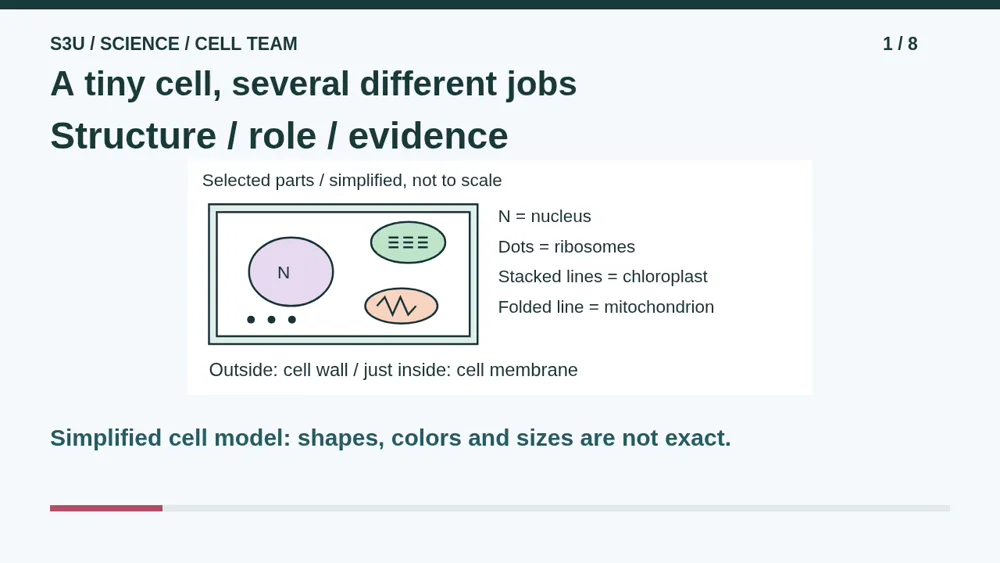
A cell is not an empty bag with one very busy button. Different structures help it do different jobs. We will use a simplified green leaf cell to connect five structures with their roles. The shapes and colors are labels, not a photograph. This example has a nucleus, so it is a eukaryotic cell. Not every kind of cell contains everything in our picture.
2. Start at the boundary
Video: 0:28
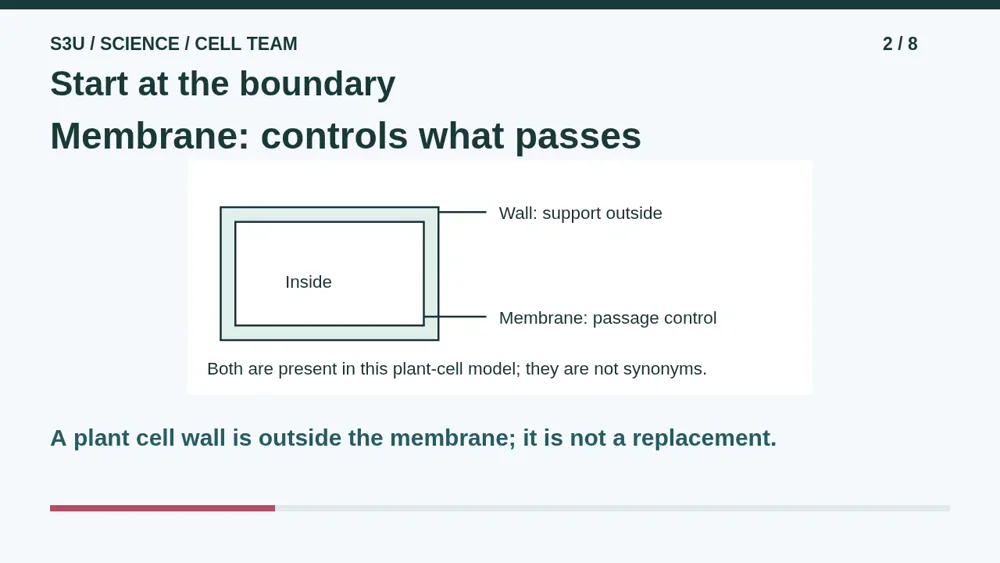
Trace the inner boundary marked membrane. It separates the inside from the surroundings and controls the passage of substances. The plant cell also has a wall outside that membrane, helping support it. The two structures are not interchangeable. If our clue says selective boundary, choose membrane. Think of a boundary with controlled passage, not a sealed lunch box that never lets anything through.
3. Instructions and assembly are different
Video: 0:58
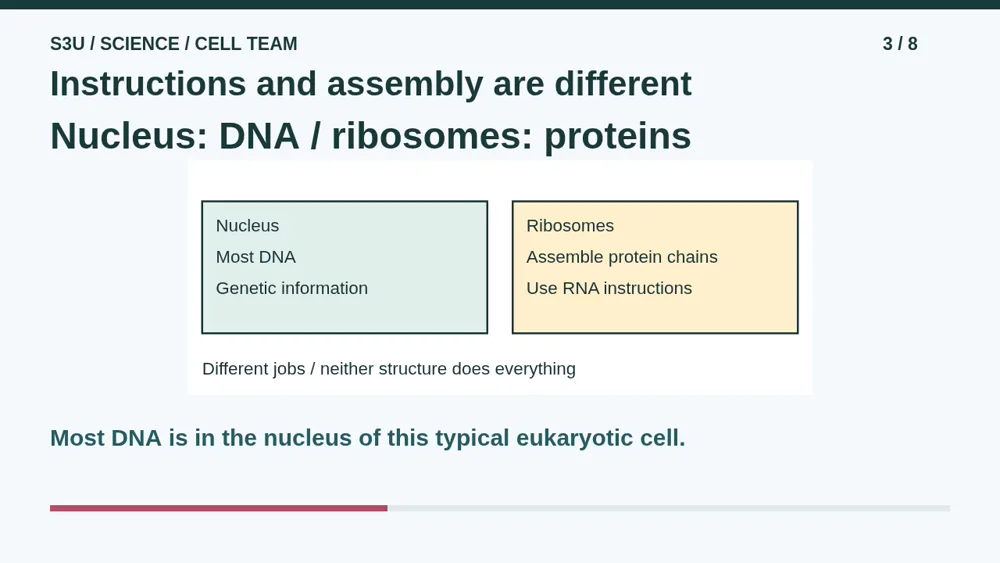
Now match two different jobs. The nucleus contains most of the cell's D N A, its genetic information. Ribosomes assemble proteins using instructions carried by R N A. In our picture, ribosomes are tiny labeled dots. A nucleus does not do all the assembly itself. If the clue is making a protein chain, point to ribosomes. If the clue is the compartment holding most D N A, point to the nucleus.
4. Two organelles, different energy roles
Video: 1:31
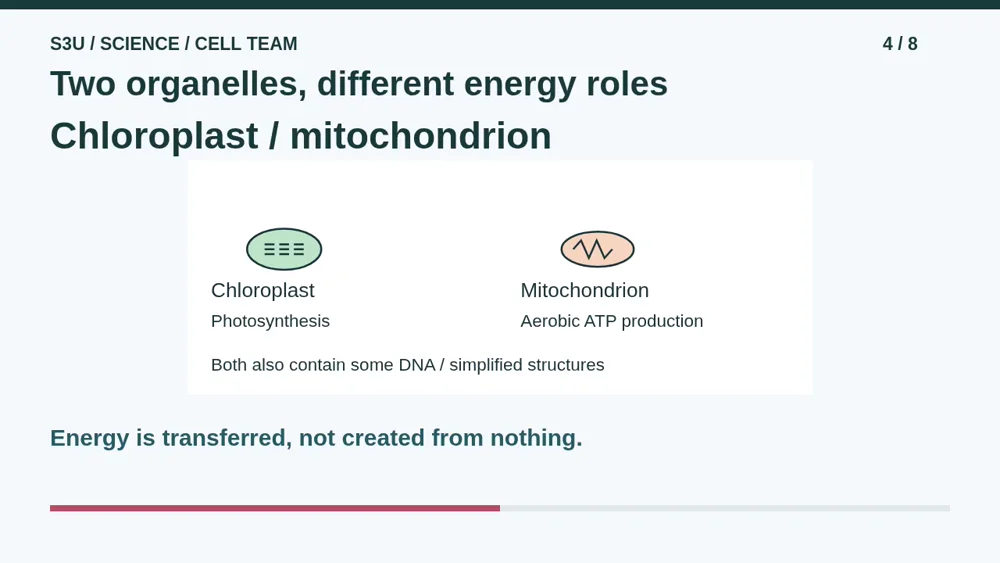
A chloroplast uses light in photosynthesis, helping this green leaf cell make sugars. A mitochondrion is a major site of aerobic energy transfer into A T P, a molecule cells use to power work. One is not a replacement for the other. This plant cell has both. Not all plant cells have chloroplasts, and not every cell has a nucleus. Read the stated example instead of applying one picture to everything alive.
5. Pause: repair the mixed-up labels
Video: 2:04
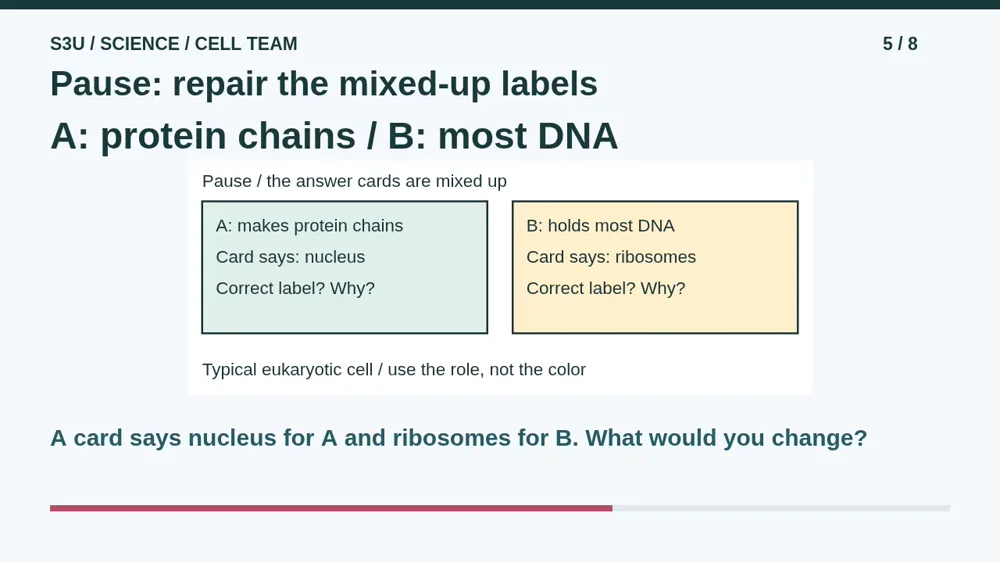
A museum helper has mixed up two labels on our model. Clue A says small structures assembling protein chains, but its answer card says nucleus. Clue B says compartment holding most D N A, but its card says ribosomes. Pause and correct both cards. Explain the job that supports each correction. Do not choose by color: the labels must still work on a black and white printout.
6. Use the job to check the label
Video: 2:34
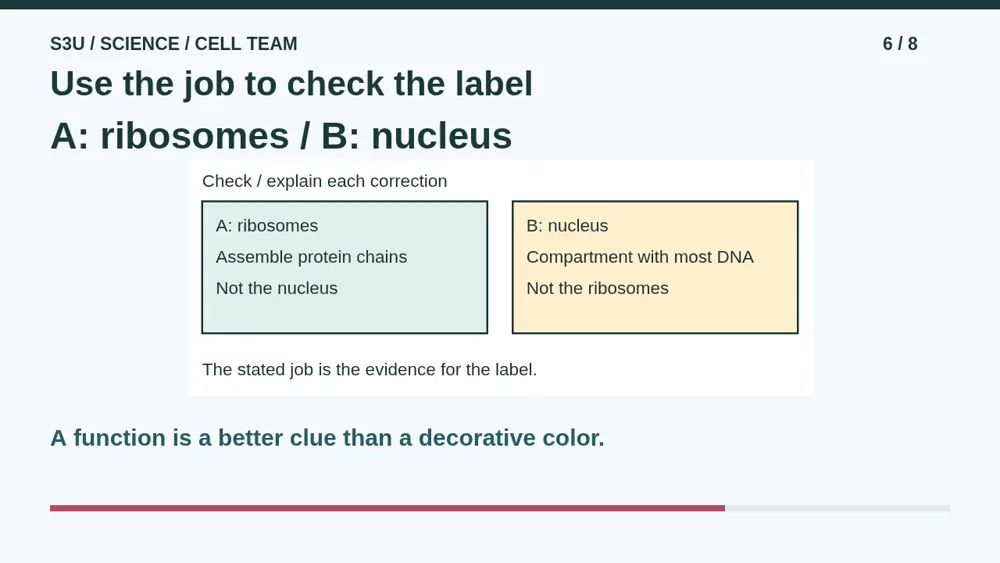
Clue A needs ribosomes because it describes protein assembly. Clue B needs nucleus because it describes the compartment holding most D N A in our typical eukaryotic cell. The cards were swapped. The helper can keep the colorful pens, but the jobs must decide the labels. Try another explanation aloud: why would cell membrane be a better answer than cell wall for the selective boundary?
7. The nucleus is not the only DNA address
Video: 3:05
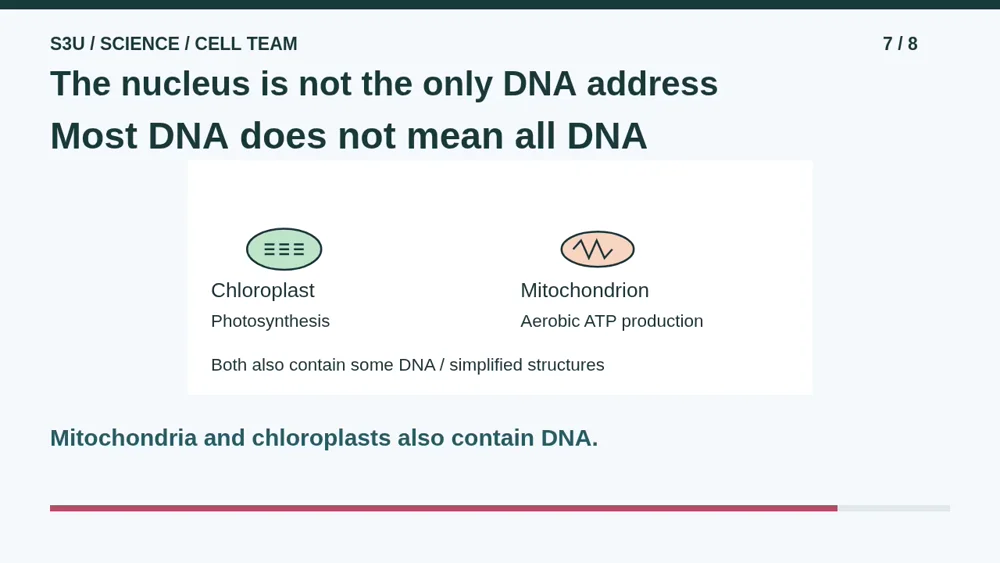
Fun fact: mitochondria and chloroplasts contain some D N A of their own. That is why our nucleus clue carefully says most, not all. Small words can carry important science. This does not mean either organelle can do every cell job alone. Our model shows selected parts of a much more complicated living system, with structures working together rather than competing for a single best-part trophy.
8. Continue to the cell worksheet
Video: 3:35
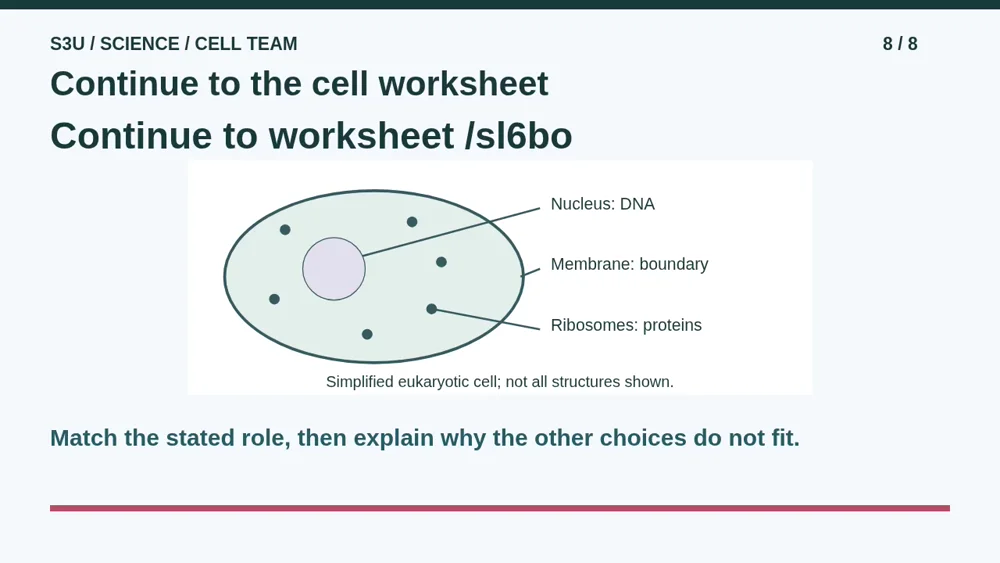
Continue to the worksheet below. Use the stated function to choose the matching structure, then explain your choice in a sentence. Practice Two asks about the same jobs in a different way. You can say the explanation or write it beside the printed question. No microscope, sample collection, or upload is needed. Next, explore how photosynthesis and respiration connect without being the same process.
Show your understanding
You can point, explain aloud, draw or write.
- Match membrane, nucleus, ribosomes, chloroplast and mitochondrion to the stated roles in a typical green leaf cell.
- Correct a mislabeled model using function and explain why a simplified picture does not represent every kind of cell.
Try it yourself
Pause at the mixed-up nucleus and ribosome labels. Correct each label and explain the role that supports your choice.
Continue to the worksheet and Practice Two. Say or write why each function fits; no samples, microscope or upload are needed.
Next: your worksheet
Match a Cell Structure to Its Main Stated Role - Practice 1https://s3u.com/sl6bo
Lesson: https://s3u.com/lessons/cell-team