Math / Grade 6
Cash is not the whole workshop
Learning goal: Track a contribution, borrowing and equipment purchase through assets, liabilities and equity in a simplified model.
Before you start: Add and subtract whole numbers and check two sides of an equation. Use only the supplied fictional transactions.
Read or print this lesson What to practiceThe video could not load. The transcript is still available below.
Next: your worksheet
Balance a Tiny Workshop's Books
Checking sign-in...
Read the transcript
Saved reading place
Video transcript and practice. Reading or printing does not count as playback time or an assessed grade.
1. Three parts of a balance
Video: 0:00
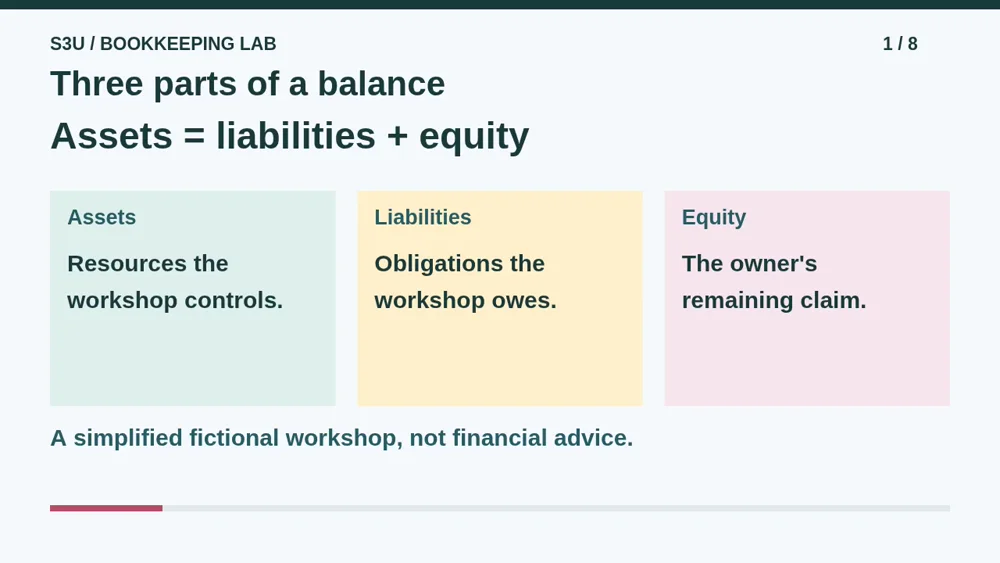
A tiny fictional workshop needs more than a cash count to describe its position. Assets are resources it controls. Liabilities are obligations it owes. Equity is the owner's remaining claim. We will use a simplified model with no interest, taxes, fees, sales or depreciation. It is practice, not financial advice.
2. The owner contributes cash
Video: 0:27
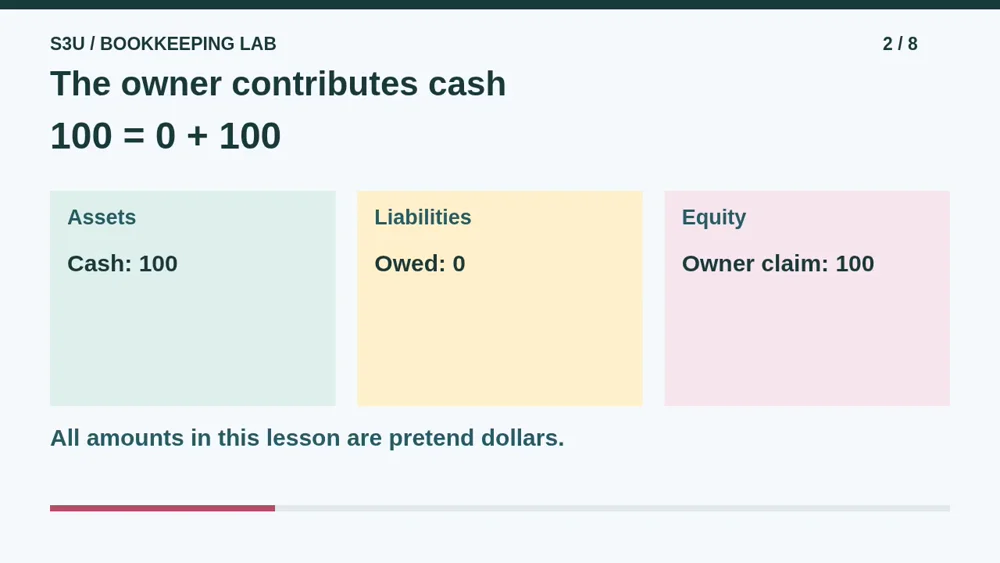
Start with no balances. The owner contributes one hundred dollars in cash. The workshop now has one hundred dollars of assets, no liabilities and one hundred dollars of equity. The two sides agree: one hundred equals zero plus one hundred. An owner contribution is not a sale to a customer.
3. Borrowing adds an obligation
Video: 0:51
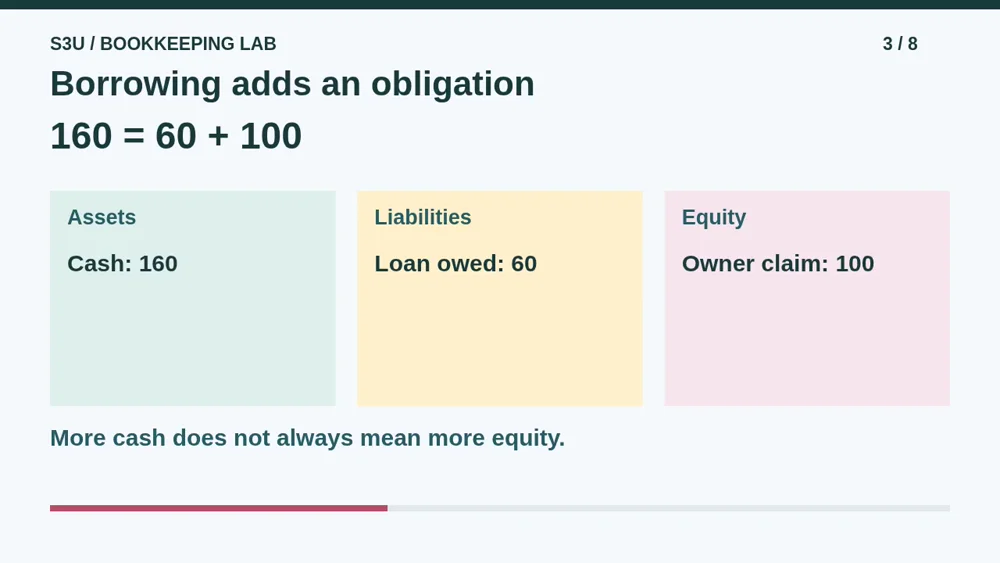
Next, the workshop borrows sixty dollars. Cash rises to one hundred sixty, but it also owes sixty. Equity is still one hundred. Borrowing is not earned revenue: it brings an obligation to repay. Counting only the extra cash would miss half of this transaction.
4. Cash can become equipment
Video: 1:13
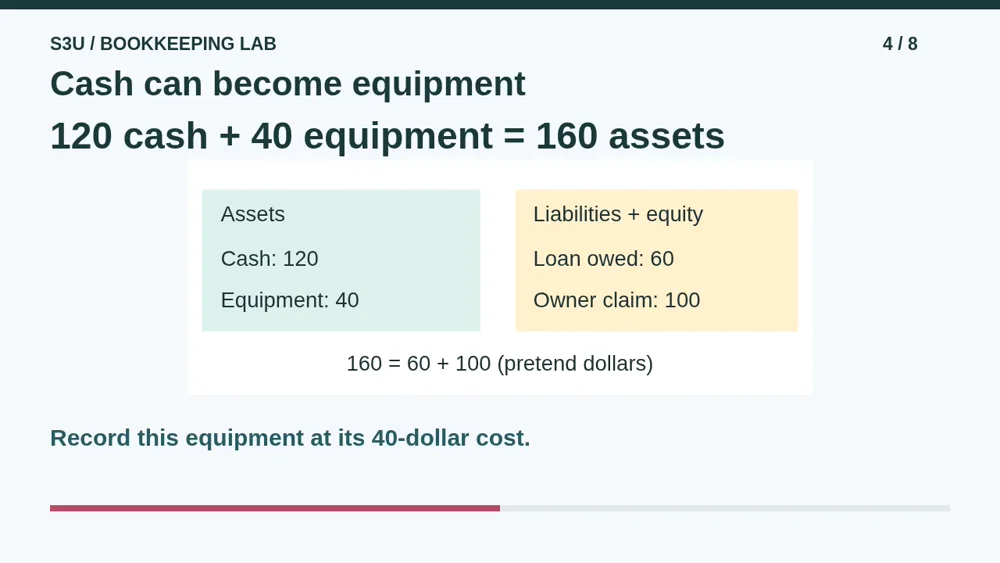
Now the workshop buys equipment for forty dollars cash. Cash falls to one hundred twenty, but equipment worth forty in our records joins the assets. Total assets are still one hundred sixty. Liabilities remain sixty and equity remains one hundred. We exchanged one kind of asset for another.
5. Pause: balance a new workshop
Video: 1:37
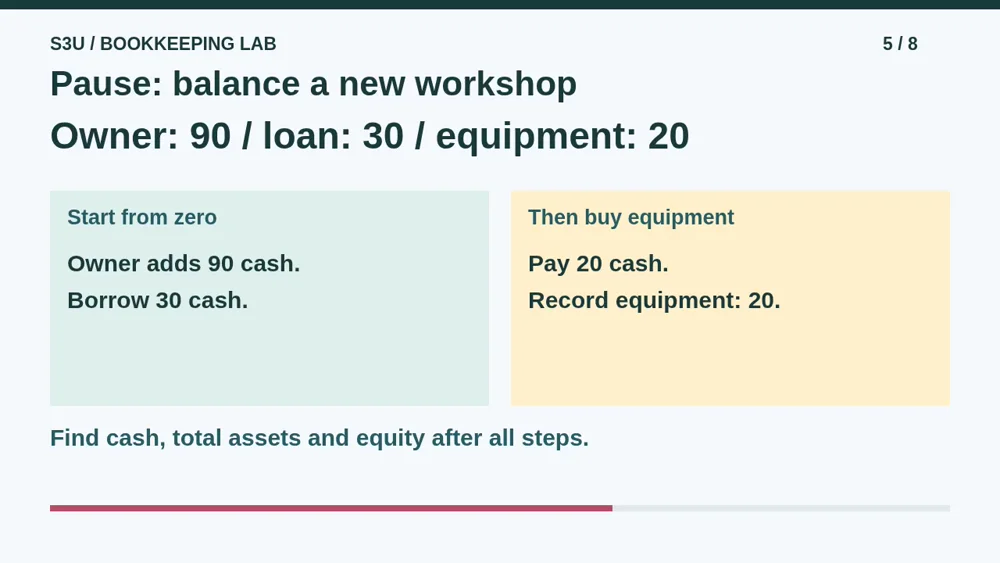
Try a fresh workshop starting from zero. Its owner adds ninety dollars, it borrows thirty, and then it buys equipment for twenty dollars cash. Record that equipment as a twenty-dollar asset. Pause and find the final cash, total assets and equity. Keep the loan obligation in your calculation.
6. Check both sides
Video: 2:01
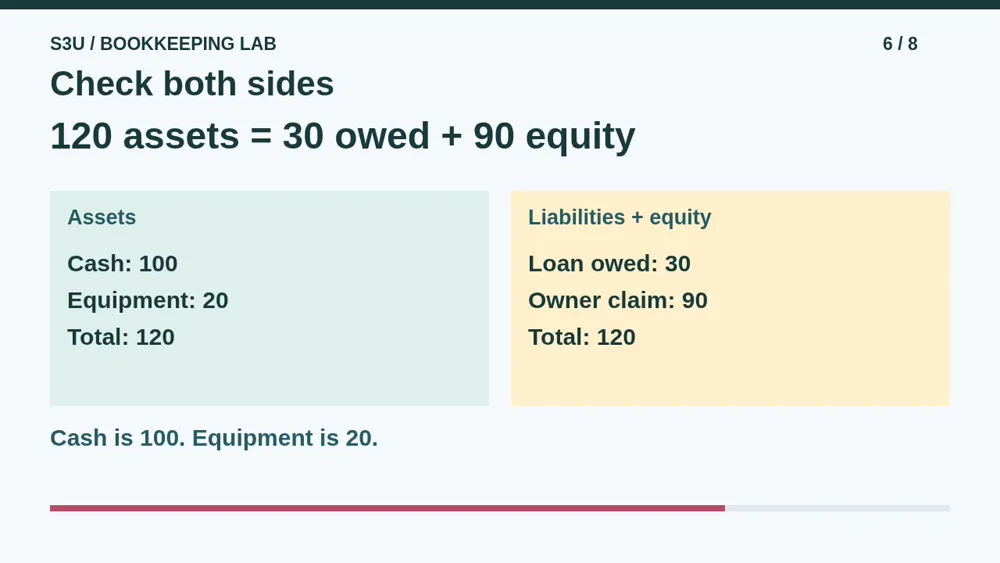
Cash is ninety plus thirty minus twenty, which is one hundred. Add the twenty-dollar equipment asset to get total assets of one hundred twenty. Subtract the thirty owed to get equity of ninety. Both sides match. Notice that cash and equity are different numbers, even though both are measured in dollars.
7. The cash count is not the whole story
Video: 2:25
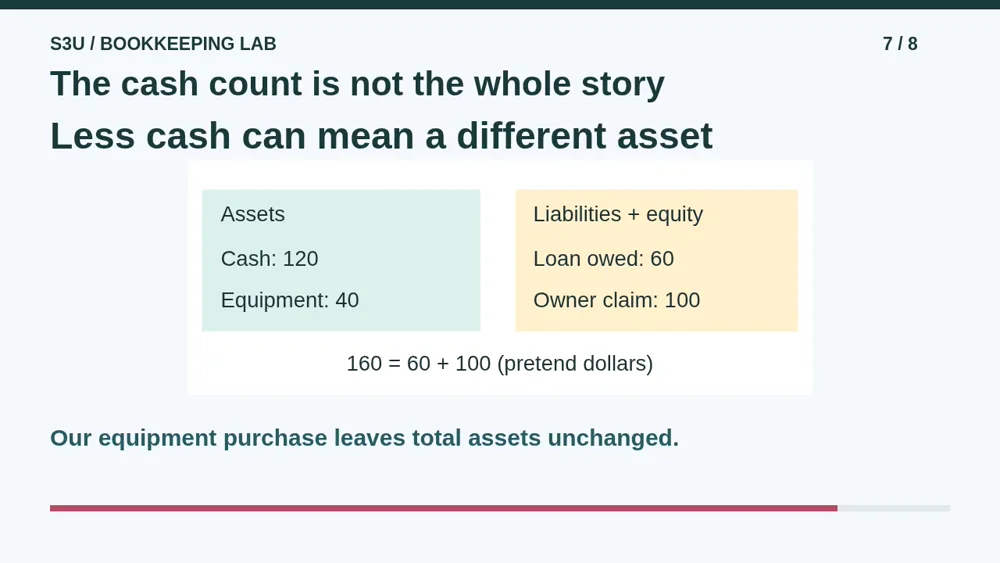
Fun fact: in our workshop model, buying equipment reduces cash without reducing total assets. The equipment replaces some cash in the asset total. A cash box cannot describe the whole workshop by itself, however loudly it rattles. This model records equipment at cost and leaves later depreciation out.
8. Continue to the workshop worksheet
Video: 2:49
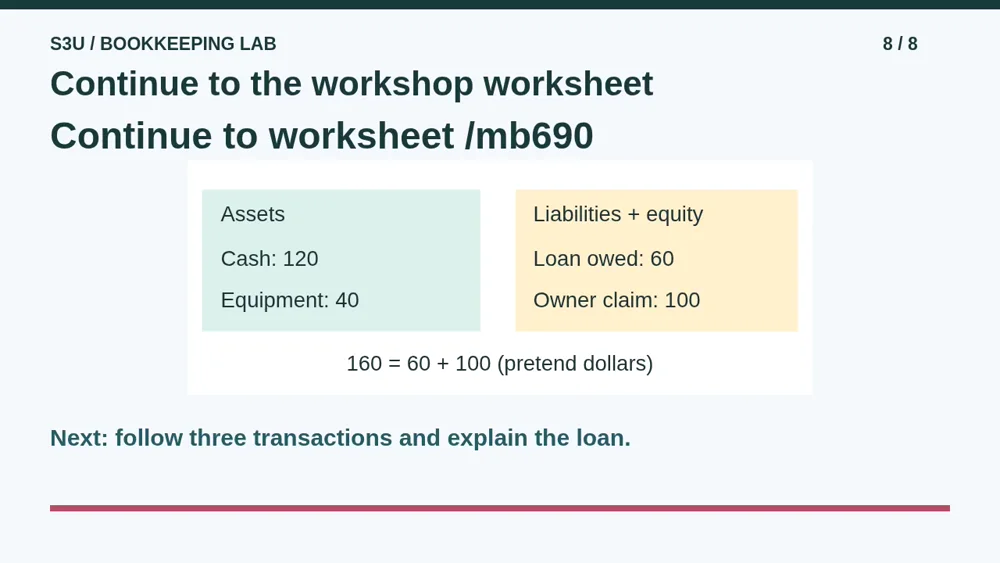
Continue to the worksheet below for a different workshop. Follow its stated contribution, loan and equipment purchase in order. Calculate cash separately from total assets, then check assets equal liabilities plus equity. Explain why the loan is not revenue. No real accounts, borrowing or personal financial details are needed.
Show your understanding
You can point, explain aloud, draw or write.
- Track cash and equipment separately while checking assets equal liabilities plus equity.
- Explain why borrowing adds a repayment obligation rather than earned revenue in the simplified model.
Try it yourself
Pause at the new workshop: owner contributes 90, borrowing adds 30, equipment costs 20. Find cash, total assets and equity separately.
Continue to the worksheet. Explain the repayment obligation and keep this fictional bookkeeping model separate from real financial advice.
Next: your worksheet
Balance a Tiny Workshop's Bookshttps://s3u.com/mb690
Lesson: https://s3u.com/lessons/cash-is-not-everything