History / Grade 6
Ask who made the source
Learning goal: Investigate creator, date, audience and purpose without treating one account as every person's experience.
Before you start: Identify a writer and reader in a short passage. All records are invented; no private documents are needed.
Read or print this lesson What to practiceThe video could not load. The transcript is still available below.
Next: your worksheet
Ask Who Made a Historical Source - Practice 1
Checking sign-in...
Read the transcript
Saved reading place
Video transcript and practice. Reading or printing does not count as playback time or an assessed grade.
1. A record has a point of view
Video: 0:00
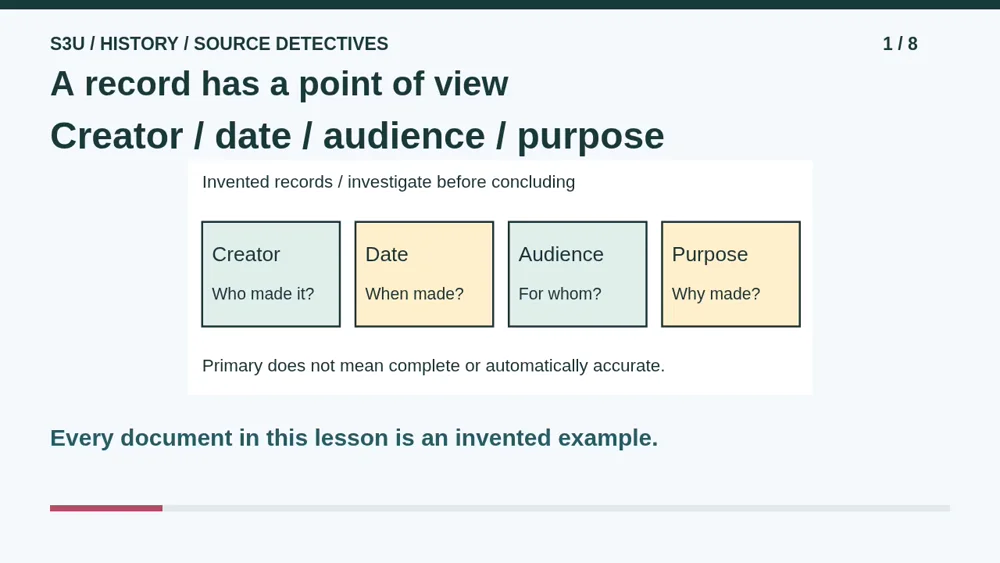
Imagine a box of records from a pretend clock shop. Before using a record, ask who made it, when, for whom, and for what purpose. A primary source comes from the time or experience being studied, but primary does not mean perfect. Our documents are invented teaching examples, not real archival quotations. We will practice asking useful questions without pretending to discover an actual town.
2. An advertisement is a clue
Video: 0:30
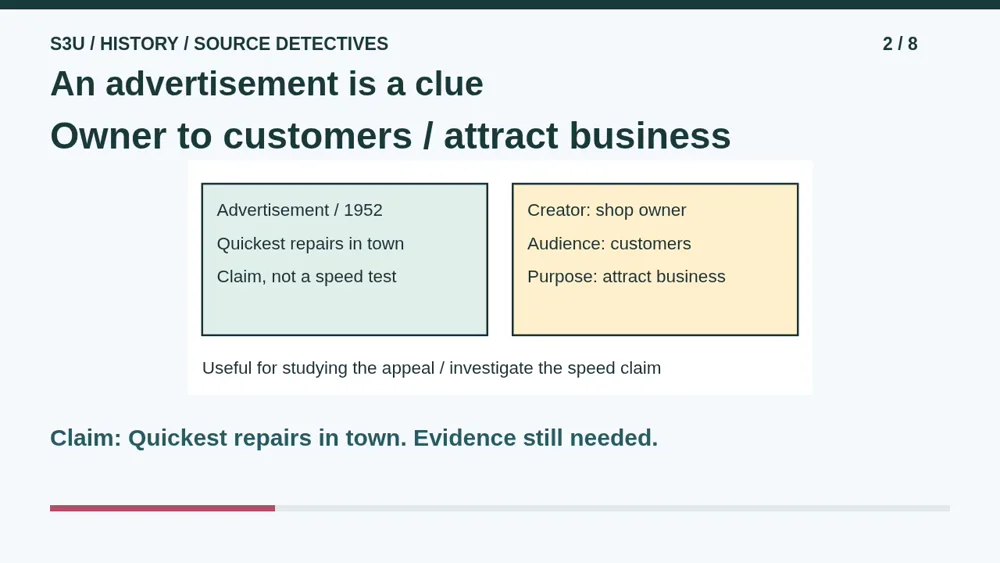
Our first record is an advertisement made by the shop owner in nineteen fifty-two. It tells potential customers, quickest repairs in town. That is useful evidence about how the owner wanted to present the shop. It does not, by itself, prove that every repair was faster than every competitor. Large letters are very good at being large. They are not a stopwatch.
3. A diary answers a different question
Video: 0:59
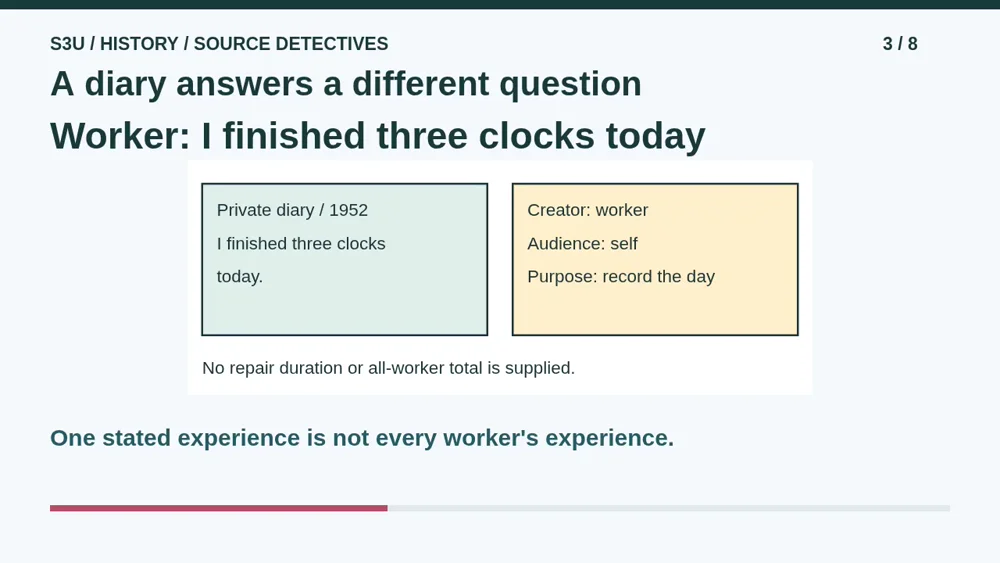
A worker writes in a private diary from the same year: I finished three clocks today. Its stated audience is the writer, and its purpose is to record that day. It may help us investigate the worker's experience. It does not tell us how long those repairs took, what all workers finished, or whether the advertisement was accurate. Private writing can contain errors too.
4. Ask what would help you check
Video: 1:27
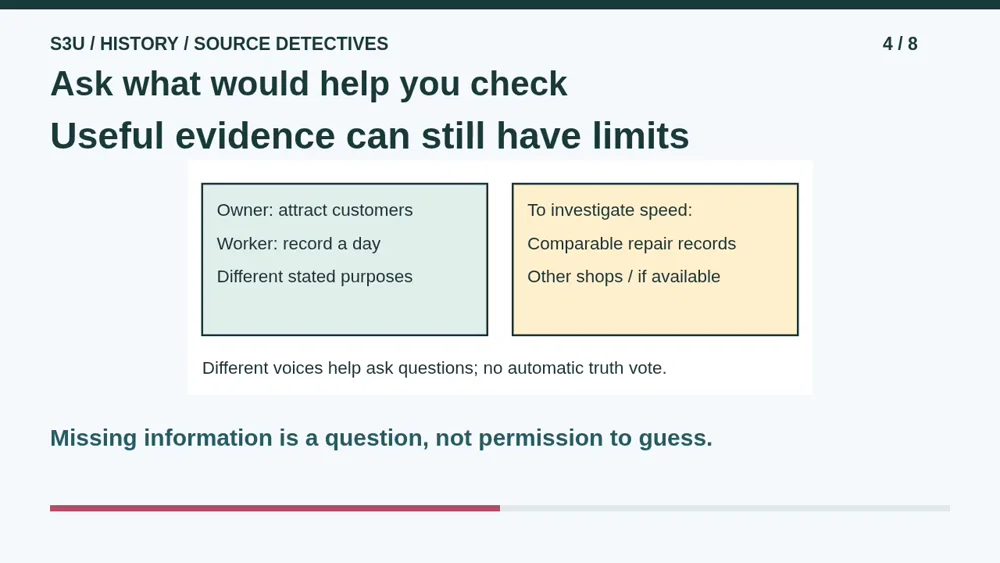
Neither record is automatically useless, and neither settles every question. To investigate repair speed, we could look for dated repair records from comparable jobs and other shops, if they survive. To investigate daily work, we might compare accounts by different workers. Check when and why each record was made. Do not turn one voice into a vote from everyone, or fill a missing detail with a confident guess.
5. Pause: a traveler writes home
Video: 1:58
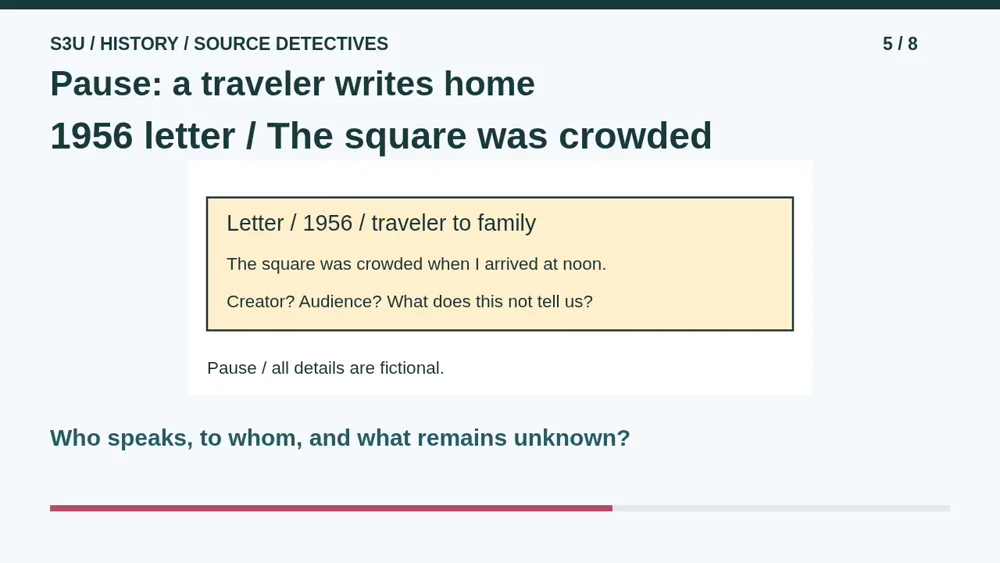
Here is a fresh invented source. A traveler writes to their family in nineteen fifty-six: the square was crowded when I arrived at noon. Pause and identify the creator, intended audience, and the stated experience. Does this tell us what every resident thought? Does it count everyone who visited during the whole day? Name one additional question before continuing.
6. Keep the claim inside the record
Video: 2:26
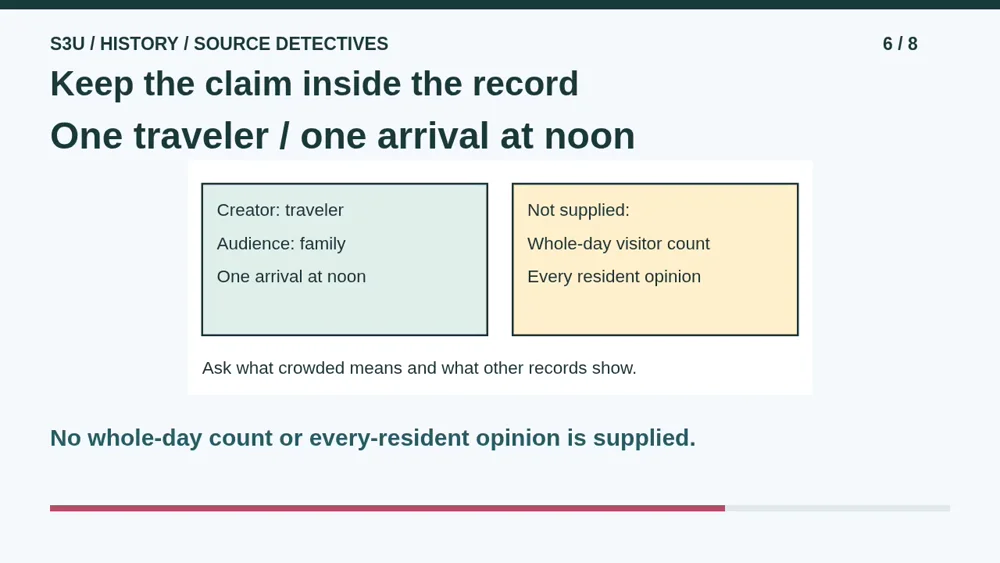
The traveler is the creator, and their family is the intended audience. The letter describes the traveler's impression on arriving at noon. It does not supply a full-day visitor count or every resident's opinion. We could ask what crowded meant to this writer, why they wrote, or what other records show. A useful answer names both what the source supports and what it leaves unanswered.
7. The source tells two kinds of stories
Video: 2:54
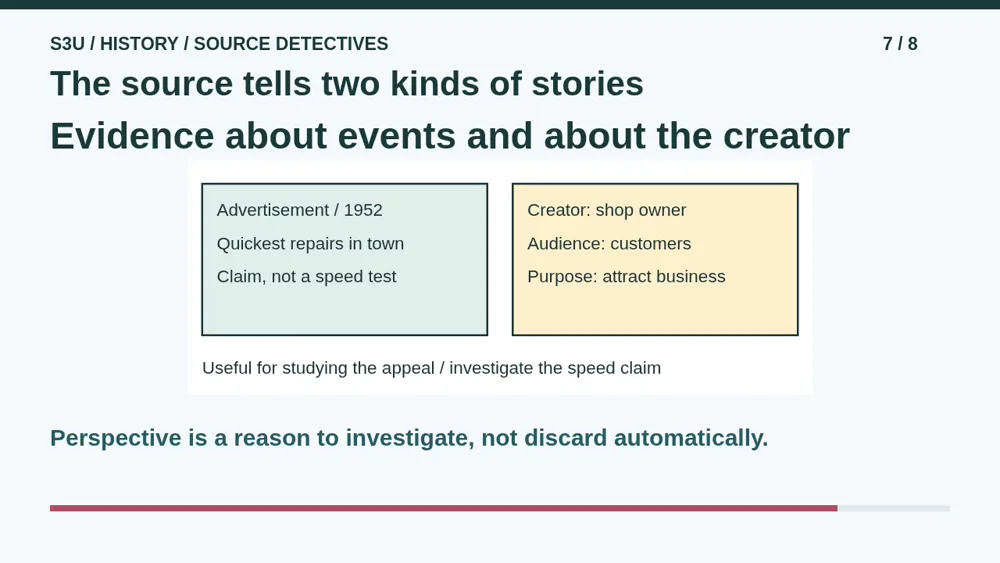
Fun fact: a source can be evidence about its creator as well as the event it describes. Even before checking the clock shop's speed claim, the advertisement tells us how its owner chose to appeal to customers. Recognizing that purpose helps us ask a sharper question. It does not mean every advertisement is false or every diary is true. Evaluate the particular claim and its evidence.
8. Continue the source investigation
Video: 3:24
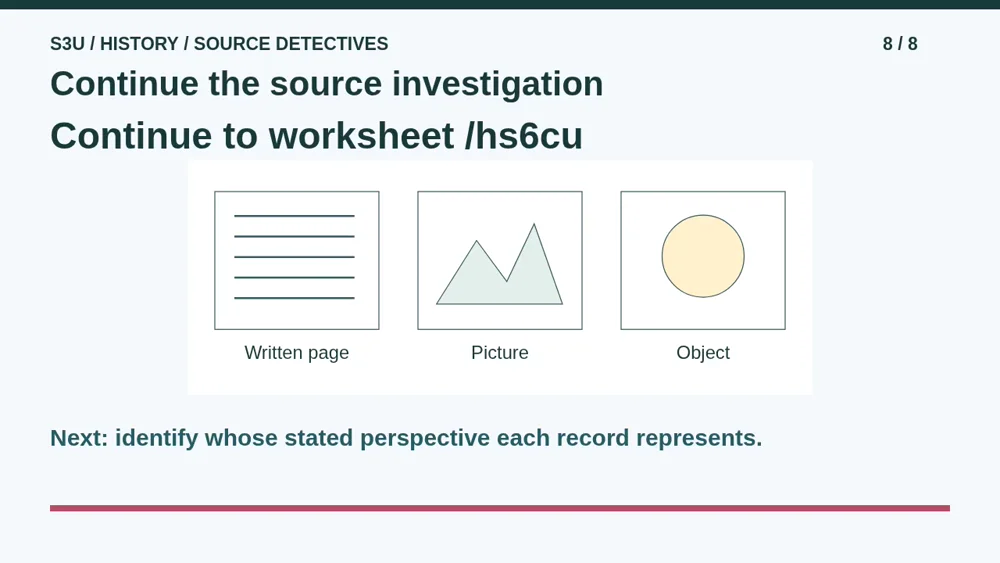
Continue to the worksheet below. For each invented record, identify whose stated perspective it directly represents. Then explain why that person does not automatically speak for everyone else. Practice Two offers different record types. You can discuss the answers or write them. Use these provided examples; do not publish private letters, personal diaries, or information about a real person for this activity.
Show your understanding
You can point, explain aloud, draw or write.
- Identify a record's stated creator, date, intended audience and purpose.
- Explain one supported claim and one unanswered question without treating the creator as every person's voice.
Try it yourself
Pause at the traveler's letter. Name the creator and audience, then identify a claim the letter does not establish.
Continue to the worksheet and Practice Two. Compare whose perspective is stated without assuming that source type guarantees truth. Use the fictional examples only.
Next: your worksheet
Ask Who Made a Historical Source - Practice 1https://s3u.com/hs6cu
Lesson: https://s3u.com/lessons/ask-who-made-the-source