Math / Grade 5
Add fractions with common-sized parts
Learning goal: Rename halves, thirds, fourths and sixths into shared units before adding, then explain sums greater than one and equivalent results.
Before you start: Name fractions of matching wholes, use multiplication facts through twelve and recognize equivalent fractions.
Read or print this lesson What to practiceThe video could not load. The transcript is still available below.
Next: your worksheet
Add Fractions with Unlike Denominators
Checking sign-in...
Read the transcript
Saved reading place
Video transcript and practice. Reading or printing does not count as playback time or an assessed grade.
1. Different pieces need a shared unit
Video: 0:00
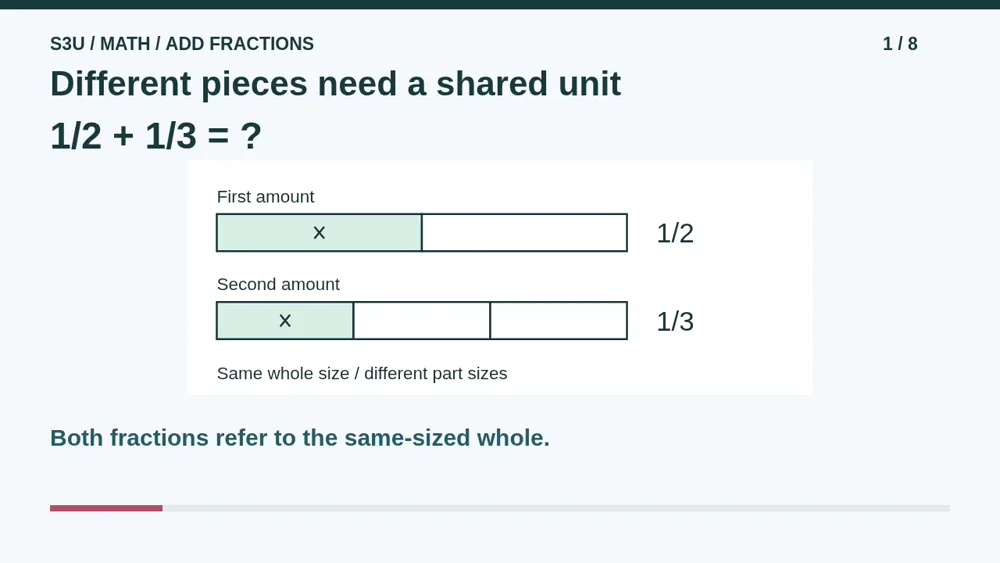
Our paper ribbon design uses one half of a strip and another one third. Both measurements use the same-sized whole strip. How much ribbon is that altogether? Halves and thirds are different-sized pieces. We need one shared piece size before counting them together. Adding the top numbers and bottom numbers separately would not solve that problem.
2. Rename without changing the amount
Video: 0:27
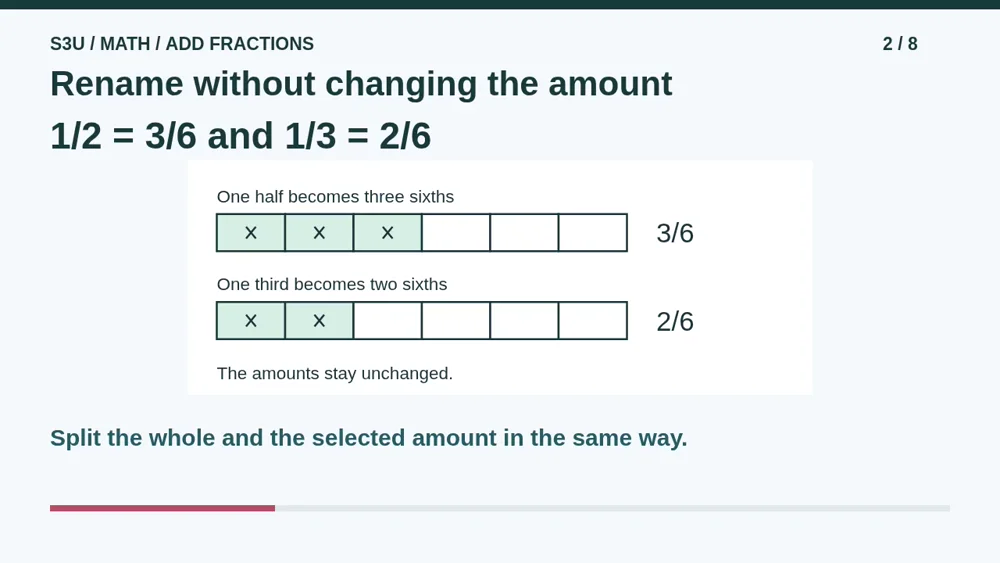
Sixths fit both fractions. Split each half into three equal pieces. The whole now has six pieces, and the selected half has three: three sixths. Split each third into two equal pieces. The whole has six pieces, and the selected third has two: two sixths. We changed the names, not the amounts. Our ribbon did not get longer during the paperwork.
3. Count the common-sized parts
Video: 0:55
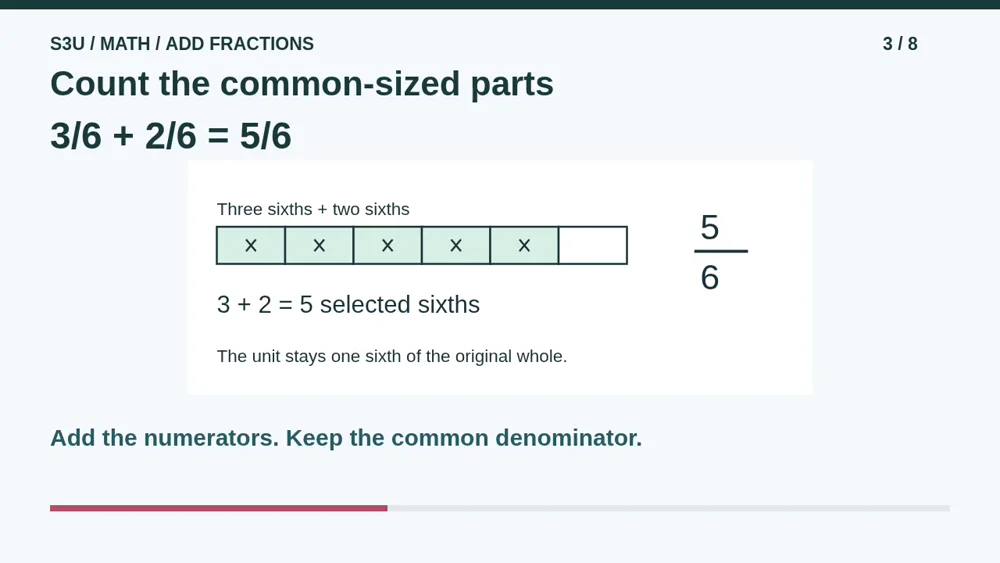
Now the parts have the same size. Three sixths plus two sixths is five sixths. We add three and two because those numbers count selected sixths. The denominator stays six: the unit is still one sixth of our original whole. It does not become twelfths just because we used two fractions. Five sixths is less than one whole and greater than either starting fraction.
4. Sometimes the sum passes one
Video: 1:24
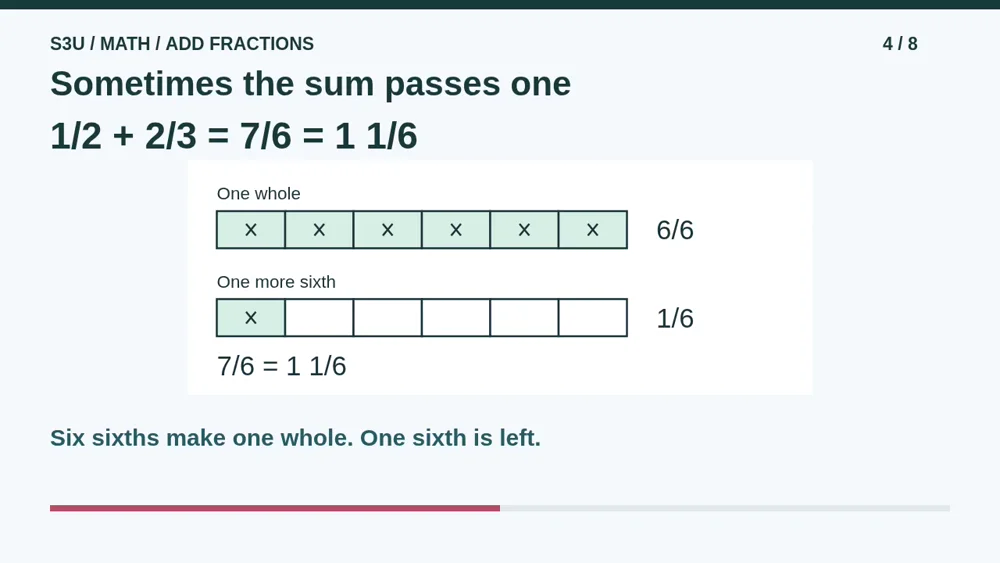
What if the second amount is two thirds? One half is still three sixths. Two thirds is four sixths. Together they make seven sixths. Six of those sixths make one whole, with one sixth left. We can write the amount as seven sixths or one and one sixth. A fraction can be greater than one; it does not have to stay inside a single strip.
5. Pause: a new ribbon combination
Video: 1:51
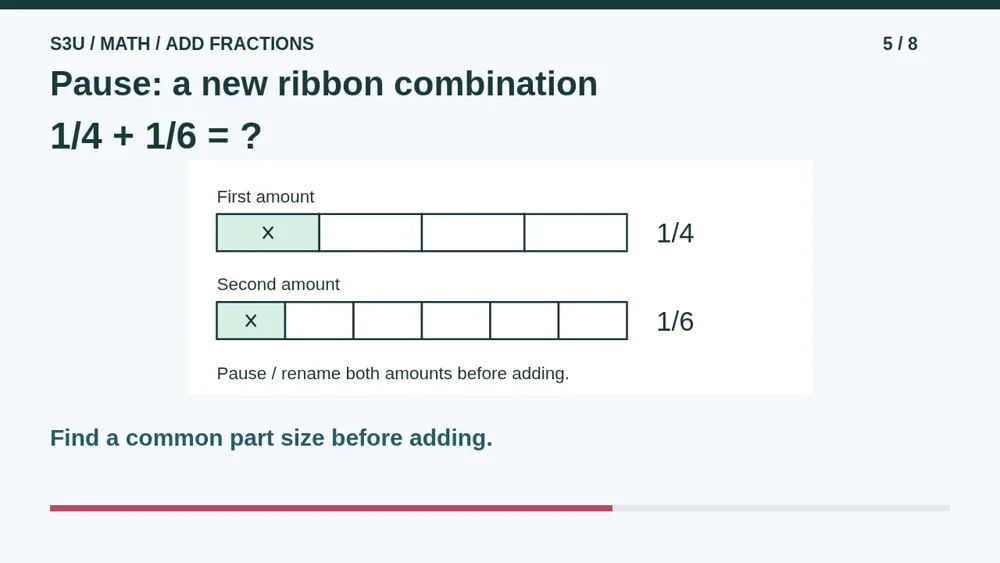
Here is a different combination: one fourth plus one sixth of the same-sized whole. Pause the video. Find a number of equal parts that works for both fourths and sixths. Rename each fraction, then add. Explain why the bottom number stays the same during that last step. A drawing, spoken explanation, or written calculation can show your thinking.
6. Check with twelfths
Video: 2:19
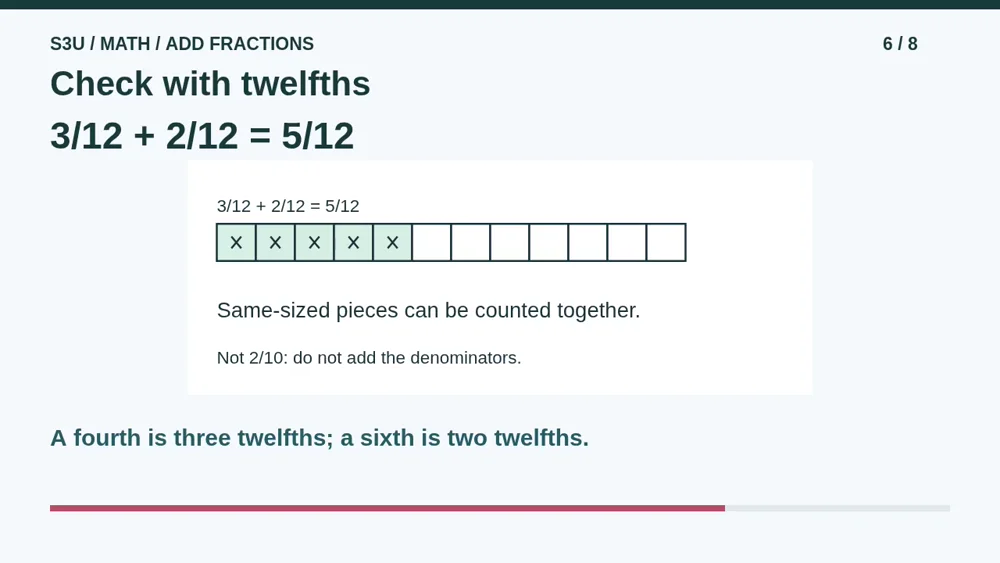
Twelfths work. One fourth becomes three twelfths, and one sixth becomes two twelfths. Three plus two gives five, so the sum is five twelfths. Notice that one fourth plus one sixth is not two tenths. Simply adding four and six changes the size of the pieces instead of renaming them into a shared unit. Our answer counts five equal twelfths.
7. Different routes, same amount
Video: 2:46
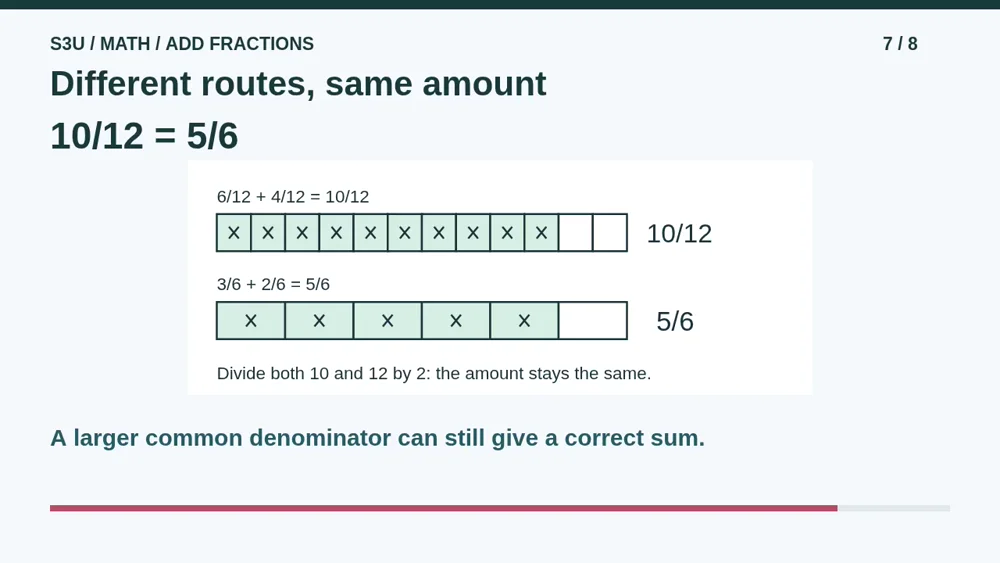
Fun fact: a common denominator does not have to be the smallest possible one. For our first sum, one half plus one third, twelfths also work. Six twelfths plus four twelfths makes ten twelfths. That simplifies to five sixths by dividing both numbers by two. Using sixths first was shorter, but either careful route gives the same amount.
8. Continue to the worksheet
Video: 3:13
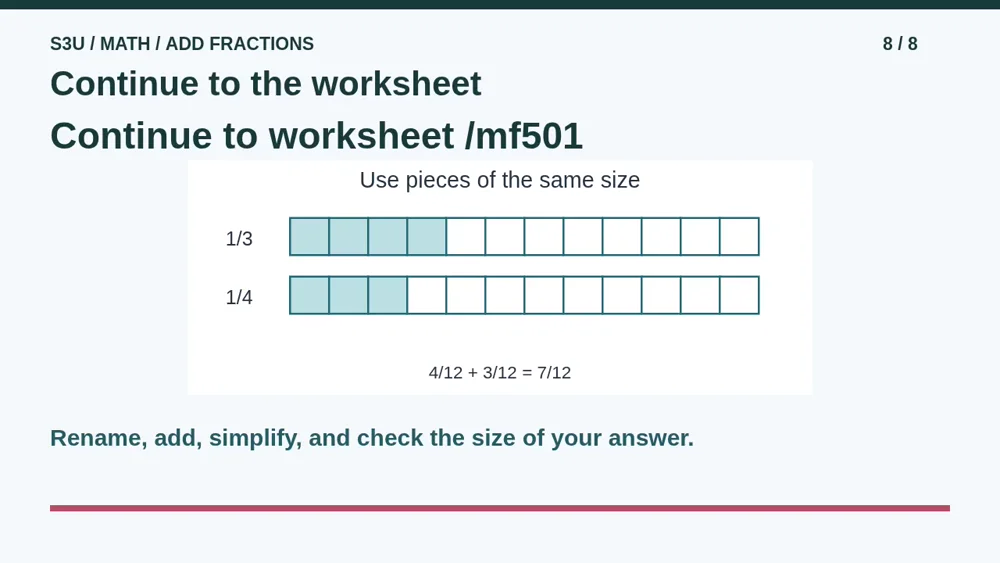
Continue to the worksheet below. Start with equal-sized wholes. Choose a common denominator, rename both fractions, and add the numerators while keeping that common denominator. Simplify when possible. If the sum is greater than one, you can show a whole and the leftover fraction. Check whether your answer is reasonable. The worksheet has its own numbers, so use the method rather than copying a video answer.
Show your understanding
You can point, explain aloud, draw or write.
- Rename positive fractions into common-sized parts, add their counts and explain why the common denominator stays unchanged.
- Express seven sixths as one and one sixth, and explain how different common denominators can give equivalent sums.
Try it yourself
Pause at one fourth plus one sixth. Find common-sized parts and explain why the denominator stays fixed while adding their counts.
Continue to the worksheet. Rename both fractions, add, simplify when possible and check whether the result passes one whole.
Next: your worksheet
Add Fractions with Unlike Denominatorshttps://s3u.com/mf501
Build and compare fractions at Fraction Dock
Lesson: https://s3u.com/lessons/add-common-parts